CALL US NOW
 TEXT US NOW
You climbed into an Uber or Lyft to get home safe. Then a crash turned everything upside down. Now you face pain, missed work, and bills you never planned for, while an insurance company looks for reasons to pay you less. A Seattle rideshare accident lawyer can take that weight off your shoulders. At Elsner Law Firm, we hold Uber accident, Lyft accident, and their insurers responsible so you can focus on getting better. Call 206-447-1425 now for a free case review. You pay nothing unless we win.
Rideshare crashes are not like normal car wrecks. The hard part is the insurance claims. Uber and Lyft carry up to $1 million in coverage, but it only applies at certain moments. Knowing which policy covers your crash is the difference between a small check and full payment for your injuries. That is what our Seattle Uber and Lyft accident attorneys sort out for daily commuters, students, airport travelers, and families across the city.
Why a Rideshare Crash Claim Is Different From a Normal Car Accident
A rideshare claim is harder because more people and more insurance policies are in play. In a normal car accident, you deal with one driver and one insurer. In a rideshare crash, you may face the rideshare driver, another driver, Uber or Lyft, and two or three insurance companies at once.
Uber and Lyft call their drivers independent contractors, not employees. They do this on purpose. It lets them argue they are not responsible for what a driver does behind the wheel. That argument is often wrong, but it can slow your claim and shrink the first offer. A Seattle rideshare accident lawyer knows how to push past it and find every policy that should pay you.
Who Pays After an Uber or Lyft Crash in Seattle?
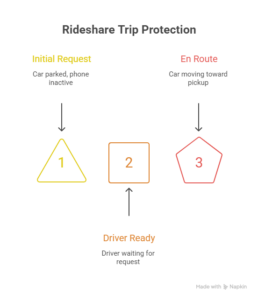
Who pays depends on what the driver was doing in the app at the moment of the crash. Washington law splits a driver’s time into stages. Each stage has its own insurance. We pull the driver’s trip logs to prove which stage applied to you.
| Driver’s app status | Whose insurance pays | Coverage limits |
|---|---|---|
| Offline (app closed) | The driver’s personal auto policy only | Whatever the driver’s own policy carries |
| Logged in, no ride accepted (Period 1) | Uber or Lyft backup coverage, if the personal policy will not pay | $50,000 per person and $100,000 per crash for injuries, plus $30,000 property damage |
| Ride accepted or passenger aboard (Periods 2 and 3) | Uber or Lyft commercial policy, as the primary coverage | Up to $1 million liability, plus uninsured and underinsured motorist coverage |
When the Driver Was Offline
If the driver was not logged into the app, only their personal car insurance applies. Uber and Lyft owe nothing. The case works like any other car accident claim. Personal policies often carry low limits, so finding extra coverage matters.
When the Driver Was Logged In but Had No Ride Yet (Period 1)
This stage is often the most fought over. The driver is online and waiting for a ping. They may be circling busy areas like Capitol Hill or South Lake Union, watching the app instead of the road. Here, Washington makes Uber and Lyft provide backup coverage of $50,000 per person and $100,000 per crash for injuries, plus $30,000 for property damage. This coverage applies when the driver’s own policy does not.
When the Driver Was on the Way or Had a Passenger (Periods 2 and 3)
Once the driver accepts a ride or has you in the car, the full commercial policy turns on. Uber and Lyft provide up to $1 million in coverage during this window. It also includes uninsured and underinsured motorist protection in many cases. If you were a passenger, your crash almost always falls here. This is the coverage that pays for serious injuries, lost wages, and long-term care.
Washington Rideshare Insurance Laws, in Plain English
Washington has clear rules for rideshare companies. Under state law (RCW 46.72B.180), every rideshare company must carry insurance that starts the second a driver logs in. The limit grows as the trip moves through the stages above, up to $1 million once a ride is accepted. The Washington State Office of the Insurance Commissioner oversees these policies.
A different law (RCW 49.46.300) gives rideshare drivers minimum pay, paid sick time, and workers’ comp during work hours. The Department of Labor & Industries enforces it. That law is about driver pay, not passenger insurance, so it does not limit what you can recover for your injuries.
Two more rules matter. Washington bans handheld phone use while driving (RCW 46.61.667 and RCW 46.61.668). Yet drivers must still tap the app to accept and follow trips, so distraction is built into the job. Learn more about what Washington’s cell phone law means for drivers. Washington also follows pure comparative fault, which we explain below.
How Common Are Crashes on Seattle Roads?
Far too common. Across Washington, 731 people died in traffic crashes in 2024, down from 809 in 2023, the highest count in 33 years, but still well above pre-pandemic levels. State safety officials say four behaviors, impairment, speeding, distraction, and skipping seatbelts, play a role in at least three out of four traffic deaths. Distraction is the risk that hits rideshare driving hardest, because the job depends on a phone.
Seattle’s streets add their own risk. The city saw roughly 7,300 reported crashes in 2024, according to state and city collision data. Dense, hilly corridors and curbside pickups keep collision counts high year after year, especially where pedestrians and cyclists share the road with cars. Read more about car accident rates and statistics across the region.
Common Causes of Seattle Rideshare Crashes
Most rideshare crashes trace back to driver choices and Seattle’s tough roads. Drivers rush to take more trips. They watch the app for the next fare. They drive streets they do not know well.
Common causes include:
Distracted driving: Drivers check GPS, accept pings, and message riders while moving. One glance at the screen is one glance off the road. Understanding how cell phone records serve as proof in accident claims can strengthen your case.
Driver fatigue. Many drivers work long shifts or a second job. Drowsy driving claims slows reaction time.
Speeding and aggressive moves. The pay model rewards speed, which leads to hard braking and risky turns in heavy traffic. Learn why speeding leads to car crashes.
Streets they do not know. A driver new to the city may stop short or swerve near Pike Place Market, on the climbing streets of Queen Anne, or along the busy strip in Ballard.
Backups and tight merges. Crashes cluster where lanes squeeze together, like the I-5 Ship Canal Bridge near Green Lake.
These crashes hurt passengers, other drivers, people walking, and people biking across Downtown Seattle and South Lake Union.
Injuries We See After Rideshare Crashes
Rideshare crashes cause the same injuries as other car wrecks, from minor to life-changing. See a doctor even if you feel fine, because some injuries hide for days. Harborview Medical Center handles the region’s most serious trauma cases.
Injuries we see often include whiplash, concussions and other brain injuries, neck and back injuries, spinal cord damage, broken bones, and in the worst cases, paralysis. A clear medical record ties each injury to the crash and shapes the value of your claim. Learn about the full range of injury types we handle.
What to Do After a Rideshare Crash in Seattle
Acting fast protects both your health and your claim. Take these steps when you can.
- Check for injuries and call 911: Get medical help first. Police will document the scene.
- Get the police report number: from Seattle Police or the Washington State Patrol.
- Take photos :of the vehicles, the street, traffic signs, and your injuries.
- Save the trip in the app: Screenshot your Uber or Lyft receipt, because it proves the driver’s status and the ride.
- Get names and insurance details: for every driver and witness.
- Report the crash to Uber or Lyft: Stick to the facts and do not guess about fault.
- Call a Seattle rideshare accident lawyer: The sooner we start, the more evidence we save.
For a more detailed walkthrough, read our guide on what to do in the first 24 hours after a collision.
Evidence That Can Make or Break Your Claim
Strong evidence proves who caused the crash and how badly you were hurt. Some of it disappears fast, so we move quickly to lock it down.
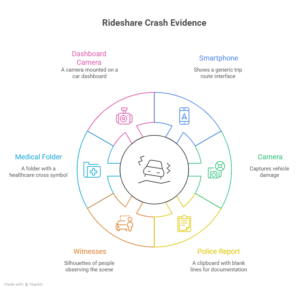
Standard crash evidence includes the police report, scene photos, dashcam or nearby security video, witness statements, and your medical records. Rideshare cases need more. We also gather the driver’s in-app trip data, the trip receipt, the driver’s history with the company, the driver’s record, and vehicle data when it exists. This extra layer is where many rideshare claims are won or lost.
Money You Can Recover After a Seattle Rideshare Crash
You can seek money for both your financial losses and your personal suffering. Washington law calls this money “damages.” It falls into two groups.
Economic damages are your hard costs: medical bills now and in the future, lost wages, lost earning power, and property damage.
Non-economic damages cover losses with no price tag: pain and suffering settlement, emotional distress damages, loss of enjoyment of life, and scarring. If a loved one dies, family members may bring a wrongful death claim. In rare cases of extreme misconduct, a court may add punitive damages. Explore the full breakdown of types of damages in personal injury cases.
We value the full claim, not just the bills on your table today. That includes the care you will need next year and beyond.
How Long Do You Have to File a Rideshare Accident Claim?
You have three years from the date of the crash to file a personal injury lawsuit in Washington (RCW 4.16.080). Miss that deadline and you lose the right to recover. If a city, county, or state agency shares blame, a shorter notice step comes first, so do not wait. Filing early also protects your case, because evidence fades and memories blur. Read about the dangers of delaying legal action.
What If the Crash Was Partly Your Fault?
You can still recover money even if part of the crash was your fault. Washington uses pure comparative fault (RCW 4.22.005). Your payment drops by your share of blame, but it is not erased. Say your losses are $100,000 and you were 20% at fault. You can still recover $80,000. Insurers often blame victims to pay less. We push back with facts.
Were You the Uber or Lyft Driver, Not the Passenger?
You have rights too. If you were hurt while logged in, the rideshare company’s coverage may apply during the stages above. You may also have a workers’ comp claim through the Department of Labor & Industries, which covers many drivers during dispatch and trips. And if the company wrongly deactivated you after a crash, you may have a way to challenge it. A Seattle rideshare accident lawyer can sort out which path fits your case.
How Elsner Law Firm Helps Seattle Rideshare Accident Victims
We handle every part of your claim from start to finish. You heal. We fight. Our Seattle Uber and Lyft accident lawyers offer a free first consultation and charge no fee unless we win.
- Free case review. We explain your rights and your options at no cost.
- Full investigation. We gather evidence, pull the app data, and name every party who should pay.
- Insurance talks. We handle every call and letter, so you are never pressured into a low offer. Understand why insurance is not always on your side after an accident.
- Lawsuit and trial. If the insurer will not pay fairly, we file suit in King County Superior Court and prepare your case for trial. Find out what happens when a personal injury case goes to trial.
- Clear updates. You always know where your case stands.
Frequently Asked Questions
Who pays if I was hurt as an Uber or Lyft passenger?
The rideshare company’s $1 million policy usually applies, because a passenger ride is the commercial stage. That policy can cover your medical bills, lost wages, and pain. We confirm the driver’s app status to lock in the right coverage. For more details on Uber claims, see our page on whether Uber is responsible for passenger injuries.
Can I file a claim if I did not book the ride myself?
Yes. You do not have to be the person who paid for the ride. Any injured passenger can seek payment after a rideshare crash.
What if the at-fault driver had no insurance?
You may still recover. If you were a rideshare passenger, the company’s uninsured and underinsured motorist coverage often applies. That coverage exists for exactly this situation. Learn more about your options if you are hit by an uninsured driver.
Should I talk to Uber’s or Lyft’s insurance adjuster?
Be careful. Adjusters work to lower payouts. You are not required to give a recorded statement. You can decline and send them to your lawyer instead. Read about what to expect from the at-fault party’s adjuster.
Can I hold Uber or Lyft responsible if a driver assaulted or robbed me?
Possibly. If the company should have known the driver was dangerous, it may be liable for negligent hiring. Our negligent security lawyers can check the driver’s background and the company’s records.
My rideshare was in a multi-car crash. Who pays first?
Personal injury protection, a no-fault coverage, often pays your first medical bills and lost wages no matter who caused the crash. For a serious injury, you can then seek more from the at-fault parties. We sort out which insurer pays. Our guide on navigating the aftermath of a multi-vehicle crash explains the process.
How much is my rideshare accident claim worth?
It depends on your injuries, your bills, your lost income, and how the crash changed your life. A minor injury and a permanent one are worth very different amounts. We give you an honest estimate after a free review. For context, see Uber accident settlement amounts in Washington and Lyft accident settlement amounts.
Do I have to pay anything up front?
No. We work on contingency. You pay nothing unless we win money for you. Learn about the benefits of hiring a personal injury lawyer on a contingency fee basis.
Meet Your Seattle Rideshare Accident Attorney
Justin Elsner founded Elsner Law Firm in 2007 after graduating cum laude from Seattle University School of Law with a B.A. from Central Washington University. He is a member of the Washington State Bar Association and admitted to practice in the Western District of the Federal Court. Justin has spent over 17 years fighting for injured passengers, drivers, and pedestrians against rideshare corporations like Uber and Lyft and their insurers when an app-based ride ends in a serious collision, serving clients in Seattle and across Washington State.
Justin’s path to this work is personal. A life-changing car crash during his high school years left him and his family feeling lost and unsure of how to move forward. Watching firsthand how aggressively insurance companies work to minimize what injured people receive and how different the outcome was once a personal injury attorney stepped in left a mark that never faded. That experience became the foundation for everything he built at Elsner Law Firm: a practice rooted in the belief that someone hurt in a rideshare accident deserves a lawyer who fights just as hard for them as the corporations and their insurance carriers fight against them.
He has authored two client guides: “7 Mistakes Accident Victims in Washington Make And How to Avoid Them” and “Your Guide to the First 30 Days After a Crash” because informed clients consistently reach better outcomes.
His caseload covers rideshare passenger injuries on Uber, Lyft, and other app-based platforms, collisions caused by distracted or speeding rideshare drivers, accidents involving uninsured or underinsured motorists who strike rideshare vehicles, pedestrian and cyclist injuries caused by rideshare drivers, disputed liability between TNC insurance tiers under RCW 46.72B, catastrophic injuries including spinal cord and traumatic brain injuries, and wrongful death claims arising from rideshare accidents on Seattle highways, intersections, and neighborhood streets throughout Washington State.
Victims of such harm are entitled to seek “loss of consortium” for the impact on family relationships and “survival actions” for the pain and suffering endured by the deceased prior to death. When these cases involve nursing home abuse or other professional negligence, personal injury law becomes a central focus of the litigation.
If you or a loved one was injured in a rideshare accident in Seattle, call or text Elsner Law Firm at 206-447-1425 for a free consultation.
Talk to a Seattle Rideshare Accident Lawyer Today
A rideshare crash leaves you with pain, bills, and questions. You do not have to face Uber, Lyft, and their insurers alone. A Seattle rideshare accident lawyer at Elsner Law Firm will protect your rights and fight for every dollar you are owed. We help injured riders and drivers across Downtown Seattle, Capitol Hill, Ballard, Queen Anne, South Lake Union, and all of Washington State. Your consultation is free, and you pay nothing unless we win.
We also handle Lyft accident cases, Uber accident cases, and crashes involving trucks, motorcycles, and buses throughout Washington. Call 206-447-1425 now for your free case review.