CALL US NOW
 TEXT US NOW
Why Seattle families call Elsner Law Firm after child injuries
Medical documentation support for emergency care, follow-up visits, specialist treatment, therapy, pain symptoms, and future care needs.
Insurance pushback support when adjusters minimize a child’s pain, school impact, emotional distress, or long-term limitations.
Accident and liability review for incident reports, witness evidence, property conditions, medical records, and facts connecting negligence to the injury.
Washington personal injury focus for families dealing with child injuries after Seattle-area crashes, falls, dog bites, or preventable incidents.
Free case review by phone at 206-447-1425.
Your child was hurt. The medical bills keep coming. The school or daycare is not returning your calls. You did not cause this, and neither did your child.
Every year, more than 9 million children visit emergency rooms across the United States due to preventable accidents. The Centers for Disease Control and Prevention reports that unintentional injury is the leading cause of death for children and teens. In King County alone, hundreds of children suffer serious injuries at daycare centers, playgrounds, schools, swimming pools, and roadways and intersections each year.
A Seattle child injury lawyer at Elsner Law Firm fights for families who are living through this right now. We handle child injury claims on a contingency fee basis, which means you pay nothing unless we recover compensation for your family. Our team brings decades of combined trial and negotiation experience to every catastrophic injury case involving a minor.
You have limited time. Evidence disappears. Witnesses forget details. Washington state law sets strict deadlines for personal injury claims, and child injury cases have specific rules that most attorneys do not handle regularly. If your child was injured due to someone else’s negligence in Seattle, Brier, Pullman, Ellensburg, or anywhere in the Puget Sound area, call us now at 206-447-1425 for a free case evaluation.
Why Child Injury Cases Need a Specialized Attorney
Child injury claims are not the same as adult personal injury claims. The legal process is different. The medical considerations are different. The damages calculation is different.
Washington state treats injured minors differently because children cannot represent themselves in court. A parent or legal guardian must file a claim on the child’s behalf. In most cases, the court appoints a guardian ad litem to protect the child’s interests independently. This means your case involves an additional layer of legal oversight that does not exist in standard personal injury claims.
Children’s injuries also carry long-term consequences that adult injuries often do not. A broken femur in a 5-year-old can affect bone growth for the next 13 years. A traumatic brain injury in a toddler may not show its full impact until the child enters school. An experienced child injury attorney in Seattle knows how to work with pediatric specialists to project future medical expenses, special education needs, and loss of quality of life across an entire lifetime.
Insurance companies know that child injury cases involve large potential payouts. They assign their most aggressive adjusters to these files. They will try to settle quickly, before the full extent of your child’s injuries becomes clear. Our Seattle child injury attorneys do not let that happen.
Types of Child Injuries We Handle in Seattle
Children get hurt in places that should be safe. Daycare centers, schools and school districts, playgrounds, swimming pools, and family neighborhoods throughout Seattle are locations where negligence leads to serious harm. Our child injury lawyers represent families across King County and Washington state in the following types of cases.
Daycare Center Negligence
Daycare facilities in Washington state must be licensed under WAC 110-300. They owe your child the highest duty of care. When a daycare center fails to provide adequate supervision, serious injuries result.
Common daycare negligence claims include injuries from falls due to inadequate supervision, burns from hot surfaces or liquids, choking on food or small objects, physical abuse or emotional abuse by staff, and transportation accidents during field trips. We also handle cases where background check failures allowed dangerous individuals to work with children.
If a daycare is operating without a valid Washington state license, that facility can be found negligent regardless of how the injury happened. An unlicensed daycare violates state law, and that violation alone can support a personal injury claim.
Warning signs your child may be experiencing harm at daycare:
Parents should watch for unexplained bruises, cuts, or injuries. Sudden changes in behavior such as increased aggression, fearfulness, or withdrawal can signal a problem. Regression in toilet training, sleep difficulties, and reluctance to go to daycare are all red flags. If you notice any of these signs, document everything and contact a child injury lawyer in Seattle right away.
Car Accident Injuries to Children
Motor vehicle accident claims involving children are among the most serious cases we handle. The World Health Organization reports that traffic collisions are the leading cause of injury-related death for children between ages 5 and 19.
In Seattle’s dense traffic patterns, children face particular risks near the University District, South Lake Union, Aurora Avenue, and school zones in Greenwood, Magnolia, and Wallingford. Over 40% of child safety seats are installed incorrectly, according to the National Highway Traffic Safety Administration. Distracted driving, impaired driving, and school zone violations put children at risk every day.
Children’s smaller bodies absorb crash forces differently than adult bodies. Even a low-speed collision can cause broken bones and fractures, spinal cord injuries, or traumatic brain injuries in a child. Our car accident attorneys work with pediatric medical experts to document the full scope of your child’s injuries.
Playground Accidents and Equipment Failures
The Consumer Product Safety Commission reports that more than 200,000 children visit emergency rooms each year due to playground-related injuries. Defective playground equipment, broken surfaces, exposed bolts, and inadequate fall zones cause broken bones, head injuries, and severe lacerations and scarring.
In Seattle, high-risk areas include public playgrounds at Green Lake Park, Volunteer Park, Lincoln Park, and school playgrounds throughout Capitol Hill, Fremont, and Wallingford neighborhoods. When a municipality fails to maintain playground equipment or a private property owner neglects safety standards, they can be held liable under Washington premises liability law.
Playground accident claims often involve the attractive nuisance doctrine, which we discuss in detail below.
Swimming Pool and Drowning Accidents
Drowning is the leading cause of unintentional death for children ages 1 to 4 in the United States. Near-drowning incidents can cause permanent brain damage in as little as 4 to 6 minutes without oxygen.
Swimming pool accident claims arise when property owners fail to install proper barriers, when lifeguards or supervisors are not paying attention, when pool drains create entrapment hazards, or when water parks and recreation facilities ignore safety protocols. In Washington state, property owners who maintain swimming pools must take reasonable steps to prevent unsupervised access by children.
Our attorneys handle drowning and near-drowning cases throughout the Seattle area, including incidents at community centers, private residential homes, water parks, and hotel pools.
School Injury Lawsuits
Children spend more waking hours at school than almost anywhere else. Schools and school districts have a legal obligation to provide a safe environment. When they fail, school injury lawsuits become necessary.
We handle claims involving injuries caused by inadequate supervision on school grounds, unsafe conditions such as broken stairs, slippery floors, or faulty gym equipment, physical altercations and bullying that school staff failed to prevent, sports-related injuries from inadequate safety measures, and injuries during school-sponsored field trips or events.
Filing a claim against a public school or school district involves specific legal requirements under Washington’s governmental immunity laws. We address this process in a dedicated section below.
Defective Product Injuries
Every year, millions of children’s products are recalled due to safety defects. When a defective car seat, crib, toy, stroller, high chair, or piece of playground equipment injures your child, the manufacturer, distributor, and retailer may all be liable.
Washington state recognizes strict product liability. This means you do not have to prove the manufacturer was negligent. You only need to prove that the product was defective and that the defect caused your child’s injury. This is a lower legal standard than standard negligence claims, which makes defective product liability cases stronger for families in many situations.
The U.S. Consumer Product Safety Commission maintains a public recall database. If your child was injured by a product, check whether that product has been recalled. Either way, contact our office. A recalled product strengthens your case, but an injury from a non-recalled product can still support a valid claim.
Dog Bite Injuries to Children
Children are the most common victims of dog bite injury cases. Their small size means bites frequently affect the face, head, and neck. Washington state follows a strict liability standard for dog bites under RCW 16.08.040. The dog’s owner is liable regardless of whether the dog has bitten anyone before.
Dog bite injuries to children can result in severe lacerations and scarring, nerve damage, infection, emotional distress and mental anguish, and in the worst cases, wrongful death. Our attorneys pursue full compensation from the dog owner’s homeowner insurance policy and, when necessary, through civil litigation.
Pedestrian and Bicycle Accidents Involving Children
Seattle is a walking and biking city. The Washington Traffic Safety Commission reports that pedestrian casualties remain a persistent problem throughout King County. Children walking to school, riding bicycles in residential neighborhoods, or crossing roadways and intersections near transit stops are at high risk.
Washington law under RCW 46.61.235 requires drivers to yield to pedestrians in crosswalks. But children do not always use crosswalks. They run into streets. They ride bicycles without signaling. Washington courts recognize that children cannot be held to the same standard of care as adults. The younger the child, the less responsibility the court assigns.
Our pedestrian accident and bicycle accident attorneys handle child injury claims involving distracted drivers, speeding in school zones, failure to yield, and poor visibility conditions common in Seattle’s rainy climate.
How Child Injury Cases Differ From Adult Claims
Child injury claims operate under a separate set of rules in Washington state. Understanding these differences is critical for protecting your child’s legal rights and maximizing compensation.
Statute of Limitations and Tolling for Minors
Washington state law under RCW 4.16.190 “tolls” (pauses) the statute of limitations for minors. The three-year clock does not start running until the child turns 18. This means a child who is injured at age 5 could technically file a lawsuit until their 21st birthday.
However, waiting is almost never in your child’s best interest. Evidence degrades. Medical records become harder to obtain. Witnesses move or forget details. A parent or legal guardian can file a personal injury claim on behalf of a minor child at any time. Acting quickly gives your child injury attorney the best chance of building a strong case.
For wrongful death claims, the statute of limitations is three years from the date of death, regardless of the child’s age.
The Parental Immunity Doctrine
Can you be blamed for your child’s injury? In many cases, no.
Washington state recognizes the Parental Immunity Doctrine. This legal rule prevents at-fault parties from shifting blame onto parents to reduce their own liability. The doctrine exists to protect family relationships and to make sure children can recover full compensation.
Here is what this means in practice: if your child was injured at a daycare center and the daycare’s insurance company argues that you should have known the daycare was unsafe, the Parental Immunity Doctrine limits their ability to use that argument. The focus stays on the negligent party, not on you.
This is a critical protection that many families do not know about. A Seattle child injury attorney at our firm will make sure this doctrine works in your favor.
Guardian Ad Litem and Court Oversight
Washington courts appoint a guardian ad litem in most child injury cases. This is an independent person, often an attorney, who represents the child’s interests separately from the parents.
The guardian ad litem reviews the proposed settlement to make sure it is fair to the child. If the case goes to trial, the guardian ad litem may also participate in proceedings. This additional oversight exists because children cannot evaluate or approve legal decisions on their own.
Court-Approved Settlements and Trust Funds
Any settlement in a child injury case must be approved by a Washington state court. The judge reviews the terms to confirm the settlement amount is reasonable and that the child’s interests are protected.
For larger settlements, the court may require that funds be placed in a trust fund for minors or a structured settlement. These arrangements protect the money until the child reaches adulthood. Payments can be structured to cover ongoing medical care, education expenses, and living costs as the child grows.
Our attorneys handle the settlement approval process from start to finish, including preparing the petition to the court, presenting medical evidence to justify the settlement amount, and establishing the trust or structured payment plan.
The Attractive Nuisance Doctrine in Washington
What happens when a child trespasses on someone’s property and gets hurt? In many cases, the property owner is still liable. Washington state applies the attractive nuisance doctrine to protect children from dangerous conditions that naturally attract their curiosity.
The attractive nuisance doctrine holds that a property owner can be held liable for injuries to a trespassing child if the property contains a condition that is likely to attract children, the owner knows or should know that children are likely to trespass, the condition poses an unreasonable risk of serious injury or death, the child does not understand the danger due to their age, and the cost of eliminating the danger is small compared to the risk.
Common attractive nuisances in the Seattle area include unfenced swimming pools, abandoned vehicles, construction sites without proper barriers, trampolines without enclosures, ponds and fountains on private property premises, and old appliances left in yards.
This doctrine is powerful because it shifts liability to the property owner even when the child was not supposed to be on the property. Property owners in Washington state have a duty to take reasonable steps to prevent children from accessing dangerous conditions. When they fail, our child injury attorneys hold them accountable.
If your child was injured on someone else’s private property premises in Seattle or King County, contact us immediately for a free case evaluation. The attractive nuisance doctrine may apply to your case.
Filing a Child Injury Claim Against a Government Entity
Many child injuries in Seattle happen on public property. City parks, public school playgrounds, Metro bus stops, community swimming pools, and roadways maintained by the Washington Department of Transportation or Seattle Department of Transportation are all government-controlled locations.
Filing a claim against a government entity is different from filing against a private party. The rules are stricter. The deadlines are shorter. Missing a single requirement can destroy your case.
The 60-Day Notice Requirement
Under RCW 4.96.020, you must file a formal written claim with the government entity before filing a lawsuit. Washington law requires this notice at least 60 days before filing suit. The notice must include specific information about the incident, the injuries, and the damages.
For claims against Seattle Public Schools, the Seattle Parks and Recreation Department, King County, or any other municipality, this notice must go to the correct government office. Sending it to the wrong department can delay or invalidate your claim.
Government Immunity and Exceptions
Government entities in Washington state have limited immunity under RCW 4.92 and RCW 4.96. This means they cannot be sued for every type of claim. However, there are important exceptions.
Government entities CAN be held liable for negligent maintenance of public property such as playgrounds and roads, inadequate supervision at publicly run programs, dangerous conditions on government property that the entity knew or should have known about, and negligent hiring or retention of employees.
Government entities generally CANNOT be held liable for discretionary decisions such as policy choices about staffing levels or budget allocations.
Time Is Critical
The shortened notice requirements mean you have far less time to act than in a standard personal injury claim. If your child was injured at a public school, city park, or any government-controlled location in Seattle, contact a child injury attorney immediately. Delays can permanently eliminate your right to compensation.
Traumatic Brain Injuries in Children
A traumatic brain injury in a child can change the course of an entire life. Children’s brains are still developing, which makes them both more vulnerable to injury and more unpredictable in recovery.
The Centers for Disease Control and Prevention reports that children aged 0 to 4 and adolescents aged 15 to 19 have the highest rates of traumatic brain injuries. Falls are the leading cause of TBI in young children. Motor vehicle accidents are the leading cause in older children and teenagers.
Why Pediatric TBI Is Different
Adult brains are fully developed. When an adult suffers a concussion, doctors can predict recovery patterns based on decades of research. Children’s brains are different. A TBI at age 3 may not show its full effects until the child reaches school age and struggles with reading, math, or social interaction.
Pediatric traumatic brain injuries can cause cognitive difficulties including problems with memory, attention, and learning, behavioral changes such as increased aggression or emotional instability, physical symptoms including chronic headaches, seizures, and coordination problems, speech and language delays, and in severe cases, permanent disability.
Signs Parents Should Watch For
After any head injury, watch your child for headaches that get worse over time, vomiting or nausea, unusual drowsiness or difficulty waking, slurred speech or confusion, unequal pupil size, loss of balance or coordination, personality changes or mood swings, and difficulty concentrating at school.
Seek emergency medical attention at Seattle Children’s Hospital, Harborview Medical Center, or University of Washington Medical Center if your child shows any of these symptoms after a head injury. Even symptoms that seem mild can indicate serious brain damage.
The Long-Term Cost
A child with a moderate to severe TBI may need years of rehabilitation, special education services, occupational therapy, speech therapy, and behavioral counseling. The lifetime cost of a pediatric traumatic brain injury can exceed $1 million. Our attorneys work with pediatric neurologists, life care planners, and economists to calculate the true cost of your child’s injury, including future medical expenses, lost earning capacity, and loss of quality of life.
Common Locations for Child Injuries in Seattle
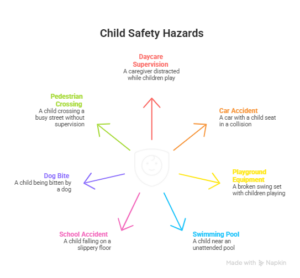
Seattle’s urban environment creates specific risks for children. Understanding where injuries commonly occur helps parents stay alert and helps our legal team identify liable parties.
Schools and Playgrounds
Green Lake Park, Volunteer Park, and Lincoln Park are among the highest-risk areas for playground accident claims in Seattle. School playgrounds throughout Capitol Hill, Fremont, Wallingford, Greenwood, and Magnolia also see frequent injuries from defective equipment, inadequate fall surfaces, and lack of supervision.
Roads, Intersections, and Transit
Pike Street, Pine Street, and Aurora Avenue are high-traffic corridors where pedestrian and bicycle accidents involving children occur regularly. School zones in residential neighborhoods are particularly dangerous during morning drop-off and afternoon pickup. Metro bus stops where children wait for transportation create additional exposure.
Swimming Pools, Water Parks, and Recreation Centers
Community centers with swimming pools, private sports facilities, and waterfront areas like Alki Beach and Golden Gardens present drowning and near-drowning risks. Amusement parks and water parks in the greater Puget Sound area also contribute to child injuries each year.
Daycare Centers and Residential Homes
Licensed and unlicensed daycare centers throughout Seattle are locations where inadequate supervision causes preventable harm. Private residential homes with unfenced pools, unsecured firearms, or other hazards account for a significant number of child injuries in King County.
Who Can Be Held Liable for a Child’s Injury?
Identifying every responsible party is critical to maximizing your child’s compensation. In many child injury cases, more than one party bears responsibility.
Individuals who cause harm through negligence can be held liable. This includes drivers who cause motor vehicle accidents, dog owners, babysitters, sports coaches, and property owners who fail to maintain safe conditions.
Businesses and organizations carry liability when their employees or operations cause injury. Daycare centers, private schools, sports facilities, restaurants, retail stores, and amusement parks can all be held accountable for child injuries on their premises.
Government entities including Seattle Public Schools, the Seattle Parks and Recreation Department, the Washington Department of Transportation, King County Metro, and other municipalities can be liable under the exceptions described above.
Product manufacturers, distributors, and retailers are liable under Washington’s strict product liability law when a defective product injures a child. This applies to car seat manufacturers, toy companies, playground equipment makers, and any other company in the distribution chain.
Employers of negligent individuals can be held liable through a legal doctrine called respondeat superior. If a delivery driver hits your child while working, both the driver and the employer may owe compensation.
Property owners and property managers are distinct parties who may both be liable for dangerous conditions on private property premises. A landlord and a property management company may share responsibility for hazards that injure a child.
Our child injury lawyers investigate every potential source of liability to build the strongest case for your family.
What Should Parents Do After a Child Injury?
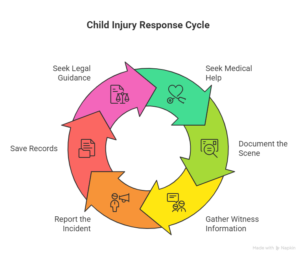
The steps you take in the first hours and days after your child’s injury affect both their medical recovery and the strength of your legal claim. Here is what to do.
Get medical attention immediately. Even if your child’s injuries seem minor, take them to a doctor. Seattle Children’s Hospital, Harborview Medical Center, and University of Washington Medical Center all have pediatric emergency departments. Some injuries, especially traumatic brain injuries, do not show symptoms right away.
Document everything. Take photos and videos of the location where the injury happened. Photograph your child’s visible injuries. Save all text messages, emails, and written communication with the daycare, school, property owner, or any other party involved.
Gather witness information. Get names and phone numbers from anyone who saw the incident.
Report the incident. File a formal report with the appropriate authority. For school injuries, report to the principal and school district. For injuries at businesses, report to management. For traffic accidents, call the Seattle Police Department.
Do not sign anything. Do not sign any release, settlement offer, or incident report from the opposing party without speaking to an attorney first. Insurance companies will try to get you to accept a low offer before you understand the full scope of your child’s injuries.
Do not post on social media. Insurance investigators monitor social media accounts looking for anything they can use to reduce your child’s claim.
Contact our team. Call 206-447-1425 for a free case evaluation. Early legal intervention protects your child’s rights and preserves critical evidence. Our Seattle child injury attorneys will guide you through every step from here.

Compensation Available for Child Injury Claims in Washington
Child injury cases often involve larger damages than similar adult cases because children have decades of life ahead. Every dollar of compensation matters for their future.
Current Medical Expenses
Compensation covers emergency room treatment, hospital stays, surgical procedures, specialist consultations, prescription medications, physical therapy, rehabilitation, and mental health counseling. Keep every medical bill and receipt.
Future Medical Expenses
Many child injuries require ongoing treatment as the child grows. Additional surgeries may be needed as bones develop. Assistive devices, accessibility modifications, and long-term therapy are all compensable. Our attorneys work with life care planners to project costs across your child’s entire lifespan.
Pain and Suffering Damages
Washington law allows compensation for physical pain, emotional distress and mental anguish, loss of enjoyment of childhood activities, and the impact on family relationships. These are called non-economic damages. They do not have a fixed dollar value. A jury determines the amount based on the severity and duration of suffering.
Educational and Developmental Costs
Children with serious injuries may need special education services, tutoring, adaptive technology, and career counseling. If the injury affects your child’s ability to work as an adult, compensation for lost earning capacity over a lifetime may be available.
Permanent Disability Compensation
If your child suffers a permanent disability, compensation accounts for the lifelong impact. This includes ongoing medical care, assistive equipment, home modifications, and the loss of opportunities the child would have otherwise enjoyed.
Washington’s Non-Economic Damage Cap
Washington state caps non-economic damages in certain cases under RCW 4.56.250. The cap is calculated as 43% of the average annual wage in Washington multiplied by the injured person’s life expectancy, with a minimum calculation period of 15 years.
For children, this cap is typically very high because of their long life expectancy. However, it still sets a ceiling. Our attorneys calculate the maximum recovery available under this formula and fight to reach it.
Parental Damages
Parents can recover their own damages in a child injury case, including lost wages from taking time off work to care for the child, out-of-pocket medical expenses already paid, and emotional distress caused by witnessing the child’s injury or suffering.
Local Resources for Seattle Families
Emergency Medical Facilities
Seattle Children’s Hospital provides specialized pediatric emergency and trauma care. Harborview Medical Center is a Level 1 trauma center with pediatric specialists. University of Washington Medical Center offers children’s medical services. Swedish Medical Center has multiple locations serving Seattle families. Northwest Hospital and Medical Center provides community-level pediatric care.
Government and Safety Resources
Seattle Police Department handles incident reports and investigations. Seattle Fire Department provides emergency response and safety education. The Seattle Department of Transportation enforces school zone safety. King County Sheriff’s Office investigates incidents in unincorporated areas. Washington State Patrol handles highway accident investigation. The Washington State Department of Health maintains data on childhood injury prevention.
Legal and Support Resources
Child Protective Services investigates abuse and provides family support. King County Superior Court handles child injury proceedings and guardian ad litem appointments. Seattle Public Schools manages safety reporting for school injuries. Elsner Law Firm is located at 2130 Westlake Ave N #3, Seattle for in-person consultations with our child injury attorneys.
Meet Your Seattle Child Injury Lawyers
Justin Elsner founded Elsner Law Firm in 2007 after graduating cum laude from Seattle University School of Law. He is a member of the Washington State Bar Association and admitted to practice in the U.S. District Court for the Western District of Washington. For nearly two decades, he has focused his practice on representing injured individuals and families including children harmed by another party’s negligence across King County, Snohomish County, Pierce County, Whitman County, and Kittitas County.
Justin’s commitment to families runs deeper than the law. During high school, he was seriously injured in a car crash. His family had no idea how to navigate the insurance process, until a personal injury attorney stepped in and leveled the playing field. That experience became the foundation for everything he built at Elsner Law Firm: a practice rooted in the belief that injured people. especially children who cannot speak for themselves deserve an advocate who fights as hard for them as the insurance companies fight against them.
He has authored two client guides: “7 Mistakes Accident Victims in Seattle Make and How to Avoid Them” and “Your Guide to the First 30 Days After a Crash”, because informed families consistently reach better outcomes. His child injury caseload covers daycare center negligence, playground accidents, car accident injuries involving minors, swimming pool drownings, bicycle and pedestrian accidents near schools, and premises liability claims involving children throughout the Seattle metro area and across Washington State.
If your child was injured due to someone else’s negligence in Seattle, Bellevue, Renton, Kirkland, Everett, Tacoma, Pullman, or Ellensburg, Justin and the Elsner Law Firm team are ready to fight for your child’s full recovery and future.
Call 206-447-1425 or email: justin@elsnerlawfirm.com for a free consultation today.
Frequently Asked Questions About Child Injury Cases in Seattle
Can my child be held partially responsible for their injury?
It depends on the child’s age. Washington state applies comparative negligence rules differently to children. Courts consider the child’s age, maturity, and mental capacity when deciding whether the child could have prevented the injury.
Children under 6 years old are generally considered incapable of negligence under Washington case law. A 4-year-old who runs into the street cannot be found at fault. Older children are judged by what a reasonable child of similar age and experience would do. A 15-year-old may be assigned some fault. A 7-year-old almost certainly will not.
Even if your child is assigned partial fault, Washington’s pure comparative fault system under RCW 4.22.005 still allows recovery. The compensation is reduced by the percentage of fault, but it is not eliminated.
How much is my child’s injury case worth?
Every case is different. The value depends on the severity of the injury, the cost of current and future medical treatment, the impact on the child’s development and earning potential, and the strength of the evidence proving negligence.
Minor injuries with full recovery may result in settlements covering medical bills and pain and suffering damages. Catastrophic injury cases involving traumatic brain injuries, spinal cord injuries, or permanent disability can reach six or seven figures. Our attorneys evaluate the specific facts of your case during the free case evaluation and provide an honest assessment.
Can I file a claim against a public school or school district?
Yes, but the process is different from suing a private party. Public schools are government entities with limited immunity protections under Washington law. You must file a formal written notice of claim before filing a lawsuit. The notice must be filed at least 60 days before the lawsuit under RCW 4.96.020.
Private schools and daycare centers do not have governmental immunity. You can file a standard personal injury claim against them.
What is the attractive nuisance doctrine?
The attractive nuisance doctrine is a Washington state legal rule that holds property owners liable for injuries to trespassing children when a dangerous condition on the property attracted the child. Common examples include unfenced swimming pools, construction sites, trampolines, and abandoned vehicles. The doctrine recognizes that children are naturally curious and cannot be expected to understand hazards the way adults can.
What if my child was injured by a defective product?
Washington state has strict product liability laws. If a defective car seat, toy, crib, or other product injured your child, you may have a claim against the manufacturer, distributor, or retailer. You do not need to prove the company was negligent. You only need to prove the product was defective and caused the injury.
Check the Consumer Product Safety Commission recall database to see if the product has been recalled. Contact our child injury attorneys whether or not it appears on the recall list.
Can I still file if the accident happened years ago?
Likely yes. Under RCW 4.16.190, the statute of limitations is tolled (paused) for minors. The three-year filing deadline does not begin until the child turns 18. A child injured at age 3 has until age 21 to file.
However, a parent or guardian can file on behalf of the child at any time before that deadline. Earlier filing leads to stronger cases because evidence is fresher and witnesses are easier to locate.
What if my child suffered a brain injury?
Seek medical attention immediately. Traumatic brain injuries in children require urgent evaluation at a facility like Seattle Children’s Hospital or Harborview Medical Center. Then contact a Seattle child injury attorney.
Pediatric TBI cases are among the most complex child injury claims because the full impact may not be apparent for years. Our attorneys work with pediatric neurologists to document the injury and project future medical expenses, educational costs, and lost earning capacity.
Can I be blamed for my child’s injury?
Washington state recognizes the Parental Immunity Doctrine. This legal principle prevents at-fault parties and insurance companies from shifting blame to parents in order to reduce their own liability. The purpose is to protect family relationships and make sure the child can recover full compensation.
In practice, this means the daycare, school, driver, or property owner who caused your child’s injury cannot argue that you are at fault simply because you trusted them with your child.
What if the injury happened at school during a sport?
Sports injuries at schools and organized activities can support a legal claim when the injury resulted from inadequate safety measures, defective equipment, improper coaching, or lack of medical response. Assumption of risk is a defense that may apply, but it does not protect schools or leagues from claims based on negligence in supervision or equipment maintenance.
Will my child need to testify in court?
Most child injury cases settle without trial. Your child will not need to testify. When court testimony is necessary, Washington courts provide protections for child witnesses. These include closed proceedings, video testimony, and the presence of a support person. Our attorneys work to minimize any trauma to your child while making sure their voice is heard.
How do we handle medical bills while the case is pending?
Your health insurance should cover immediate treatment costs. Many medical providers also accept letters of protection, which allow treatment to continue while legal claims develop. The insurance company or at-fault party reimburses these costs from the settlement.
If you are struggling with medical bills for your child’s treatment, contact us. We work with medical providers to arrange care even when insurance coverage is insufficient.
What evidence do we need to prove our case?
Medical records are the foundation. We also gather incident reports from the school, daycare, or property owner, witness statements, photographs and video of the accident scene, surveillance footage when available, safety inspection records, employee background check records, and expert testimony from doctors, economists, and life care planners.
Evidence preservation is critical. The sooner you contact a child injury lawyer, the sooner we can send preservation letters to prevent the other side from destroying evidence.
Why Choose Elsner Law Firm for Your Child Injury Case?
Our Seattle child injury lawyers understand that your family is going through one of the hardest times of your life. We combine legal experience with genuine care for your child’s future.
Decades of combined experience handling personal injury claims and catastrophic injury cases throughout Washington state. We work on a contingency fee basis. You pay nothing unless we win. Free case evaluations with no financial risk. We work with pediatric medical experts, accident reconstruction specialists, economists, and life care planners to build the strongest case possible. Our team provides both in-person and virtual consultations for families across Seattle, Brier, Pullman, and Ellensburg. We fight for maximum compensation, including future medical expenses, special education needs, permanent disability compensation, and pain and suffering damages.
Contact a Seattle Child Injury Lawyer Today
Your child’s future depends on the decisions you make now. Every day that passes without legal representation is a day when evidence can be lost and deadlines can slip.
Our child injury attorneys at Elsner Law Firm are ready to protect your family. We handle every type of child injury claim, from daycare negligence to motor vehicle accidents to defective product liability. We serve families throughout Seattle, King County, and Washington state.
Call 206-447-1425 today for a free case evaluation. You pay nothing unless we recover compensation for your child. Our team is available to discuss your case, answer your questions, and start building the strongest claim possible for your family.
Areas We Serve in Washington State