CALL US NOW
 TEXT US NOW
A collision with an 18-wheeler doesn’t play out like a normal car crash. The truck outweighs your vehicle by tens of thousands of pounds, the motor carrier’s insurer is often on scene within hours, and evidence like event data recorder (black box) data can vanish in days if no one moves to preserve it. If you or someone you love was hurt in a semi truck accident, big-rig collision, or tractor-trailer crash in Seattle, you need a truck accident attorney who moves as fast as the other side does and who knows Washington’s rules cold.
At Elsner Law Firm, we’ve spent 17 years handling personal injury cases across Washington, with offices in Seattle, Brier, Ellensburg, and Pullman. We take Seattle semi truck accident cases on contingency: no fee unless we win, and we advance the costs of your case. Call, text, or schedule online 24/7 for a free consultation in person, by video, or at your home if you can’t travel.
Free case review, day or night – call (206) 447-1425 now.
Why Seattle Truck Accident Victims Choose Elsner Law Firm
- 17+ years, one focus- We handle Washington personal injury law exclusively, including semi truck accident, wrongful death, and catastrophic injury claims. That focus means we know Washington’s pure comparative fault rule, local court practices, and insurer tactics without a learning curve.
- Free consultations, 24/7- Call, text, or book online any time. Choose an in-person meeting, a video call, or a home visit if you can’t come to us.
- No upfront cost- We work on contingency. You owe us nothing unless we recover compensation for you, and we advance case expenses along the way.
- Statewide coverage, local knowledge- Offices in Seattle, Brier, Ellensburg, and Pullman mean we know King County and Pierce County court practices, local insurer habits, and the roads where these crashes happen from the I-5/SR-99 interchange to the Duwamish industrial corridor and the Port of Seattle’s freight routes.
- Every case built for trial- We prepare each semi truck accident claim as if it’s going in front of a jury. That preparation is often what pushes an insurer to make a fair offer instead of a lowball one.
- A network you need for a truck case- Accident reconstruction experts, medical specialists, and vocational experts strengthen your evidence and your settlement.
What Is the Statute of Limitations for a Semi Truck Accident Claim in Washington?
You generally have three years from the date of the crash to file a personal injury lawsuit in Washington, under RCW 4.16.080. If a loved one died, the estate generally has three years from the date of death to bring a wrongful death claim.
Three years sounds like plenty of time. It isn’t, once you account for how truck accident evidence disappears. Electronic logs, dashcam footage, and black-box data can be overwritten or lost within days if no one sends a preservation demand. Waiting to talk to a lawyer can cost you evidence long before it costs you your filing deadline. A narrow exception, called the discovery rule, can extend the deadline if an injury wasn’t reasonably discoverable right away but don’t count on an exception. Talk to a semi truck accident lawyer as soon as you can.
Who Is Liable After a Seattle Semi Truck Accident?
More than one party is often responsible. Washington law lets you pursue every party whose negligence contributed to the crash. Under RCW 4.22.070, each defendant generally pays only their own percentage share of fault not the full judgment unless you bear no fault at all, in which case the defendants share full responsibility for their combined portion. Identifying every liable party still matters, because it determines which insurance policies are in play and how the fault percentages get divided.
Parties who may be liable include:
- The truck driver – for fatigue, distraction, speeding, or driving under the influence.
- The trucking company – for negligent hiring, inadequate training, or pressuring drivers to break Hours-of-Service rules.
- The cargo loader or shipper – if improperly secured freight caused the truck to become unstable.
- A maintenance contractor – if a known brake, tire, or steering problem went unaddressed.
- The truck or parts manufacturer – if a defective component contributed to the crash (a product liability claim).
- A freight broker – if the broker negligently selected a carrier with a poor safety record.
Multiple defendants and multiple insurance policies is standard in these cases, not the exception. Identifying every liable party is one of the first things a semi truck accident attorney should do for you.
Free case review, day or night – call (206) 447-1425 now.
What Is a Truck’s Black Box, and Why Does It Matter?
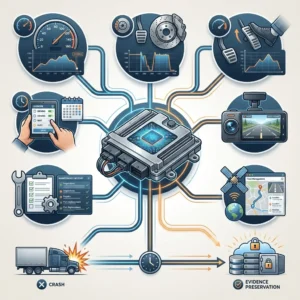
A semi truck’s “black box,” technically its Electronic Control Module (ECM), records speed, braking force, and throttle input in the seconds before a crash. It functions like an aircraft’s flight recorder, and it can confirm or contradict the truck driver’s version of events.
This data does not last forever. Trucking companies routinely overwrite or delete it during normal operations, sometimes within days of a crash. That’s why, on the day you hire us, we send a spoliation letter demanding the carrier preserve the ECM data, driver logs, dashcam footage, and maintenance records. Waiting even a week can mean this evidence is gone.
What Happens If the Trucking Company Destroys Evidence?
Losing or destroying evidence relevant to a legal claim is called spoliation. In a truck accident case, that can mean an overwritten black box, a repaired truck with the damage evidence gone, or a driver’s log that’s been “corrected” after the fact.
Courts can penalize a company that destroys evidence after being told to preserve it, which is exactly why a same-day preservation letter matters. If a carrier ignores that demand and evidence disappears anyway, your attorney can ask a judge to instruct the jury that the missing evidence would have hurt the trucking company’s case. Acting fast is the only way to protect this option.
How Do Hours-of-Service Violations Affect My Truck Accident Claim?
Federal Hours-of-Service (HOS) rules under 49 CFR § 395.3 generally limit a commercial truck driver to 11 hours of driving within a 14-hour on-duty window, after at least 10 consecutive hours off duty. These rules exist because a fatigued driver reacts slower and makes worse decisions behind the wheel of an 18-wheeler the same way an impaired driver does.
Federal rules also require a 30-minute break after 8 hours of driving, and cap a driver at 60 hours over 7 days or 70 hours over 8 days, depending on the carrier’s schedule. Every truck with an Electronic Logging Device (ELD) generates a time-stamped record of the driver’s hours. If those logs show a violation at the time of your crash, that record becomes strong evidence of negligence. Discrepancies between logged hours and GPS or fuel receipts can also point to falsified logs, which courts and insurers both take seriously.
Free case review, day or night – call (206) 447-1425 now.
How Is a Semi Truck Accident Claim Different From a Car Accident Claim?
Three differences matter most. First, severity: a fully loaded semi can weigh 20 to 30 times more than a passenger car, and the federal government’s largest truck crash causation study to date attributes the critical reason for the crash to the truck driver in roughly 87% of large truck collisions studied mostly recognition and decision errors, the kind that come with fatigue and distraction. Second, regulation: commercial motor carriers answer to FMCSA rules that don’t apply to ordinary drivers, and violations of those rules are direct evidence in your favor. Third, data: a modern tractor-trailer generates ELD and ECM records that a passenger car simply doesn’t, which means big-rig cases turn on technical evidence, not just eyewitness accounts.
What Compensation Can I Recover After a Seattle Semi Truck Accident?
You may recover economic damages and non-economic damages. Washington law does not allow punitive damages in truck accident, car accident, or wrongful death cases no matter how reckless the driver or motor carrier was so we’ll never tell you otherwise just to sound impressive. We’d rather give you an honest number than a hopeful one.
Economic damages cover your direct financial losses: past and future medical bills, lost wages, reduced future earning capacity, property damage, and home or vehicle modifications made necessary by a permanent disability.
Non-economic damages cover the harder-to-price cost of the crash: physical pain, emotional distress, loss of enjoyment of daily life, and loss of consortium if your injuries affect your marriage or family relationships.
Because Washington is a pure comparative fault state under RCW 4.22.005, you can still recover damages even if you were partly at fault for the collision your award is simply reduced by your percentage of fault under RCW 4.22.070, even if that percentage is high. Many people assume any shared blame ends their claim. In Washington, it doesn’t.

What Should I Do Immediately After a Semi Truck Accident in Seattle?
- Move to a safe location if you’re able to.
- Call 911 and request police and medical response.
- Get medical care, even if you feel fine some injuries, like internal bleeding or a concussion, don’t show symptoms right away.
- Photograph the scene: vehicle damage, road conditions, the truck’s license plate and USDOT number.
- Get contact and insurance information from the driver and any witnesses.
- Avoid statements that suggest fault, even something as simple as apologizing at the scene.
- Don’t give a recorded statement to the trucking company’s insurer before speaking with a lawyer.
- Contact a semi truck accident attorney before you sign anything or accept an early settlement offer.
The trucking company’s insurer may already have an investigator reviewing your case within hours. Acting early protects both your evidence and your claim.
What If My Loved One Died in a Semi Truck Accident?
If a family member died in a truck accident, Washington’s wrongful death statutes (RCW 4.20.010 and RCW 4.20.020) generally allow the personal representative of the estate to bring a claim on behalf of a surviving spouse, domestic partner, or children within three years of the date of death. Recoverable damages are economic and non-economic funeral and burial costs, the loss of the decedent’s income and financial support, and the loss of companionship, guidance, and support the family has lost. As with any Washington injury claim, punitive damages aren’t part of a wrongful death recovery here, whatever a settlement calculator on another site might suggest.
No settlement replaces a person. Our role is to make sure the trucking company and its insurer are held to the full value of what your family has lost, so you can focus on grieving instead of fighting an insurance adjuster.
How Much Does a Seattle Semi Truck Accident Lawyer Cost?
Nothing upfront. We handle semi truck accident cases on a contingency fee basis: you pay no hourly rate and owe us nothing unless we recover compensation for you. We also advance the costs of investigating and building your case expert fees, records requests, and court costs. so money is never a reason to delay calling us.
Why Choose a Local Seattle Semi Truck Accident Attorney
Truck accidents cluster around predictable places: the merge points on I-5 and SR-99, the steep grade on I-90 near Mercer Island, the freight-heavy Duwamish industrial corridor, and the routes feeding the Port of Seattle. Knowing where and why these crashes happen shapes how we investigate which cameras to request footage from, which weigh-station or inspection records to pull, and which local court’s practices apply to your case, whether that’s King County, Pierce County, or elsewhere across our Seattle, Brier, Ellensburg, or Pullman coverage areas.
Get a Free Consultation With a Seattle Semi Truck Accident Lawyer
If you or a family member was hurt in a semi truck accident, jackknife crash, or rollover involving an 18-wheeler, tractor-trailer, tanker, or dump truck, talk to us before you talk to an insurance adjuster. We offer free, 24/7 consultations by phone, text, video, or in person including home visits if you can’t travel and you pay nothing unless we win your case.
Call now for a free case review, or reach out online any time we’re available 24/7, call (206) 447-1425 now.
Sources –
- Washington statute of limitations, RCW 4.16.080: Métier Law Firm summary
- Washington pure comparative fault, RCW 4.22.005: official statute text via Justia
- Washington proportionate (several) liability among multiple defendants, RCW 4.22.070: official statute text via Justia
- Washington wrongful death right of action, RCW 4.20.010: Washington State Legislature official statute text
- Washington’s bar on punitive damages in personal injury cases: Herschensohn Law (ZBH Law)
- Federal Hours-of-Service rule, 49 CFR § 395.3 (11-hour/14-hour/10-hour/30-minute break/60-70 hour weekly limits): eCFR official federal regulation text
- FMCSA Large Truck Crash Causation Study (driver-related critical reasons ~87%): FMCSA final report; study-age caveat and successor program confirmed via FMCSA Crash Causal Factors Program
- Washington statewide traffic fatality/serious injury trend (2023 vs 2022): WSDOT Gray Notebook – Total Fatal & Serious Injury Crashes