CALL US NOW
 TEXT US NOW
Why Seattle bicycle crash victims call Elsner Law Firm
Cyclist-bias pushback when insurers claim you were hard to see, outside the bike lane, or partly responsible.
Serious-injury claim guidance for emergency care, road rash, fractures, head injuries, lost income, and future treatment.
Evidence preservation for traffic cameras, witness statements, police reports, bike damage, roadway conditions, and driver conduct.
Washington personal injury focus for cyclists hurt in Seattle and statewide crashes.
Free case review by phone at 206-447-1425.
Trusted Legal Advocates for Injured Cyclists Across King County and Washington State
A dooring accident can happen in an instant. A distracted driver can change your life in a single second. When you are lying on the pavement wondering what just happened, the last thing you need is a legal system that feels impossible to navigate alone.
At Elsner Law Firm, our Seattle bicycle accident attorneys fight for daily commuters, weekend riders, families who bike together, and experienced cyclists who have been injured by someone else’s negligence. We handle bicycle accident claims across Seattle, Tukwila, Brier, and communities throughout the Puget Sound region.
Evidence disappears. Witnesses forget. Insurance adjusters start building their case against you from day one. The sooner you call, the stronger your claim.
You pay nothing unless we win. Call 206-447-1425 for your free case review today. Even if you choose not to hire us, you will leave the call knowing your rights and your next steps.
Attorney responsible for this page
Justin G. Elsner, Elsner Law Firm’s managing attorney, was admitted to the Washington bar in 2007 and has practiced personal injury law in Washington since founding the firm that year. His practice covers personal injury matters including motor-vehicle, pedestrian, bicycle, rideshare, premises liability, and wrongful death claims. Review Justin Elsner’s credentials and experience. Every case is different, and past results do not guarantee a similar outcome.
How Dangerous Is Cycling in Washington State?
Cycling in Seattle and across Washington is growing. So is the risk. The numbers tell a sobering story.
Nationally, bicycle fatalities increased 37% over a 10-year period, rising from 900 deaths in 2012 to 1,230 in 2021, according to the National Safety Council. Eighty-one percent of those fatal crashes occurred in urban areas. Men account for roughly 88% of all cycling fatalities.
In Washington State, the Washington Traffic Safety Commission (WTSC) reports that bicyclist traffic fatalities have trended upward over the past decade. Active transportation user fatalities, which include pedestrians and cyclists, rose 30% in a single year between 2020 and 2021, jumping from 123 to 160 deaths. Eighteen pedal cyclist fatalities were recorded statewide in 2023.
King County alone averages 42 collisions between bicyclists and motor vehicles that cause severe injuries each year, with 2 to 3 fatalities annually, according to King County Public Health data. These are not abstract numbers. Each one represents a person, a family, and a life disrupted.
The most dangerous times for cyclists are afternoon and evening hours. The most dangerous settings are urban roads and intersections, not bike lanes or shoulders. And the most common crash pattern, according to WTSC data, involves a driver overtaking a cyclist from behind or a cyclist crossing or entering a roadway.
Steps to Take Immediately After a Bicycle Accident
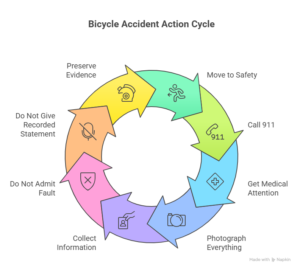
What you do in the first hours after a bicycle accident directly affects the strength of your claim. Follow these steps.
Move to safety. Get out of the roadway if you can. Turn on your phone’s flashlight or any bike lights to make yourself visible to traffic.
Call 911. A police report creates an official record of the crash. Tell the responding officer exactly what happened. Do not downplay your injuries or speculate about fault.
Get medical attention immediately. Some injuries, including concussions, internal bleeding, and spinal damage, do not show symptoms right away. A medical evaluation within 24 hours creates documentation that directly links your injuries to the crash.
Photograph everything. Use your phone to capture the accident scene, vehicle damage, your injuries, skid marks, road conditions, traffic signals, and the driver’s license plate. Take wide shots and close-ups. These photos are evidence.
Collect the driver’s information. Get their name, phone number, driver’s license number, insurance company, and policy number. If there are witnesses, get their contact information too.
Do not admit fault. Do not apologize or say “I should have been more careful.” Anything you say can be used against you by the insurance company.
Do not give a recorded statement to the other driver’s insurance company. They may call you within hours. Politely decline until you have spoken with an attorney. Insurance adjusters are trained to get you to say things that reduce your claim.
Preserve physical evidence. Keep your damaged bicycle, helmet, torn clothing, and any other items from the crash. Do not repair or dispose of anything.
Common Causes of Bicycle Accidents in Seattle
Bicycle accidents in Seattle and across Washington State result from a mix of driver behavior, road conditions, and environmental hazards. Understanding these causes helps establish fault in your claim.
Driver Negligence. The most common cause. Drivers fail to yield at intersections, turn left into oncoming cyclists, merge into bike lanes without checking mirrors, or pass too closely. Under RCW 46.61.110, drivers must pass cyclists at a safe distance of at least three feet. Many do not.
Distracted Driving. Texting, eating, adjusting GPS, or reaching for objects diverts a driver’s attention for critical seconds. Distracted driving fatalities in Washington increased in both 2023 and 2024, according to the WTSC, reaching 138 deaths statewide.
Dooring Accidents. A dooring accident occurs when a vehicle occupant opens their door into the path of an oncoming cyclist. The cyclist has no time to react, strikes the open door at full speed, and frequently flips over it onto the road. In dense urban corridors across Seattle, Capitol Hill, the University District, and Fremont, dooring remains one of the most frequent and devastating causes of cycling injuries. The vehicle occupant who opens a door without checking bears liability.
Sideswipe Collisions. WTSC data show that an overwhelming percentage of crashes occur when a driver overtakes a cyclist from behind. These sideswipes happen most often on arterial roads where cyclists share the travel lane with faster-moving vehicles.
Left-Turn Collisions. A common pattern involves a vehicle turning left across an intersection and striking an oncoming cyclist. The driver misjudges the cyclist’s speed or fails to see them entirely.
Poor Road Conditions. Potholes, cracked pavement, debris, unmarked construction zones, missing signage, and poorly designed intersections create hazards that are especially dangerous for two-wheeled vehicles. When a government agency such as SDOT, King County, or WSDOT is responsible for the hazardous condition, that entity may be liable.
Adverse Weather. Rain, fog, and wet pavement reduce visibility and traction for both drivers and cyclists. Seattle’s frequent rain makes this an ongoing concern. Drivers must adjust their speed and following distance in wet conditions.
Cyclist Errors. Cyclists who run red lights, ride against traffic, swerve unpredictably, or ride under the influence of alcohol can contribute to their own accidents. However, even partial fault does not bar recovery under Washington’s comparative negligence system.
Defective Bicycle Equipment. Brake failures, tire blowouts, frame fractures, and malfunctioning lights can cause or worsen crashes. The manufacturer, distributor, or retailer of defective equipment may be liable.
Types of Bicycle Accident Injuries
Cyclists have almost no protection in a collision with a motor vehicle. The injuries are often severe, sometimes permanent, and always expensive.
Traumatic Brain Injuries (TBI). Concussions, contusions, and diffuse axonal injuries are the leading cause of death and long-term disability in bicycle crashes. Head injuries account for over 60% of cycling fatalities. Helmets reduce risk significantly, but cannot prevent all brain trauma. TBI cases often involve the highest compensation awards because of their life-altering consequences.
Spinal Cord Injuries. Damage to the spinal cord can result in partial or complete paralysis, loss of sensation, and permanent changes to bodily functions. These injuries require extensive rehabilitation, assistive equipment, and long-term medical care that can cost millions of dollars over a lifetime.
Broken Bones and Fractures. Collarbones, wrists, arms, ribs, ankles, and legs are particularly vulnerable. Cyclists instinctively extend their arms to break a fall, resulting in fractures. Compound fractures, where bone pierces skin or organs, require surgical intervention and carry risks of infection.
Road Rash and Soft Tissue Injuries. When a cyclist slides across pavement, the friction strips away skin, fat, and sometimes muscle. Severe road rash requires skin grafts and can cause permanent scarring and disfigurement. Soft tissue damage to muscles, tendons, and ligaments may require months of physical therapy.
Facial and Dental Injuries. Broken jaws, shattered cheekbones, lost teeth, and orbital fractures are common when a cyclist strikes a vehicle or pavement face-first. Reconstructive surgery and dental work are expensive and often require multiple procedures.
Internal Organ Damage. Blunt force trauma from a collision can cause internal bleeding in the lungs, spleen, liver, or kidneys. These injuries may not show external symptoms immediately but can be life-threatening without prompt medical treatment.
Amputation and Crush Injuries. When a vehicle runs over a cyclist after the initial collision, crush injuries to limbs may require surgical amputation. These catastrophic injuries permanently alter a victim’s ability to work, care for themselves, and participate in daily life.
If you have suffered any of these injuries in a bicycle accident, you deserve full compensation for your medical costs, lost income, and the lasting impact on your life. Call Elsner Law Firm at 206-447-1425.
The Emotional Toll of a Bicycle Accident
The physical injuries are only part of the story. Many cyclists experience anxiety, depression, and post-traumatic stress after a serious accident. The fear of getting back on a bike can be overwhelming. Daily commuters lose their independence. Weekend riders lose their outlet. Families who once biked together stop riding altogether.
These emotional injuries are real, and they are compensable. Washington law allows recovery for pain and suffering, emotional distress, and loss of enjoyment of life. If cycling was a central part of your identity and a crash has taken that from you, that loss has value.
At Elsner Law Firm, we fight to restore your life, not just cover your medical bills. Get back on your bike and back to the life you love. That is our goal for every client.
Washington Bicycle Laws: Your Rights and Duties on the Road
Washington law gives cyclists the same rights and duties as vehicle drivers. Under RCW 46.61.755, every person riding a bicycle on a roadway is granted all of the rights and is subject to all of the duties applicable to the driver of a vehicle. This is the foundation of every bicycle accident claim in the state.
Key Cycling Laws in Washington:
Right to the Road. Cyclists may ride on most public roadways. They must ride as near to the right side of the right lane as is safe, except when preparing to turn, passing another cyclist, or when the lane is too narrow to share safely (RCW 46.61.770). Cyclists may choose to ride in the travel lane, bike lane, or shoulder based on their safety needs.
Stop Sign Yield (Idaho Stop). Since 2020, Washington cyclists may treat a stop sign as a yield sign under RCW 46.61.190, unless the stop sign is at a railroad crossing or a school bus is displaying its stop signal. This law reduces liability exposure for cyclists who safely proceed through low-traffic intersections.
Three-Foot Safe Passing Distance. Drivers must move completely into an adjacent lane or reduce speed and pass at a safe distance, where practicable at least three feet, when overtaking a cyclist (RCW 46.61.110). A driver who violates this law and strikes a cyclist is presumptively negligent.
Night Riding Equipment. Cyclists riding after dark must use a white front headlight visible from at least 500 feet and a red rear reflector visible from at least 600 feet (RCW 46.61.780). A red rear light visible from 500 feet may supplement, but not replace, the reflector. Failure to comply may be used as evidence of comparative negligence.
Helmet Law Status. Washington repealed its statewide bicycle helmet law in 2023. No state law currently requires cyclists to wear helmets. Some cities, including Tacoma, maintain local helmet ordinances. While not legally required statewide, helmet use significantly reduces the risk of traumatic brain injury.
Sidewalk Riding. When riding on a sidewalk, cyclists are granted the rights and duties of a pedestrian (RCW 46.61.755). Some Seattle municipal areas prohibit sidewalk riding in commercial zones. Check local ordinances before riding on sidewalks downtown.
Two Abreast Maximum. Cyclists may ride side by side but not more than two abreast on the roadway (RCW 46.61.770).
E-Bike Classifications. Washington classifies electric-assisted bicycles into three classes under RCW 46.61.710. Class 1 (pedal-assist up to 20 mph) and Class 2 (throttle-assist up to 20 mph) are permitted on shared-use paths. Class 3 (pedal-assist up to 28 mph) is restricted from sidewalks and most shared-use paths unless local ordinance permits. All e-bikes must carry a permanent label showing class, top speed, and motor wattage.
Understanding these laws is essential. A violation does not automatically bar your claim, but it may reduce your compensation under Washington’s comparative negligence system. A Seattle bicycle accident lawyer can assess how any alleged violation may affect your case.
Who Can Be Held Liable for a Bicycle Accident in Seattle?
To recover compensation after a bicycle accident, you must prove that someone else’s negligence caused your injuries. This requires establishing four elements: the defendant owed you a duty of care, they breached that duty, the breach caused your injuries, and you suffered actual damages as a result.
Liability often extends beyond the driver who struck you. Multiple parties may bear legal responsibility.
The At-Fault Driver. A motorist who fails to yield, runs a red light, texts while driving, speeds through a school zone, or opens a car door without checking owes a duty of care to every cyclist on the road. When that duty is breached, the driver is liable for resulting injuries.
The Driver’s Employer. If the driver was on the job at the time of the crash, such as a delivery driver, commercial truck operator, or rideshare driver, the employer may be vicariously liable under the doctrine of respondent superior. This can significantly increase available insurance coverage.
Government Agencies. The Seattle Department of Transportation (SDOT), King County, and the Washington State Department of Transportation (WSDOT) are responsible for designing and maintaining safe roadways. When a bicycle accident results from a pothole, missing signage, a faded bike lane, a poorly designed intersection, or an unmarked construction zone, the responsible government entity may be liable. Government claims require a tort claim notice and a 60-day waiting period before filing suit.
Bicycle and Equipment Manufacturers. A defective bicycle frame, malfunctioning brakes, a tire blowout caused by a manufacturing defect, or a helmet that fails on impact can cause or worsen injuries. The manufacturer, distributor, or retailer may be liable under Washington’s product liability laws.
Third Parties. A pedestrian who steps into a bike lane, another cyclist who rides recklessly, or a property owner whose overgrown landscaping obstructs a cyclist’s line of sight may all share liability. Washington’s pure comparative negligence system allows recovery from any party whose negligence contributed to the crash.
Evidence That Proves Fault. Eyewitness statements, police reports, traffic camera footage, surveillance video, cell phone records, damage patterns on vehicles and bicycles, and accident reconstruction analysis all play a role in establishing liability. Gathering this evidence quickly is critical. A Seattle bicycle accident attorney from Elsner Law Firm will investigate every potential source of liability to maximize your compensation.
How Comparative Negligence Affects Your Bicycle Accident Claim
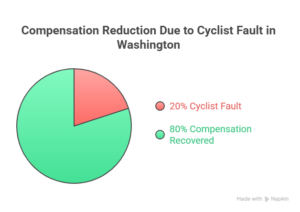
Washington follows a pure comparative negligence system under RCW 4.22.070. This means you can recover compensation even if you were partially at fault for the accident. Your award is simply reduced by your percentage of responsibility.
Here is how it works. Suppose you were riding at night without a front headlight and a driver ran a red light and struck you. A jury determines your total damages are $200,000 and assigns you 20% fault for the missing light. You would recover $160,000.
There is no threshold that bars your claim. Even if you are found 80% at fault, you can still recover 20% of your damages. This is different from many other states that bar recovery once fault exceeds 50%.
Insurance companies exploit comparative negligence aggressively. Adjusters will look for any reason to shift blame onto you: not wearing a helmet, riding outside the bike lane, failing to signal, or even riding in conditions they characterize as unsafe. Their goal is to inflate your fault percentage and reduce what they pay.
A skilled Seattle bicycle accident attorney fights back against these tactics. At Elsner Law Firm, we gather evidence, work with accident reconstruction experts when needed, and present your case to minimize the fault attributed to you. The difference between 10% fault and 40% fault on a $300,000 claim is $90,000 in your pocket. That is why legal representation matters.
How Long Do You Have to File a Bicycle Accident Claim in Washington?
Three years. That is the deadline. Under RCW 4.16.080, you have three years from the date of your bicycle accident to file a personal injury lawsuit in Washington State. Miss this deadline, and the court will almost certainly dismiss your case, regardless of the strength of your evidence.
The clock starts on the date of the crash. In rare cases involving injuries that were not immediately apparent, the discovery rule may start the clock on the date you knew or should have known about the injury.
Special Rules for Minors. If the injured cyclist is under 18, the statute of limitations is tolled (paused) until the child’s 18th birthday under RCW 4.16.190. A minor injured at age 14 would have until age 21 to file suit.
Claims Against Government Entities. If your bicycle accident was caused by a dangerous road condition maintained by a city, county, or state agency, additional steps apply. You must file a tort claim notice with the responsible government entity before filing a lawsuit. For claims against Washington State, the notice goes to the Department of Enterprise Services, Office of Risk Management. A 60-day waiting period must pass before you can proceed with litigation. These procedural requirements have strict deadlines. Missing them can forfeit your right to recover.
Wrongful Death Claims. If a cyclist is killed in an accident, the personal representative of the estate has three years from the date of death (not the accident date) to file a wrongful death lawsuit under RCW 4.20.010.
Do not wait. Evidence degrades. Surveillance footage gets overwritten. Witnesses relocate. The best time to contact a Seattle bicycle accident attorney is immediately after your accident. Call Elsner Law Firm at 206-447-1425 for a free consultation.
Filing a Personal Injury Claim After a Bicycle Accident
If you have been injured in a bicycle accident caused by someone else’s negligence, you have the right to file a personal injury claim for compensation. Here is how the process works in Washington State.
Step 1: Medical Treatment and Documentation. Your health comes first. Follow your doctor’s treatment plan completely. Every medical visit, prescription, imaging scan, and therapy session creates documentation that proves the severity of your injuries and links them to the accident.
Step 2: Investigation and Evidence Gathering. Your attorney obtains the police report, collects witness statements, preserves surveillance footage, photographs the scene, and documents road conditions. In complex cases, accident reconstruction experts may be retained.
Step 3: Calculating Your Damages. Your lawyer will tally your economic damages (medical bills, lost wages, future medical costs, reduced earning capacity) and assess your non-economic damages (pain, suffering, emotional distress, loss of enjoyment of life). The total represents the full value of your claim.
Step 4: Filing the Insurance Claim. Your attorney submits a demand package to the at-fault driver’s insurance company. This package includes your medical records, bills, proof of lost income, and a detailed account of how the accident has affected your life. If you have PIP coverage on your own auto policy, a separate PIP claim can be filed simultaneously.
Step 5: Negotiation. The insurance company will respond with a counter-offer, usually far below the demand. Your attorney negotiates aggressively. Most bicycle accident claims settle during this phase, but only when the offer reflects the true value of your injuries.
Step 6: Litigation if Necessary. If the insurance company refuses to offer fair compensation, your attorney files a lawsuit and prepares for trial. The mere act of filing often prompts a better settlement offer. If the case goes to trial, your attorney presents your case before a judge or jury.
Throughout this process, you focus on your recovery. Your attorney handles the paperwork, phone calls, deadlines, and negotiations.
Recovering Damages for Bicycle Accident Victims
Bicycle accident victims in Washington can recover compensation for both economic and non-economic damages. The goal is to restore you, as fully as money can, to the position you were in before the crash.
Economic Damages (Documented Financial Losses):
Medical expenses, including emergency treatment, hospitalization, surgery, imaging, medication, physical therapy, and future medical care. Lost wages for time missed from work during recovery. Reduced earning capacity if your injuries prevent you from returning to your previous job or working at the same level. Replacement services for household tasks you can no longer perform, such as cleaning, cooking, or childcare. Property damage, including bicycle repair or replacement, damaged gear, and electronics. Out-of-pocket costs such as transportation to medical appointments, home modifications, and assistive devices.
Non-Economic Damages (Quality of Life Losses):
Physical pain and suffering caused by the accident and ongoing treatment. Emotional distress, including anxiety, depression, PTSD, and fear of riding. Loss of enjoyment of life if your injuries prevent you from cycling, exercising, or participating in activities you once loved. Loss of consortium for the impact on your relationship with your spouse or partner. Permanent disability or disfigurement that affects your appearance, mobility, or independence.
Wrongful Death Damages:
If a cyclist is killed, surviving family members may recover funeral and burial costs, loss of financial support, loss of companionship and guidance, and the deceased’s pain and suffering before death.
Does Insurance Cover Bicycle Accidents in Washington?
Yes. Multiple insurance sources may apply to your bicycle accident claim. Understanding your coverage options is critical to recovering full compensation.
The At-Fault Driver’s Liability Insurance. Washington requires all drivers to carry minimum liability insurance. If a motorist caused your crash, their liability policy is the primary source of compensation for your medical bills, lost wages, and pain and suffering.
Personal Injury Protection (PIP). If you have an auto insurance policy with PIP coverage, it may cover your medical expenses and lost wages regardless of who was at fault. PIP applies to you as a policyholder even when you are riding a bicycle, not driving your car. This is one of the most underutilized coverage options for injured cyclists.
Uninsured/Underinsured Motorist Coverage (UM/UIM). If the at-fault driver has no insurance or insufficient coverage, your own UM/UIM policy can fill the gap. This is especially important in hit-and-run cases where the driver is never identified.
Homeowner’s or Renter’s Insurance. In some cases involving non-vehicle causes, such as a dog running into a cyclist’s path, the property owner’s homeowner’s insurance may provide coverage.
Insurance companies routinely minimize payouts to injured cyclists. They may argue you were partially at fault, that your injuries are not as severe as claimed, or that you delayed medical treatment. A Seattle bicycle accident lawyer from Elsner Law Firm knows these tactics and fights back. Call 206-447-1425 for a free consultation.
How Much Does It Cost to Hire a Bicycle Accident Lawyer?
Nothing upfront. Elsner Law Firm works on a contingency fee basis. That means you pay no attorney fees unless we recover compensation for you. If we do not win your case, you owe us nothing.
Here is how it works. Our fee is a percentage of the settlement or verdict we obtain on your behalf. We also advance all case-related expenses, including filing fees, expert witness costs, medical record retrieval, and accident reconstruction. You are never asked to pay out of pocket.
This arrangement exists because we believe that financial constraints should never prevent an injured cyclist from accessing quality legal representation. We also offer a free initial consultation where you can discuss your accident, learn about your legal options, and get honest answers with no obligation.
Call 206-447-1425 today. The consultation is free. The advice is real. And you pay nothing unless we win.
Why Choose Elsner Law Firm as Your Seattle Bicycle Accident Lawyer?
We are not a billboard law firm that hands your case to a paralegal. At Elsner Law Firm, your case is handled by experienced attorneys who understand the specific challenges cyclists face in Seattle.
We Know Bicycle Accident Law. Our attorneys understand Washington’s cycling statutes, comparative negligence rules, government entity claim procedures, and the insurance coverage options available to injured cyclists. This specialized knowledge translates to stronger claims and better results.
We Investigate Thoroughly. We obtain police reports, secure surveillance footage, interview witnesses, analyze road conditions, and retain accident reconstruction experts when needed. We identify every liable party and every available insurance policy.
We Negotiate Aggressively. Insurance companies know which law firms will accept lowball offers and which will fight. We fight. We do not let adjusters dictate the value of your injuries.
We Go to Trial When Necessary. Most cases settle. But if the insurance company refuses to offer fair compensation, we are prepared to take your case to a judge and jury. That willingness to litigate gives us leverage in every negotiation.
We Communicate. You will never wonder what is happening with your case. We return calls. We explain developments in plain language. We treat you like a person, not a file number.
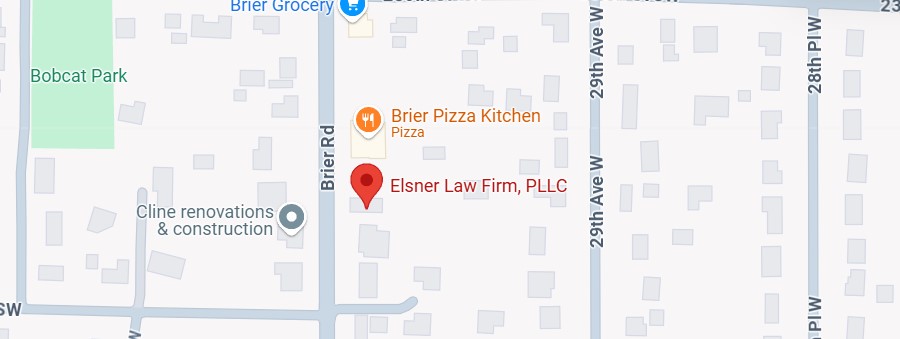
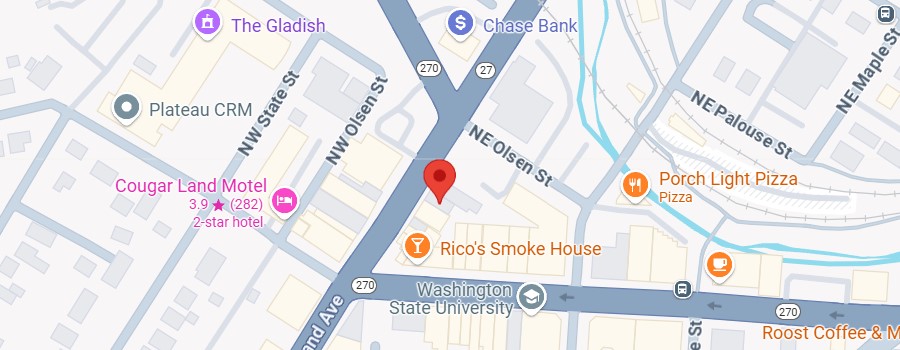
We Serve All of Washington. Our offices are in Seattle, Brier, Pullman, and Ellensburg. We represent injured cyclists across King County, Snohomish County, Pierce County, and throughout Washington State.
Meet Your Seattle Bicycle Accident Attorney
Justin Elsner founded Elsner Law Firm in 2007 after graduating cum laude from Seattle University School of Law. He is a member of the Washington State Bar Association and admitted to practice in the Western District of the Federal Court. For nearly two decades, Justin has dedicated his career to fighting for accident victims across King County, Snohomish County, Pierce County, Whitman County, and Kittitas County.
Justin’s commitment to this work is personal. During his high school years, he was involved in a serious Bicycle crash. Unsure of what to do and intimidated by the insurance process, his family turned to a personal injury attorney. That experience showed him how much a knowledgeable legal advocate changes the outcome for accident victims. It shaped everything he built at Elsner Law Firm.
He has since authored two client resources: “7 Mistakes Accident Victims in Washington Make and How to Avoid Them” and “Your Guide to the First 30 Days After a Crash.” Both reflect his belief that informed clients get better results.
Justin handles motor vehicle accidents, pedestrian and bicycle accidents, wrongful death, dog bites, and premises liability cases. He is a triathlete, a racing enthusiast, and above all a dedicated advocate for the people who trust him with their cases.
If you were injured in a bicycle crash in Seattle, Brier, Pullman, or Ellensburg, Justin and the Elsner Law Firm team are ready to fight for your full recovery.
Call 206-447-1425 or email justin@elsnerlawfirm.com for a free consultation today.
Frequently Asked Questions About Seattle Bicycle Accidents
Can you sue if you get hit by a car while riding a bike?
Yes. If a driver’s negligence caused your crash, you have the right to file a personal injury lawsuit. Washington law treats cyclists as vehicle operators with equal rights on the road under RCW 46.61.755. You can seek compensation for medical expenses, lost income, pain and suffering, and other damages. Even if you were partially at fault, Washington’s pure comparative negligence system allows you to recover reduced damages. Contact a Seattle bicycle accident attorney to evaluate your claim.
Does my car insurance cover me in a bicycle accident?
It may. Your auto insurance policy’s Personal Injury Protection (PIP) coverage can apply to injuries you sustain while riding a bicycle. Additionally, if the at-fault driver is uninsured or underinsured, your UM/UIM coverage may provide compensation. Review your policy or call Elsner Law Firm for help understanding your coverage options.
How long do I have to file a bicycle accident lawsuit in Washington?
Three years from the date of the accident under RCW 4.16.080. For claims against government entities, you must file a tort claim notice first, and a 60-day waiting period applies. For injured minors, the deadline is tolled until the child turns 18. Do not wait until the deadline approaches. Early action preserves evidence and strengthens your case.
What if the driver who hit me fled the scene?
Hit-and-run bicycle accidents are tragically common. Your own uninsured motorist (UM) coverage may provide compensation even if the driver is never identified. Your attorney can also pursue investigation through surveillance footage, witness accounts, and police reports. Report the accident to law enforcement immediately and contact a bicycle accident lawyer as soon as possible.
What if I was not wearing a helmet when I was hit?
Washington does not have a statewide bicycle helmet law for adults. The repeal took effect in 2023. Not wearing a helmet does not automatically bar your claim. However, insurance companies may argue that your injuries would have been less severe with a helmet, potentially reducing your compensation under comparative negligence principles. An experienced attorney can counter these arguments with medical evidence.
What is a dooring accident?
A dooring accident happens when a parked vehicle occupant opens their door into the path of a cyclist. The cyclist strikes the open door at speed, often with no time to brake or swerve. These crashes frequently cause broken bones, head injuries, and road rash. The person who opened the door without checking for oncoming traffic is typically liable.
Do I need a lawyer for a bicycle accident?
You are not required to hire a lawyer. But insurance companies have teams of adjusters and attorneys working to minimize your payout. A bicycle accident attorney levels the playing field. They investigate your crash, document your damages, negotiate with insurers, and take your case to trial if needed. At Elsner Law Firm, you pay nothing unless we win. A free consultation costs you nothing and gives you clarity.
What is my bicycle accident case worth?
Every case is different. The value depends on the severity of your injuries, your medical expenses, lost wages, the impact on your quality of life, and the degree of the other party’s fault. Cases involving traumatic brain injuries, spinal cord damage, or permanent disability are typically valued higher. An experienced Seattle bicycle accident lawyer can evaluate your case and provide a realistic assessment during a free consultation.
What is the three-foot passing law in Washington?
Under RCW 46.61.110, drivers must pass cyclists at a safe distance, where practicable at least three feet. If a driver violates this law and strikes you, that violation is strong evidence of negligence in your claim.
Can I recover compensation if I was partially at fault?
Yes. Washington’s pure comparative negligence system under RCW 4.22.070 allows you to recover damages even if you were mostly at fault. Your compensation is reduced by your percentage of fault. For example, if you are 25% at fault and your damages are $100,000, you recover $75,000.
Talk to a Seattle Bicycle Accident Attorney Today
You did nothing wrong. You followed the rules. You rode where you were supposed to ride. And someone else’s carelessness changed everything.
At Elsner Law Firm, our Seattle bicycle accident attorneys have helped injured cyclists across King County, Snohomish County, Pierce County, and throughout Washington State recover compensation for medical bills, lost wages, and the pain that comes with losing the life you had before the crash.
We know the laws. We know the insurance tactics. And we know how to win.
Call 206-447-1425 now for your free case review. You can also schedule a free virtual appointment online. We are available by phone, video, or in person at our Seattle office.
You pay nothing unless we win. No fees. No obligation. Just answers.
Areas We Serve in Washington State