CALL US NOW
 TEXT US NOW
Why Seattle eye injury victims call Elsner Law Firm
Medical documentation support for emergency care, ophthalmology visits, imaging, surgery, prescriptions, vision symptoms, and follow-up treatment.
Insurance pushback support when adjusters minimize blurry vision, light sensitivity, scarring, or long-term limitations.
Accident and liability review for incident evidence, medical records, wage loss, and facts connecting the trauma to the eye injury.
Washington personal injury focus for people dealing with eye injuries after Seattle-area crashes, falls, or preventable incidents.
Free case review by phone at 206-447-1425.
About 2.5 million eye injuries happen across the United States every year. Nearly 1 million of those require emergency room treatment, according to Prevent Blindness. In Washington state alone, 3,413 people suffered serious traffic injuries in 2023, up 70% from a decade earlier, according to WSDOT data. Car crashes, construction accidents, and workplace incidents put thousands of eyes at risk every year in Seattle and King County.
If you are dealing with blurred vision, light sensitivity, pain, or vision loss after an accident, you are not alone. But time matters. Evidence disappears. Witnesses forget. Medical records need to be preserved before insurance adjusters start building a case against you.
Elsner Law Firm represents eye injury victims across Seattle, Tacoma, Bellevue, Renton, and throughout Washington state. Attorney Justin Elsner has fought for injured people in the Puget Sound region since 2007. We work on a contingency fee basis. You pay nothing unless we win.
Eye Injury Facts That Seattle Residents Should Know
Every day, about 2,000 workers in the United States suffer a job-related eye injury that requires medical treatment, according to the National Institute for Occupational Safety and Health (NIOSH). About 90% of these injuries could have been prevented with proper protective eyewear, according to the American Academy of Ophthalmology.
The numbers tell a serious story:
- 2.5 million eye injuries occur annually in the United States (Prevent Blindness)
- Nearly 1 million require emergency room visits each year
- 24 million Americans have suffered an eye injury at some point in their lives
- 1.7 million are partially blind and 147,000 are completely blind from eye injuries (NCBI/StatPearls)
- 38,000+ workplace eye injuries were recorded by the Bureau of Labor Statistics in 2021
- $300 million+ in annual costs from workplace eye injuries in workers’ compensation and lost productivity (OSHA)
- 43,379 sports-related eye injuries were treated in the U.S. in 2024, a 33% increase from 2023 (Prevent Blindness)
In Washington state specifically:
- 810 traffic fatalities on Washington roads in 2023, a 10% increase over 2022 (WSDOT)
- 3,413 serious traffic injuries in 2023, up 70.3% from 2,004 in 2014 (WSDOT)
- 75% of deadly collisions in Washington involve impairment, speeding, distraction, or seat belt non-use (Washington Traffic Safety Commission)
- 7,312 reported crashes in Seattle in 2024 (SDOT/WSDOT), with fatalities up 90% compared to 2015
Workers with vision impairment earn an average of 31% less than workers without disabilities, according to the American Foundation for the Blind. A serious eye injury does not just affect your health. It affects your income, your independence, and your family’s future.
If someone else’s negligence caused your eye injury, Washington law gives you the right to file a personal injury claim for full compensation. An experienced Seattle eye injury attorney can help you understand what your case is worth.
Types of Eye Injuries We Handle in Seattle
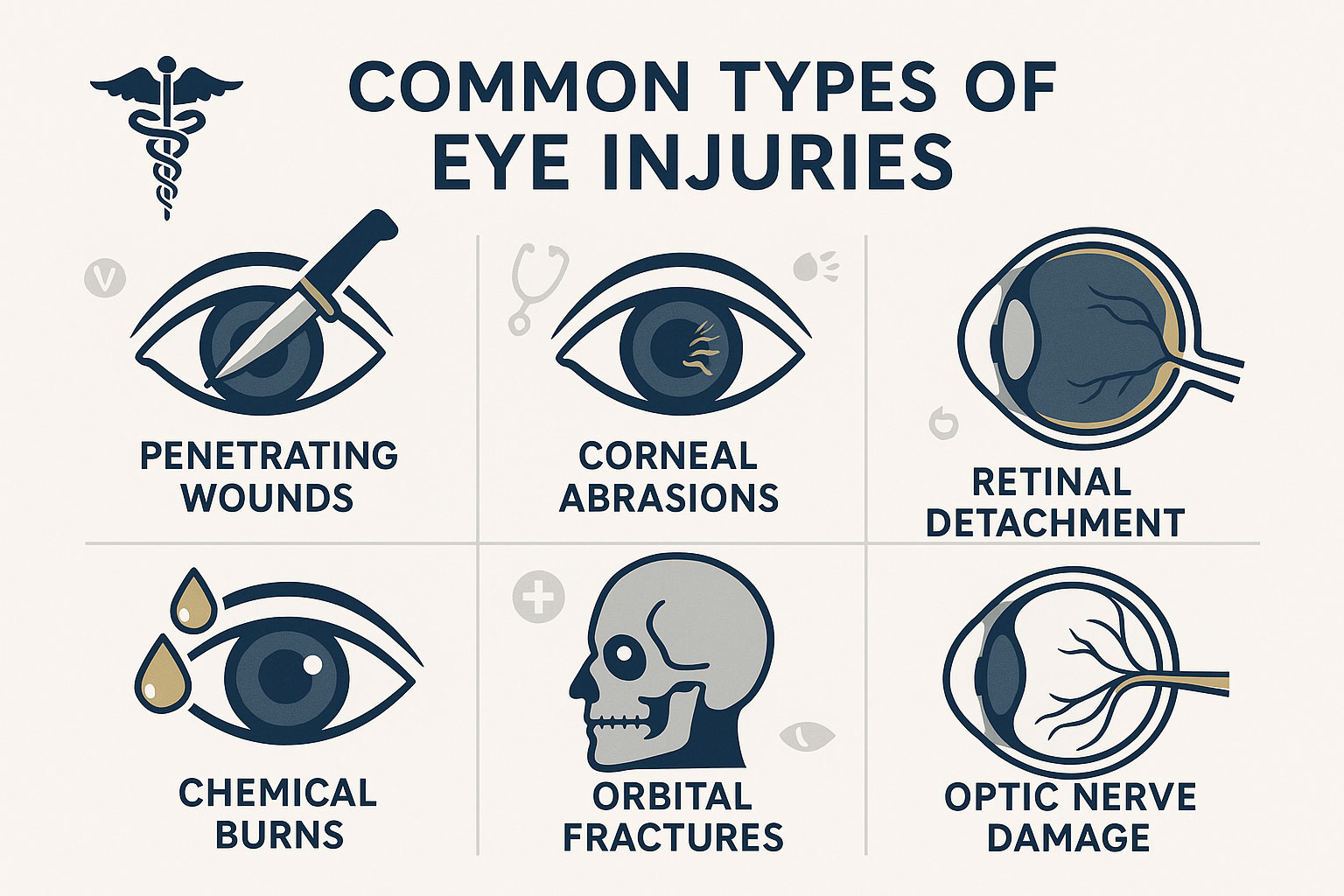
Our Seattle eye injury attorneys represent victims across the full range of traumatic eye conditions. Each injury type affects vision differently and requires a specific medical and legal approach to prove damages.
Surface and Corneal Injuries
Corneal abrasions are scratches on the clear front surface of the eye. Flying debris, metal fragments, dust, and wood chips cause most corneal abrasions in workplace and construction settings. Most heal within 48 to 72 hours. Deep lacerations may need surgery and can leave permanent scars that affect vision.
Chemical burns happen when acids, alkalis, solvents, or industrial cleaning agents contact the eye. Alkali burns from concrete dust, ammonia, or lye penetrate eye tissue faster and cause deeper damage than acid burns. Emergency irrigation within the first 10 minutes is critical. Severe chemical burns destroy the cornea and lead to permanent vision loss.
Thermal burns from fires, welding arcs, explosions, and hot liquids damage eyelids, corneas, and surrounding tissue. Severe burns can fuse the eyelid to the eyeball. Burn victims often need multiple reconstructive surgeries over months or years.
Internal Eye Injuries
Retinal detachment occurs when the thin tissue at the back of the eye pulls away from its blood supply. Without emergency surgery, retinal detachment causes permanent blindness in the affected eye. Symptoms include sudden flashes of light, floating spots, and a dark shadow spreading across your vision. Blunt force trauma from car accidents and falls is a leading cause.
Vitreous hemorrhage involves blood leaking into the clear gel that fills the center of the eye. This blocks light from reaching the retina. Blunt trauma to the head or face is a common cause. Mild cases may clear over weeks. Severe hemorrhages require surgery to remove the vitreous fluid and restore sight.
Traumatic hyphema is bleeding between the iris and cornea caused by a direct blow from an airbag, fist, ball, or falling object. Blood pooling in the front chamber raises pressure inside the eye and can permanently damage the iris and cornea.
Structural and Nerve Damage
Orbital fractures are breaks in the bones surrounding the eye socket. Car crashes, falls, and blunt force trauma cause most orbital fractures in King County. These fractures can trap eye muscles, causing double vision, and may require reconstructive surgery.
Optic nerve damage occurs when traumatic brain injuries, skull fractures, or increased intracranial pressure cut blood flow to the optic nerve. This nerve carries visual signals from the eye to the brain. Damage often causes partial or complete blindness that surgery cannot reverse.
Penetrating eye wounds from glass shards, metal fragments, nails, or wood splinters are surgical emergencies. Even with immediate treatment, many victims lose partial or complete vision. Construction workers, auto accident victims, and explosion survivors face the highest risk.
Specialized Conditions
Canalicular stenosis is a narrowing or blockage of the tear drainage ducts near the inner corner of the eye. Facial trauma, chemical exposure, and surgical complications cause this condition. Symptoms include constant tearing, recurring eye infections, and blurred vision. Treatment usually requires surgery to rebuild the drainage pathway. If you need a canalicular stenosis lawsuit lawyer, our firm handles these claims.
Globe rupture is a full-thickness wound to the eye wall. This is one of the most severe eye injuries and frequently results in permanent loss of the eye. High-velocity projectiles, severe blunt trauma, and industrial accidents are common causes.
If your eye injury type is not listed here, call our office. We handle all forms of eye trauma caused by negligence in Washington state.
Call 206-447-1425 for a free case review.

Compensation for Eye Injuries in Washington State
You suffered real harm. You deserve real compensation. Washington state places no caps on personal injury damages. Your eye inury settlement should reflect the full cost of what this injury took from you and what it will continue to cost.
Medical Expenses and Future Care
Emergency room treatment, eye surgery, specialist visits, prescription medications, corrective lenses, prosthetic eyes, vision therapy, and ongoing ophthalmology care. Future medical costs for follow-up procedures, additional surgeries, and long-term monitoring are included in your claim.
Estimated treatment costs:
- Emergency eye surgery: $50,000 or more
- Retinal specialist consultations: $500 to $1,000 per visit
- Vision therapy sessions: $150 to $300 each
- Prosthetic eye: $2,500 to $8,300 per prosthetic, replaced every 3 to 5 years
- Home modifications for vision accessibility: $5,000 to $50,000+
Lost Wages and Earning Capacity
Income you lost during recovery. Wages missed for medical appointments. Reduced earning capacity if vision loss forces a career change. Workers with vision impairment earn an average of 31% less than workers without disabilities. Your claim should account for this lifetime income gap.
Careers affected most by vision loss: commercial drivers who lose their licenses, construction workers facing safety restrictions, healthcare providers who need precise vision for patient care, designers and artists who depend on color perception.
Pain, Suffering, and Emotional Anguish
Physical pain from the injury, surgeries, and recovery. The fear of going blind. Anxiety, depression, and the psychological weight of disfigurement or permanent vision change. These damages are real and recoverable under Washington law.
Blindness and Vision Loss Adaptation Costs
Permanent vision loss creates ongoing expenses many victims do not realize they can claim:
- Seeing-eye dog costs: purchase, training, food, veterinary care, and replacement over the dog’s working life
- Braille literacy training and adaptive technology instruction
- Occupational therapy to relearn daily tasks without full vision
- Sighted companion or in-home care services
- Grocery delivery, house cleaning, and property maintenance services
- Home modifications: tactile markers, audio systems, enhanced lighting, bathroom safety equipment
Hedonic Damages
Hedonic damages compensate you for losing the ability to enjoy life. If vision loss stops you from reading, hiking, watching your children grow up, driving at night, painting, or doing anything that gave your life meaning, you can claim hedonic damages in Washington.
Loss of Consortium
Your spouse or domestic partner can file a separate claim for loss of consortium. This covers the impact your eye injury has on your relationship, companionship, intimacy, and shared daily life.
Disfigurement and Loss of Independence
Scarring around the eye, loss of an eye requiring a prosthetic, or facial disfigurement from orbital fractures. Washington law treats disfigurement as its own damage category. Severe vision loss that prevents driving, living alone, or performing self-care creates a separate claim for loss of independence.
Estimated Settlement Ranges by Injury Severity
These are general ranges. Your case may be worth more or less depending on the specific facts.
- Minor corneal abrasion (full recovery): $10,000 to $50,000
- Moderate injury requiring surgery (partial recovery): $100,000 to $500,000
- Permanent partial vision loss in one eye: $250,000 to $750,000
- Complete loss of one eye: $500,000 to $1,500,000+
- Total blindness in both eyes: $1,000,000 to $5,000,000+
These figures include medical costs, lost income, pain and suffering, and long-term care needs. An eye injury claim demands detailed documentation of how vision loss affects your daily life, your career, and your relationships. We work with ophthalmologists, vocational experts, and life care planners to calculate the full value of your claim.
Common Causes of Eye Injuries in Seattle
Identifying how your eye injury happened is the first step in building a personal injury claim. A Seattle eye injury attorney investigates the accident, gathers evidence, and determines who is legally responsible.
Vehicle Accidents
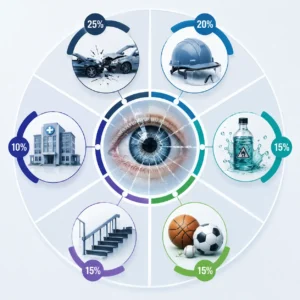
Car accidents are the leading cause of traumatic eye injuries in Washington state. Broken windshield glass cuts delicate eye tissue. Airbag deployment strikes the face hard enough to fracture orbital bones and detach retinas. Dashboard impacts during collisions on I-5, Highway 99, and I-405 drive victims into hard surfaces at fatal speed. Washington recorded 810 traffic deaths and 3,413 serious injuries in 2023 alone.
Motorcycle accidents, truck accidents, bicycle accidents, and pedestrian accidents cause severe facial and eye trauma. Riders and pedestrians lack a vehicle cabin’s protection, making eye injuries more frequent and more severe.
Workplace and Construction Accidents
About 2,000 American workers suffer job-related eye injuries every day, according to NIOSH. The Bureau of Labor Statistics recorded over 38,000 workplace eye injuries in 2021. About 40% of those occurred among craft workers like mechanics, carpenters, and plumbers. Another 20% occurred in construction.
Seattle’s building boom exposes workers to flying debris, welding flash, chemical splashes, and power tool fragments across job sites in Ballard, Capitol Hill, South Lake Union, Rainier Valley, and Northgate. Employers who fail to provide OSHA-required eye protection can be held liable through third-party claims. Construction accident and workplace injury victims may have claims beyond workers’ compensation.
Premises Liability
Property owners in Washington must keep their premises safe. Slip and fall accidents cause head and eye trauma when victims hit floors, stairs, or shelving. Broken glass from doors and windows cuts eyes and faces. Chemical exposure from improperly stored cleaning products, which cause approximately 125,000 eye injuries nationally each year, creates corneal burn risks in grocery stores, hotels, and apartment buildings.
Defective Products
Defective airbags, contaminated contact lens solutions, faulty safety goggles, and malfunctioning power tools injure eyes every year. The Takata airbag recall affected millions of vehicles and caused severe eye and facial injuries from metal shrapnel during deployment. Manufacturers, distributors, and retailers can all be held liable under Washington product liability law.
Dog Bites, Assault, Explosions, and Fire
Dog bites to the face cause corneal lacerations, orbital fractures, and permanent disfigurement, especially in children. Washington holds dog owners strictly liable under RCW 16.08.040.
Assault and intentional violence cause blunt force trauma and penetrating wounds. Victims can file civil claims regardless of criminal charges.
Industrial explosions, gas leaks, firework accidents, and structure fires cause thermal burns, chemical burns, and penetrating eye injuries. Burn injury victims often suffer eye damage alongside skin burns.
Who Can Be Held Liable for Your Eye Injury?
Washington personal injury law lets you file claims against every person or organization whose negligence caused your eye injury. Multiple parties can share responsibility. Identifying all liable parties maximizes your compensation.
Negligent drivers who cause crashes resulting in eye trauma. Their auto insurance policies cover your damages.
Employers and general contractors who fail to provide safety equipment or enforce OSHA eye protection standards. Third-party claims let workers recover beyond workers’ compensation limits.
Property owners and managers who ignore broken glass, spilled chemicals, poor lighting, and trip hazards.
Product manufacturers and distributors who sell defective airbags, safety equipment, contact lens solutions, or tools.
Dog owners who fail to control animals. Washington’s strict liability statute (RCW 16.08.040) holds owners responsible regardless of the dog’s history.
Government entities responsible for dangerous roads, defective signals, or unsafe public property. Claims against Washington state or local governments require a written claim at least 60 days before filing suit under RCW 4.96.020.
How We Prove Your Eye Injury Claim
Winning an eye injury case requires more than showing you were hurt. Your attorney must prove negligence with evidence specific to your type of injury.
Medical evidence we gather: Ophthalmology exam records, visual acuity test results, optical coherence tomography (OCT) scans, visual field testing, electroretinography (ERG) results, surgical reports, and imaging (CT, MRI). We work with treating ophthalmologists and retain independent experts when needed.
Accident evidence we collect: Police reports, workplace incident reports, surveillance footage, photos of the accident scene, witness statements, employer safety records, product recall notices, and building inspection reports.
Financial evidence we document: Medical bills and cost projections, pay stubs and tax returns showing lost income, vocational expert reports calculating future earning capacity loss, and life care plans detailing long-term treatment costs.
The four elements of negligence we prove:
- The at-fault party had a duty to act safely (drivers follow traffic laws, employers provide PPE, doctors follow medical standards).
- They breached that duty (ran a red light, skipped safety training, made a surgical error).
- The breach directly caused your eye injury (medical records and expert testimony connect the negligent act to your vision damage).
- You suffered real, measurable losses (bills, lost wages, pain, changed quality of life).
Every piece of evidence is gathered early. Insurance companies look for gaps. We make sure there are none.
What to Do After an Eye Injury in Seattle
Seek medical attention immediately. Then protect your legal rights. The steps you take in the first 24 to 48 hours after an eye injury directly affect the strength of your claim.
Get Emergency Eye Care
Go to an emergency room or urgent care if you experience:
- Sudden vision changes or complete vision loss
- Severe eye pain that does not improve
- Blood in the eye or unusual discharge
- An object lodged in or near the eye
- Chemical exposure to the eye
Seattle emergency eye care facilities:
- Harborview Medical Center (Level 1 trauma center), 325 9th Avenue
- UW Medical Center, 1959 NE Pacific Street
- Seattle Children’s Hospital (pediatric eye trauma), 4800 Sand Point Way NE
- Virginia Mason Medical Center, 1100 9th Avenue
Preserve Evidence
- Take photos of the accident scene, your injuries, and any safety hazards
- Collect names and contact information from witnesses
- Request copies of police reports, employer incident reports, or property owner records
- Save all medical records, bills, and receipts
- Do not give recorded statements to insurance companies without legal representation
Contact a Seattle Eye Injury Attorney
Insurance companies contact injury victims within hours of accidents. Their goal is a fast, low settlement before you understand the full cost of your injury. Do not sign anything. Do not accept any offer. Call 206-447-1425 for a free case review first.
Evidence disappears. Witnesses move. Memories fade. Early legal intervention protects your rights while you focus on healing.
How Long Do You Have to File an Eye Injury Claim in Washington?
Washington gives eye injury victims three years from the accident date to file a lawsuit under RCW 4.16.080. Miss this deadline and you lose your right to compensation forever.
The clock starts from:
- The accident date for most eye injury cases
- The discovery date if vision loss developed gradually and was not immediately apparent
- The child’s 18th birthday for minors injured before age 18
Exceptions that may change your deadline:
- Delayed symptoms where vision loss develops weeks or months after the accident
- Fraudulent concealment by the responsible party
- Mental incapacity preventing you from understanding your rights
- Claims against government entities require a written notice at least 60 days before filing suit (RCW 4.96.020)
Do not wait. Call for a free consultation today.
What If You Were Partly at Fault for Your Eye Injury?
You can still recover compensation. Washington follows a pure comparative negligence rule under RCW 4.22.005. Your compensation is reduced by your percentage of fault, but you are not blocked from filing.
Example: A jury finds you 20% at fault for not wearing safety glasses at a construction site. Your eye injury claim is worth $500,000. You receive $400,000.
Insurance adjusters often try to shift blame onto victims to reduce payouts. They argue you failed to wear protective eyewear, ignored safety warnings, or contributed to the accident. A Seattle eye injury attorney challenges these tactics and presents evidence that the other party’s negligence was the primary cause.
Do not let concerns about shared fault stop you from calling. We evaluate the facts and tell you where you stand. Call 206-447-1425.
Seattle Injury Lawyers Who Handle Eye Injury Cases
Elsner Law Firm has represented injured Washington residents since 2007. Attorney Justin Elsner graduated cum laude from Seattle University School of Law. He is admitted to practice before the U.S. District Court for the Western District of Washington.
Recognition and memberships:
- Super Lawyers Rising Star (2016-2017)
- National Trial Lawyers Top 40 Under 40
- Washington Association for Justice
- King County Bar Association
- Snohomish County Bar Association
How we work:
- Free consultations with no upfront costs
- Contingency fee basis: you pay nothing unless we win
- Cases handled statewide, from Seattle to Spokane
- In-person meetings at our Seattle office and virtual consultations available
Paralegal Angela Elsner provides dedicated case support. Our team includes Trisha DeHart, Lenin Torres, and additional experienced staff who build strong, detailed cases.
Seattle Area Resources for Eye Injury Victims
Medical Specialists
- UW Medicine Eye Institute, 4311 11th Avenue NE
- Seattle Eye and Laser Center (multiple locations)
- Virginia Mason Franciscan Health (retinal and corneal specialists)
- Puget Sound Eye Clinic (low vision rehabilitation)
Government Resources
- Washington State Department of Labor & Industries (workers’ compensation): www.lni.wa.gov
- King County Department of Public Health (injury prevention)
- Seattle Department of Transportation (traffic accident reporting)
- Washington State Patrol (highway accident investigations)
Support Organizations
- Washington Council of the Blind (advocacy and support)
- Lighthouse for the Blind and Visually Impaired (rehabilitation and employment)
- Seattle Public Library (accessible services)
- King County Metro Access (disabled transportation)
Frequently Asked Questions
How much compensation can you get for an eye injury?
Eye injury settlements range from $10,000 for minor corneal abrasions to over $1 million for permanent blindness. The amount depends on medical costs, lost income, pain and suffering, and long-term impact on your daily life and career. Washington state places no caps on personal injury damages.
What is considered a traumatic eye injury?
A traumatic eye injury is any damage to the eye or surrounding structures caused by an external force. This includes penetrating wounds, blunt force trauma, chemical burns, thermal burns, orbital fractures, retinal detachment, and optic nerve damage. Any eye injury requiring emergency medical treatment qualifies.
How long does an eye injury lawsuit take in Washington?
Most eye injury cases resolve within 12 to 24 months from filing. Complex cases involving severe injuries or multiple liable parties can take longer. Settlement negotiations happen throughout the process. Many cases resolve without going to trial.
Does Elsner Law Firm handle eye injuries caused by surgical errors?
No. Injuries caused by a surgeon or other healthcare provider fall under medical malpractice, which is not an area of law we practice. Elsner Law Firm focuses on accident-related eye injuries: car accidents, premises liability, defective products, dog attacks, and third-party workplace incidents. If a medical provider caused your vision damage, we recommend contacting a firm that specializes in that area.
Who is liable for a workplace eye injury in Washington?
Workers’ compensation covers medical bills and partial lost wages from your employer. If a third party caused your injury (a subcontractor, equipment manufacturer, or property owner), you can file a separate personal injury claim for full damages including pain and suffering, which workers’ comp does not cover.
Can I file a claim if my child suffered an eye injury?
Yes. Parents or legal guardians file personal injury claims on behalf of minors in Washington state. The statute of limitations does not start until the child turns 18, giving them until age 21 to file. Children suffer eye injuries at playgrounds, schools, sports events, and in car accidents.
What is the average eye injury settlement in Washington?
There is no single average. Minor injuries may settle for $10,000 to $50,000. Moderate injuries requiring surgery may reach $100,000 to $500,000. Permanent vision loss or blindness claims can exceed $1 million. Your case value depends on your age, career, medical costs, and overall life impact.
How does comparative fault affect my eye injury claim?
Washington’s pure comparative negligence rule (RCW 4.22.005) reduces your compensation by your percentage of fault but does not eliminate your claim. Even at 50% or more fault, you can still recover a portion of your damages.
Can I sue a government entity for my eye injury in Seattle?
Yes. If a dangerous road, defective traffic signal, or unsafe public property caused your eye injury, you can file a claim against the responsible government entity. Washington law (RCW 4.96.020) requires a written notice at least 60 days before filing the lawsuit.
What are hedonic damages in an eye injury case?
Hedonic damages compensate you for losing the ability to enjoy activities that gave your life meaning. Reading, driving, hiking, watching your children play, doing your hobbies. If your eye injury took those from you, hedonic damages are part of your claim in Washington.
What if a dog bite caused my eye injury?
Washington holds dog owners strictly liable for bite injuries under RCW 16.08.040. You do not need to prove the owner knew the dog was dangerous. If a dog bite caused corneal damage, orbital fractures, or other eye injuries, the owner is responsible for all your damages.
What if my eye injury was caused by a defective product?
Defective product injuries allow claims against manufacturers, distributors, and retailers under Washington product liability law. Defective airbags, contaminated contact lens solutions, faulty safety goggles, and malfunctioning power tools are common causes.
Can vision loss from an injury be restored?
Some vision loss improves with surgery, medication, or therapy. Corneal transplants, retinal reattachment surgery, and vitreous removal can restore partial vision in certain cases. Other injuries, especially optic nerve damage and severe retinal detachment, cause permanent blindness that treatment cannot reverse.
How much compensation for loss of an eye?
Complete loss of one eye often results in compensation exceeding $500,000 to $1,500,000 when you account for medical costs, prosthetic eye expenses (replacement every 3 to 5 years), lost earning capacity, pain and suffering, and lifetime adaptation costs.
What not to say to an insurance company after an eye injury?
Do not admit fault. Do not minimize your symptoms. Do not say “I’m fine” or “it’s getting better” before your treatment is complete. Do not give recorded statements without an attorney present. Insurance adjusters use your words to reduce your settlement.
Do I need surgery for a traumatic eye injury?
Many traumatic eye injuries require surgery, but not all. Retinal detachment, globe rupture, severe orbital fractures, and penetrating wounds typically need surgical repair. Corneal abrasions and mild hyphema may heal with medication and monitoring. Your ophthalmologist determines the treatment path.
How much vision loss qualifies for disability?
Social Security defines legal blindness as visual acuity of 20/200 or worse in the better eye with correction, or a visual field of 20 degrees or less. Significant visual field restrictions and inability to perform substantial gainful activity due to vision loss may also qualify.
Contact Our Seattle Eye Injury Attorneys Today
Your vision is not something you can afford to gamble with. Insurance companies want to close your case fast and pay as little as possible. We want to make sure you get every dollar your injury demands.
Since 2007, Elsner Law Firm has protected the rights of injured Washington residents. We built our reputation on personal attention, thorough preparation, and aggressive advocacy for full compensation. Your first consultation costs nothing. We only get paid when you win. We handle eye injury cases throughout Washington state, from Seattle’s downtown to Spokane and every community in between.
Call 206-447-1425 for your free case review. You can also visit our office at 2130 Westlake Ave N, #3, Seattle, WA 98109.
An experienced Seattle eye injury lawyer is ready to review your case today.