CALL US NOW
 TEXT US NOW
Why Seattle negligent security victims call Elsner Law Firm
Security failure review for lighting, locks, gates, cameras, warning signs, prior incidents, staffing, access control, and property-management records.
Property-owner pushback support when insurers argue the incident was unforeseeable, blame the victim, or deny the owner had notice of the danger.
Evidence preservation guidance for police reports, surveillance video, witness accounts, photos, incident reports, medical care, and wage-loss documentation.
Washington personal injury focus for people hurt because apartments, businesses, parking lots, hotels, or public-facing properties failed to provide reasonable security.
Free case review by phone at 206-447-1425.
Seattle recorded 5,891 violent crimes in 2024, according to FBI data. That includes 3,810 aggravated assaults, 1,677 robberies, and 352 rapes. The city ranked 4th among the 30 largest U.S. cities for total crime, with a violent crime rate of 775 per 100,000 residents, nearly double the national average of 359.
Many of these crimes happened on properties where security should have been in place. Parking garages. Apartment hallways. Hotel rooms. Bar parking lots. If you were assaulted, robbed, or sexually attacked on someone else’s property in Seattle, King County, or anywhere in Washington State, the property owner may owe you compensation.
A negligent security claim targets the property owner who failed to protect you. Not the attacker. The property owner and their insurance company.
Evidence in these cases has a short shelf life. Surveillance footage gets overwritten within 24 to 72 hours. Incident logs disappear. Security companies alter records. Witnesses relocate. The property owner’s insurer starts building a defense before you leave the hospital.
Elsner Law Firm represents negligent security victims across Seattle, Bellevue, Tacoma, and throughout the Puget Sound region. We work on a contingency fee basis. You pay nothing unless we recover money for you.
Call 206-447-1425 for a free case review. The consultation costs you nothing.
What To Do Right After a Negligent Security Attack in Seattle
Your safety comes first. But the steps you take in the next 24 to 48 hours will determine whether your claim has strong evidence or weak evidence.
Get Medical Treatment and Document Everything
Call 911 or go to an emergency room immediately. Many injuries from violent assaults do not show symptoms right away. Traumatic brain injuries, internal bleeding, and spinal damage can worsen without prompt treatment.
Harborview Medical Center is the region’s only Level I adult and pediatric trauma center. UW Medical Center, Swedish Medical Center, and Virginia Mason Medical Center also handle emergency trauma care in Seattle.
Keep every medical record, bill, prescription, and treatment note. Photograph your injuries at every stage of healing. Follow every recommended treatment plan. Gaps in treatment give insurance companies a reason to argue your injuries were not serious.
File a Police Report Immediately
Report the crime to the Seattle Police Department the same day. A police report creates the official record that anchors your negligent security claim. Get the report number and request a copy.
Preserve the Scene and Demand Footage
If it is safe, photograph the scene before leaving. Broken locks, dark areas where lights should work, missing cameras, propped-open doors, unmarked exits. Note the exact time, date, and location on the property.
Contact a Seattle negligent security attorney immediately. Your lawyer can send a spoliation letter to the property owner within hours, demanding that all surveillance footage, incident reports, maintenance records, and security staffing schedules be preserved. Without this letter, that footage may be gone by the time you need it.
Collect Witness Information
Get names and phone numbers from anyone who saw the attack or the security conditions. Witnesses who describe broken cameras, absent guards, or dark walkways provide powerful evidence.
Do not give recorded statements to the property owner’s insurance company before talking to your attorney.
Have questions? Call Elsner Law Firm at 206-447-1425 for a free case review.

What Is Negligent Security Under Washington Law
Negligent security is a category of premises liability. It applies when a property owner fails to provide reasonable security measures and that failure allows a foreseeable criminal act to harm someone on the property.
Under Washington law, property owners owe a duty of care to lawful visitors. They must take the same steps a reasonable person would take to protect tenants, customers, guests, and visitors from criminal activity that could be predicted based on location, property type, and crime history.
Four elements make a valid negligent security claim in Washington:
- The property owner owed you a duty of care
- The property owner breached that duty through inadequate security
- That breach directly caused or enabled the criminal act that harmed you
- You suffered real, measurable injuries and losses
Property owners cannot guarantee absolute safety. But they must take reasonable precautions that match the risk. When they skip those precautions, they can be held financially responsible under Washington premises liability law.
Common Security Failures That Create Liability
- Broken or missing lighting in parking areas, stairwells, hallways, and walkways
- Faulty or absent locks on doors, windows, and gates
- Non-functioning security cameras or zero video surveillance
- No security guards or inadequate staffing in high-risk areas
- Broken fences, gates, or access control systems
- Missing or non-functional keycard readers and entry systems
- Broken alarm systems or emergency call boxes
- No background checks on employees with access to tenant spaces
- Ignoring known security risks after prior incidents
Negligent Security vs. General Premises Liability
Both involve a property owner’s failure to maintain safe conditions. The difference is the source of harm.
In general premises liability, the danger is physical: a wet floor, a broken handrail, a crumbling staircase. In negligent security, the danger is the absence of protection against criminal activity. The harm comes from a third party’s criminal act enabled by the property owner’s security failures.
This distinction matters because negligent security requires an additional proof burden: foreseeability of criminal activity. You must show the property owner knew or should have known about the crime risk and failed to act.

Who Can You Sue for Negligent Security in Washington
Liability in negligent security cases can extend well beyond the property owner.
Property Owners and Landlords
Apartment complex owners, commercial building owners, hotel operators, and retail property owners carry the primary duty. A landlord who owns a building in South Seattle or a retail plaza in Tukwila must maintain working locks, lighting, cameras, and other security measures appropriate for the area’s crime risk.
Property Management Companies
If a management company was responsible for building security and failed to maintain it, they share liability. This is common in large apartment complexes and condominium buildings across the Puget Sound region.
Security Companies
When a property owner contracts with a private security firm and that firm fails to perform, the security company can be held liable. This includes situations where guards were absent, poorly trained, or negligent in responding to threats.
Employers
Bureau of Justice Statistics data shows that roughly 18% of all violent crimes happen at the workplace. If an employee is assaulted at work because the employer failed to provide adequate security, the employer may face a negligent security claim separate from workers’ compensation.
Bars, Nightclubs, and Alcohol-Serving Establishments
Under Washington’s dram shop liability rules, an establishment that over-serves a patron who then assaults someone may share liability. The establishment also bears responsibility for bouncers, crowd management, and parking lot security.
Parent Companies and Franchise Operators
A national hotel chain or franchise restaurant may bear liability for negligent security at a local Seattle or Bellevue location if corporate policies dictated inadequate security standards or failed to enforce minimum safety requirements.
If you are unsure who is responsible, call 206-447-1425. We investigate every potential source of liability.
Your Civil Claim vs. the Criminal Case
Many victims assume the criminal case against the attacker handles everything. It does not.
Criminal case: Brought by the State of Washington against the attacker. Focuses on punishment (prison, fines, probation). You have no control over it. You receive no direct compensation from it.
Civil negligent security claim: Brought by you against the property owner. Focuses on your financial losses: medical bills, lost wages, pain and suffering, emotional trauma. You control this claim with your attorney.
Key facts:
- Your civil claim can succeed even if the attacker is never caught or convicted
- Criminal cases require proof “beyond a reasonable doubt.” Civil cases require only a “preponderance of the evidence” (more likely than not). Lower bar.
- You are seeking money from the property owner and their insurer, not the attacker
- Both the criminal case and civil claim can run at the same time
Damages and Compensation for Seattle Negligent Security Victims
Washington State does not cap non-economic damages in personal injury cases. This means there is no statutory limit on what a jury can award for pain, suffering, and emotional trauma.
Economic Damages
- Emergency room visits, hospital stays, surgery costs
- Ongoing medical treatment, prescriptions, physical therapy
- Psychological counseling and mental health treatment
- Lost wages during recovery and future lost earning capacity
- Stolen or damaged property value
- Home modifications and assistive devices for permanent disabilities
- Future medical expenses projected across your lifetime
Non-Economic Damages
- Physical pain and suffering
- PTSD, anxiety, depression, and emotional distress
- Loss of enjoyment of life and daily activities
- Scarring, disfigurement, and permanent disability
- Loss of consortium (impact on your marriage/partnership)
- Fear of returning to similar locations and social isolation
Wrongful Death Damages
When a negligent security attack results in death, the victim’s family can file a wrongful death lawsuit. Recoverable damages include funeral costs, loss of financial support, loss of companionship, and emotional suffering of surviving family members. Contact our wrongful death attorneys to discuss your family’s options.
What Are Negligent Security Cases Worth?
Settlement and verdict values depend on injury severity, the strength of foreseeability evidence, and the number of prior incidents at the property. Here are general ranges based on publicly reported national data:
- Moderate assault injuries (bruises, cuts, short-term emotional distress): $55,000 to $250,000
- Serious injuries (traumatic brain injury, broken bones, spinal cord damage): $250,000 to $1,000,000+
- Sexual assault cases: $500,000 to several million dollars
- Wrongful death / fatal attacks: Multi-million dollar verdicts have been reported nationally, including a $21.25 million settlement for a fatal shooting in a retailer’s parking lot and a $21 million verdict against an apartment complex after a deadly carjacking
Every case is different. The best way to understand what your claim may be worth is to speak with a Seattle negligent security attorney who can evaluate your specific facts.
Call 206-447-1425 for a free, confidential case evaluation.
Negligent Security by Property Type in Seattle
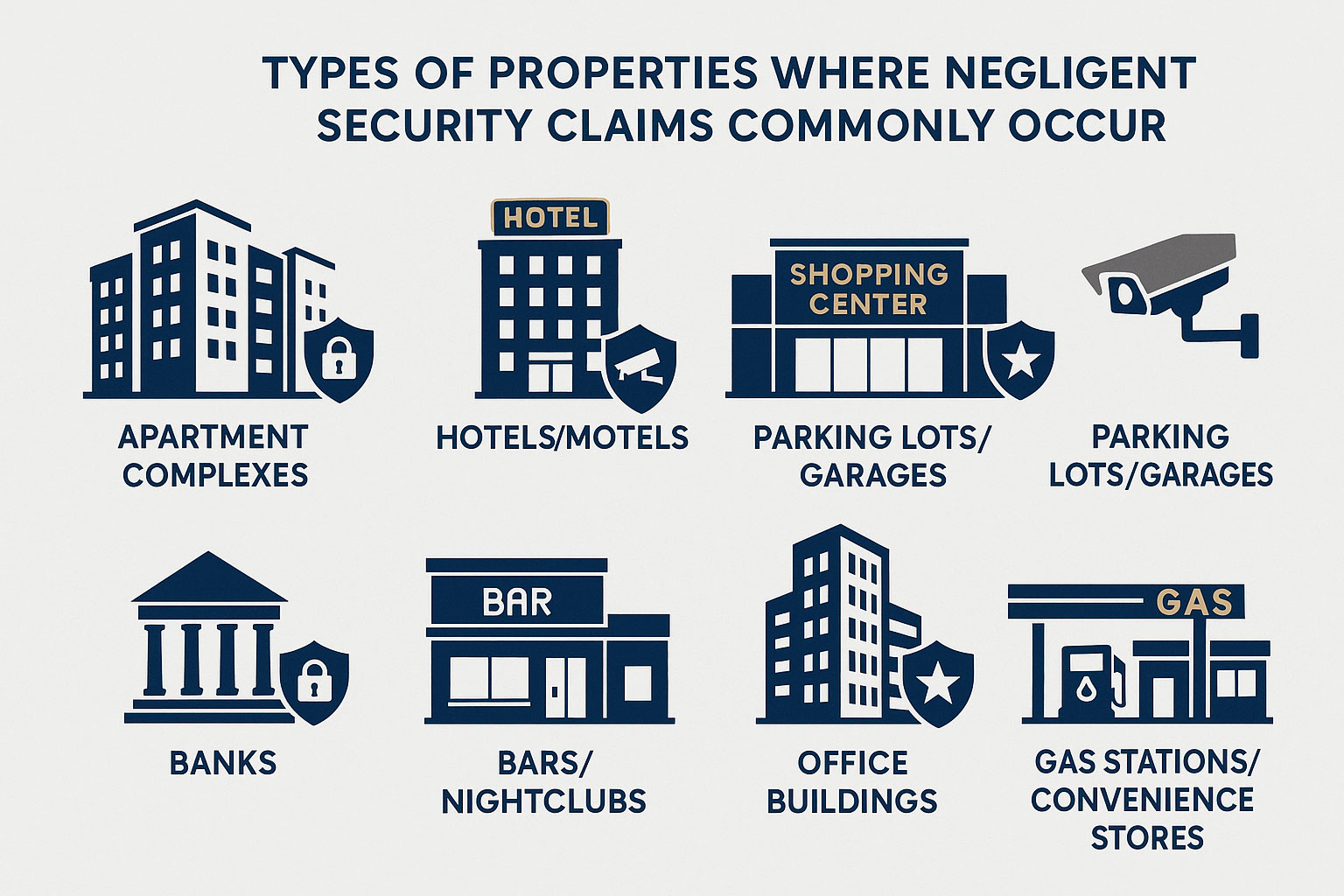
Different property types carry different security expectations and different crime patterns.
Apartment Complexes and Residential Buildings
About 66% of all property crimes occur at residential properties, according to FBI data. Apartment tenants in Seattle, Bellevue, Kent, and across King County rely on landlords for working door locks, keycard entry, security cameras in common areas, adequate hallway and parking garage lighting, and controlled building access. When landlords ignore broken locks, skip camera maintenance, or refuse to install security after prior break-ins, tenants who are assaulted or robbed may have a strong negligent security claim.
Parking Lots and Garages
FBI data shows that 7 to 10% of all violent crimes in the United States occur in parking facilities. Parking lots are the third most common location for violent crime nationwide, behind only private residences and streets. More than 130,000 crimes against persons occurred in parking lots and garages in a single reporting year (FBI, 2021). The National Crime Victimization Survey reports that 1 in 10 property crimes happen in parking facilities. Poor lighting, no surveillance cameras, and zero security patrols create conditions for carjacking, robbery, assault, and sexual attacks.
Hotels and Motels
Hotel guests are in unfamiliar surroundings, often carrying valuables, and trusting the property to control who enters. Working room locks, functional deadbolts, security cameras in hallways, controlled elevator access, and trained front desk staff are baseline expectations. When a hotel fails to maintain these and a guest is attacked, the hotel owner faces liability.
Bars, Nightclubs, and Restaurants
Trained security staff, proper crowd management, ID verification, surveillance systems, and well-lit parking areas are industry standard. Assaults in Seattle bars frequently produce negligent security claims when the establishment failed to provide adequate staffing or intervention.
Convenience Stores and Gas Stations
Late-night convenience stores and gas stations are frequent robbery targets. Security cameras, bright lighting, cash-handling procedures, panic buttons, and security barriers are expected, particularly at locations with prior incident history.
Schools, Campuses, and Public Transit Stations
Students and transit riders expect controlled access, cameras, emergency notification systems, and security presence. When a campus or transit facility fails to address known threats and someone is assaulted, the institution or agency may be liable. Claims against government-operated properties have shorter filing deadlines (discussed below).
Types of Crimes and Injuries in Seattle Negligent Security Cases
Violent Crimes Caused by Security Failures
- Physical assault and battery
- Sexual assault and rape
- Armed robbery and theft
- Carjacking in parking areas
- Home invasion in residential buildings
- Shootings and stabbings
- Gang-related violence
- Murder and homicide
In 2024, Seattle recorded 3,810 aggravated assaults, 1,677 robberies, and 352 rapes. Many of these occurred at properties where stronger security could have prevented or deterred the crime.
Physical Injuries
- Traumatic brain injury from assaults
- Spinal cord injuries causing paralysis or loss of function
- Broken bones and fractures
- Stab wounds, lacerations, and gunshot wounds
- Burn injuries from arson-related incidents
- Scarring, disfigurement, and permanent disability requiring assistive devices and long-term physical therapy
PTSD and Emotional Trauma
- Post-traumatic stress disorder with flashbacks and hypervigilance
- Anxiety and panic disorders
- Depression and mood disorders
- Sleep disturbances, nightmares, and insomnia
- Fear of returning to public spaces
- Social isolation and relationship difficulties
These conditions require professional psychological counseling and may persist for years. Under Washington law, emotional trauma is fully compensable as non-economic damages.
How To Prove a Negligent Security Case in Washington
Four elements: duty, breach, causation, and damages.
The Property Owner’s Duty of Care
Under Washington premises liability law, property owners must provide reasonable security for lawful visitors. Business customers, hotel guests, apartment tenants, and invited visitors are owed the highest level of protection. This duty includes adequate lighting, functional locks, working cameras, trained security personnel when risk demands it, and regular inspections for vulnerabilities.
Foreseeability: The Pivotal Element
You must show the property owner knew or should have known about the risk. Evidence includes:
- Prior crimes on or near the property (police reports, incident logs)
- Seattle Police Department crime statistics for the neighborhood
- Tenant or customer complaints about security concerns
- Industry-specific risk factors (late-night operation, cash-heavy business, high-traffic area)
- The property’s location in a known high-crime area of Seattle or King County
If similar crimes happened at the property before your incident, the owner was on notice. Ignoring that notice is a breach.
Demonstrating the Security Breach
Your attorney presents evidence of what was missing or broken:
- Maintenance records showing unrepaired cameras, lights, or locks
- Security contracts revealing staffing gaps
- Property inspection reports showing known hazards
- Expert witness testimony on industry security standards
The discovery process is critical. Your attorney can subpoena maintenance records, security contracts, incident reports, employee hiring files, and internal communications that reveal the property owner’s knowledge of risk and their failure to act.
Connecting the Breach to Your Injuries
You must prove that adequate security would have prevented or deterred the attack. Expert witnesses testify about how specific security measures reduce crime and how their absence created the conditions for the criminal act.
Washington State Laws and Deadlines
Three-Year Statute of Limitations: RCW 4.16.080
Under RCW 4.16.080, you have three years from the date of the incident to file a negligent security lawsuit. The same deadline applies to wrongful death claims.
Evidence disappears. Witnesses forget. Footage gets erased. Contact an attorney as soon as possible.
Comparative Fault: RCW 4.22.005
Washington uses pure comparative negligence under RCW 4.22.005. Your compensation is reduced by your percentage of fault, but you can still recover.
Example: A jury finds you 25% at fault and awards $200,000. Your recovery is reduced by 25% to $150,000. The property owner still pays.
Insurance companies routinely argue the victim should have been more aware or should have avoided the area. Your attorney’s job is to counter these arguments and keep focus on the property owner’s failures.
Claims Against Government Properties
When an incident occurs on government-owned property (public transit station, government building, public park), special rules apply. You must typically file a formal claim with the government agency before filing a lawsuit. The deadline for this initial claim is much shorter than the standard three-year statute of limitations. If your incident happened on public property, contact an attorney immediately.
Filing in King County Superior Court
Cases in Seattle are typically filed in King County Superior Court. Cases in Bellevue, Tacoma, or other areas may be filed in the corresponding county. Your attorney handles all filings, discovery, depositions, and trial preparation.
Questions about deadlines? Call 206-447-1425 now.
How Elsner Law Firm Handles Your Case
Our Approach
We move fast to protect evidence:
- Sending spoliation letters within hours to preserve surveillance footage, incident reports, and security records
- Pulling police reports and neighborhood crime statistics
- Interviewing witnesses and documenting accounts while memory is fresh
- Retaining security industry experts to establish what measures should have been in place
- Subpoenaing maintenance records, security contracts, staffing schedules, and internal communications through discovery
Insurance Company Tactics We Counter
Property owner insurers argue the attack was unforeseeable, blame the victim, dispute injury severity, and delay the process hoping you accept a low offer. We know these tactics. We counter them with evidence, expert testimony, and firm negotiation. We do not accept lowball offers.
Trial-Ready Preparation
We prepare every case as if it will go to trial. Insurance companies know this, and it produces stronger settlement offers. When negotiations fail, we take your case to a King County Superior Court jury.
The Timeline
Most negligent security cases resolve within 6 months to 2 years, depending on injury severity, liability complexity, and whether settlement or trial is needed.
Why Clients Trust Elsner Law Firm
Attorney Justin Elsner founded Elsner Law Firm in 2007. He graduated cum laude from Seattle University School of Law. He is admitted to the Washington State Bar Association and the Western District Federal Court. Our team brings decades of combined personal injury experience to negligent security, premises liability, catastrophic injury, and workplace injury cases.
We serve clients in Seattle, King County, Bellevue, Tacoma, South Seattle, North Seattle, Tukwila, and throughout Washington State.
We work on a contingency fee basis. You pay zero upfront and zero attorney fees unless we win.
Frequently Asked Questions
What is the difference between a negligent security civil claim and a criminal case?
A criminal case is brought by the state against the attacker. A civil negligent security claim is brought by you against the property owner. You can pursue both simultaneously. Your civil claim can succeed even if the criminal case does not result in a conviction.
How long do I have to file a negligent security claim in Washington?
Three years from the date of the incident under RCW 4.16.080. Claims against government entities may have shorter deadlines. Contact an attorney as soon as possible.
Can I sue my landlord for an assault at my apartment in Seattle?
Yes. If your landlord failed to maintain adequate security (working locks, lighting, cameras, access control) and that failure allowed the assault to happen, you may have a valid claim.
What if I was partially at fault?
Washington’s comparative negligence law (RCW 4.22.005) allows you to recover compensation even with partial fault. A 20% fault finding on a $100,000 award means you receive $80,000.
How much does a negligent security lawyer cost?
Elsner Law Firm works on contingency. Zero upfront costs. Zero fees unless we win.
How much is a negligent security settlement worth?
Values range widely. Moderate assault injuries typically settle between $55,000 and $250,000. Serious injuries involving TBI or spinal damage can exceed $1 million. Sexual assault and wrongful death cases have produced multi-million dollar verdicts nationally.
Can I sue if the attacker was never caught?
Yes. Your claim is against the property owner for inadequate security. It does not depend on identifying, catching, or convicting the attacker.
What evidence do I need?
Police reports, medical records, photographs of security failures, witness statements, surveillance footage, prior incident reports, and the property owner’s maintenance and security records.
What is the difference between negligent security and premises liability?
Negligent security is a type of premises liability. General premises liability involves physical hazards on the property. Negligent security involves the absence of protection against foreseeable criminal acts.
Can I file a claim for a hotel assault?
Yes. Hotels owe guests a duty to maintain working locks, cameras, controlled access, and trained staff. Failure in these duties creates liability.
Does prior crime at the property strengthen my case?
Significantly. Prior incidents are some of the strongest evidence of foreseeability. If the property owner knew about past crimes and did nothing, your claim is stronger.
What if the property owner has no insurance?
The owner is still personally liable. Your attorney investigates assets and identifies other defendants (management companies, security firms) for additional recovery sources.
Contact Elsner Law Firm for Your Free Case Review
Evidence is disappearing right now. Surveillance footage gets overwritten within days. Witnesses relocate. Security records get altered. Every day you wait weakens your case.
Call 206-447-1425 today. Our Seattle negligent security lawyers will review your situation at no cost, explain your legal options, and fight to recover the compensation you need.
You pay nothing unless we win. We serve clients throughout Seattle, King County, Bellevue, Tacoma, South Seattle, North Seattle, Tukwila, and all of Washington State.
Call 206-447-1425 for your free case review
Elsner Law Firm | 2130 Westlake Ave N, #3, Seattle, WA 98109 | Seattle, King County, Bellevue, Tacoma, Washington State