CALL US NOW
 TEXT US NOW
How Long Does a Rideshare Settlement Take in Washington?
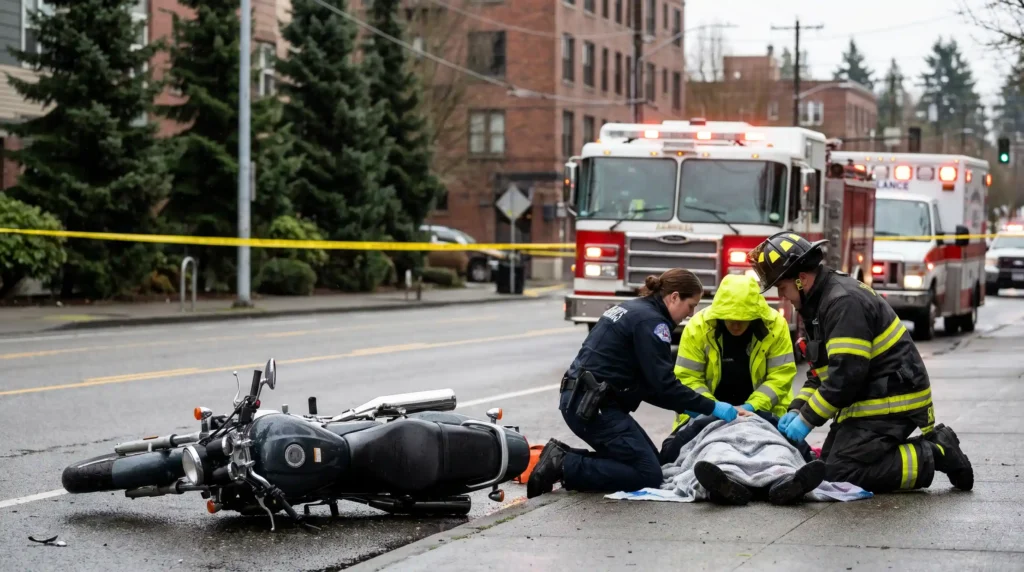
If an Uber or Lyft crash left you hurt in Seattle or anywhere else in Washington, one question probably keeps coming up: how long until this is over? The honest answer is that it depends on your injuries, who is at fault, and which insurance policy applies. But there is a real, predictable process behind every Washington rideshare accident settlement, and knowing it can help you plan your recovery instead of guessing at it.
Below, we walk through the average Washington rideshare accident settlement timeline, the state laws that control your claim, and the factors that speed a case up or slow it down.
Uber and Lyft Accidents Are More Common Than You Might Think
Rideshare travel has grown fast in Washington, and with more trips comes more crash exposure. Nationally, Uber’s own 2021-2022 U.S. Safety Report recorded 153 traffic fatalities across roughly 1.8 billion rides, a 51 percent jump from the 101 fatalities logged in the 2019-2020 report. On the safety side, Uber’s crash data put its fatal accident rate at 0.87 per 100 million vehicle miles in 2022, below the national rate of roughly 1.35, a comparison drawn from NHTSA figures.
Those numbers matter because most rideshare crashes are ordinary fender-benders, whiplash, and rear-end collisions, the exact kind of case where an insurance company will try to move fast, pay little, and close the file before you understand what your claim is worth. A rideshare accident settlement in Washington is rarely just about the crash. It is about proving fault, documenting injuries, and dealing with a layered insurance structure that is different from a normal car accident claim.
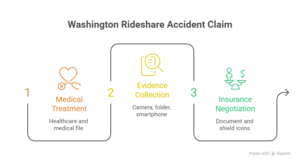
The Washington Rideshare Accident Settlement Timeline, Step by Step
Every case moves through the same basic phases. How long each phase takes depends on your injuries and how much the insurance company wants to fight.
1. Medical Treatment and Reaching Maximum Medical Improvement (MMI)
Settlement negotiations do not usually start until you finish treatment or reach maximum medical improvement, the point where your doctor says you have recovered as much as you are going to. This step alone can take anywhere from a few weeks for minor soft tissue injuries to a year or more for spinal injuries, surgeries, or permanent impairment. Settling too early, before the full extent of your injury is clear, is one of the most common mistakes accident victims make.
2. Investigation and Evidence Collection
While you are treating, your attorney should be gathering the police report, medical records, witness statements, driver app data, and, if needed, an accident reconstruction. This is also when your legal team confirms which rideshare insurance period applies, since that decision drives how much money is actually available to settle your claim.
3. Demand Letter and Insurance Negotiation
Once your damages are documented, your attorney sends a demand letter to the applicable insurance carrier. Washington regulators require insurers to acknowledge a new claim within 10 working days and to accept or deny it within 15 days of receiving proof of loss, but a full response with a fair number usually takes longer, especially on higher-value rideshare claims. National data on personal injury claims shows that cases resolved before a lawsuit is filed typically settle in about 3 to 6 months, while claims needing more back-and-forth commonly take 6 to 18 months.
4. Litigation, If Negotiations Stall
If the insurer will not offer a fair number, your attorney can file a lawsuit before Washington’s three-year statute of limitations runs out. Filing a lawsuit does not necessarily mean going to trial. Bureau of Justice Statistics data shows that only about 4 to 5 percent of personal injury cases nationally ever reach a trial verdict; the other 95 percent or so settle first, often once the case is fully prepared for court. Litigated Washington rideshare accident claims commonly take 12 to 24 months to resolve, and cases that do go all the way to trial can run 1 to 3 years or longer from the date of the crash.
Why Washington’s Rideshare Insurance Law Changes Your Timeline
Washington regulates Uber and Lyft insurance coverage under RCW 46.72B.180 and RCW 48.177, and the coverage available at the moment of your crash depends entirely on the driver’s status in the app.
- App off: The driver’s personal auto policy applies, just like a standard car accident.
- App on, waiting for a ride (Period 1): Washington law requires a minimum of $50,000 per person and $100,000 per accident in liability coverage, plus $30,000 in property damage coverage.
- Ride accepted or passenger onboard (Periods 2 and 3): Washington law requires the rideshare company’s policy to provide $1,000,000 in combined single-limit liability coverage, along with underinsured motorist coverage of $100,000 per person and $300,000 per accident, running from the moment you get in the vehicle until you get out.
A $1 million policy period usually means a slower, more contested negotiation, because the insurer has far more at stake and will scrutinize the claim more closely. A Period 1 claim, on the other hand, may move faster simply because the available coverage is lower and easier for an adjuster to evaluate. Either way, sorting out which period applies is often the first fight in a Washington rideshare case, and it can add weeks to the front end of your claim if the rideshare company or its insurer disputes the driver’s app status.
What Speeds Up or Slows Down Your Settlement
Several factors shift a Washington rideshare accident claim faster or slower than average:
Speeds things up:
- Clear liability with no dispute over who caused the crash
- Complete medical records showing a defined treatment period
- A cooperative insurance adjuster and a policy limit large enough to cover the claim
- An attorney who submits a well-documented demand instead of a rushed one
Slows things down:
- Disputes over which insurance period applies (Period 1 versus Period 2/3)
- Serious or long-term injuries that take longer to reach MMI
- Comparative fault disputes over who caused the crash
- Multiple defendants, such as the rideshare driver, another motorist, or a third party
- An insurer that denies liability and forces litigation
Washington’s Comparative Fault Rule and Your Settlement
Washington follows a pure comparative negligence rule under RCW 4.22.005. That means your compensation is reduced by your percentage of fault, but you are never barred from recovering money, even if you are found up to 99 percent at fault for the crash. In practice, this means insurance companies frequently try to shift blame onto the injured passenger or another driver to lower their payout. Disputes over fault percentage are one of the biggest reasons a rideshare settlement in Washington takes longer than expected, since both sides often need more time, and sometimes more evidence, to agree on a fair split.
How Much Is a Washington Rideshare Accident Case Worth?
Every case is different, but industry data gives a useful baseline. The Insurance Research Council has found that injury victims who hire an attorney recover substantially more than those who negotiate alone, with represented claimants netting far more even after paying standard contingency fees. Unrepresented claimants also tend to accept the insurer’s first offer far more often, even though that offer is typically well below the claim’s fair value.
Settlement value in a Washington rideshare case depends on:
- Medical expenses, both past and future
- Lost wages and loss of earning capacity
- Pain and suffering and emotional distress
- Property damage
- Permanent disability or long-term impairment
- Which insurance period applies, since a $1 million Period 2/3 policy allows for a much higher ceiling than a Period 1 claim
The Statute of Limitations for Washington Rideshare Claims
Under RCW 4.16.080, you generally have three years from the date of the crash to file a personal injury lawsuit in Washington. This deadline applies whether you are still negotiating with the insurance company or not. Settlement talks do not pause the clock, and insurance adjusters sometimes slow-walk negotiations hoping the deadline passes. If you wait too long to get legal help, you can lose your right to sue entirely, even if your claim was otherwise strong.
Why a Washington Rideshare Accident Lawyer Can Move Your Case Faster
A well-prepared claim moves through insurance review faster than one an adjuster can pick apart. That is the core reason legal representation tends to shorten the practical timeline even when it does not change the legal deadlines.
Elsner Law Firm has focused exclusively on Washington personal injury law for more than 17 years, which means the firm’s day-to-day work is built around this state’s comparative negligence rule, its rideshare insurance statutes, and its court procedures, not a generic multi-state playbook. Every case is prepared as if it is going to trial from day one, which puts pressure on insurance companies to offer a fair number instead of a lowball figure. Clients have received settlements as high as six times the insurer’s initial offer, and firm data aligns with the broader industry pattern showing injury victims with legal representation recover substantially more than those without.
Other parts of how the firm works can also keep a claim moving:
- Free consultations, available 24/7 by phone, text, or online scheduling, with in-person, virtual, or home-visit options
- No upfront cost. The firm works on contingency and advances case expenses, so there is nothing to pay unless you win
- A network of medical experts, accident reconstruction specialists, and vocational experts who can strengthen your case and support a faster, better-documented demand
- Four Washington offices in Seattle, Brier, Ellensburg, and Pullman, giving the firm local knowledge of regional courts, insurers, and traffic patterns across the state
- Culturally responsive representation, including dedicated support for Hispanic clients and their families
Frequently Asked Questions
How long does an Uber accident claim take in Washington?
Most straightforward Washington rideshare claims settle in 3 to 6 months before a lawsuit is filed. Claims that require litigation typically take 12 to 24 months, and cases that go to trial can take 1 to 3 years or more.
How long does a Lyft accident settlement take in Washington?
The timeline is essentially the same as an Uber claim. What matters most is which insurance period applies, the severity of your injuries, and whether liability is disputed, not which rideshare company was involved.
Does filing an insurance claim pause Washington’s statute of limitations?
No. Only filing a lawsuit protects your right to sue. Under RCW 4.16.080, you generally have three years from the date of the crash, regardless of ongoing settlement talks.
What if I was partly at fault for the rideshare accident?
Washington’s pure comparative negligence rule under RCW 4.22.005 still allows you to recover compensation, reduced by your percentage of fault, even if you were mostly responsible for the crash.
Talk to a Seattle Rideshare Accident Lawyer Today
If you were hurt in an Uber or Lyft accident in Washington, the clock on your claim is already running, even if the insurance company is in no hurry. Elsner Law Firm offers free, 24/7 case evaluations and does not charge any fees unless you recover compensation.
Elsner Law Firm 2130 Westlake Ave N #3, Seattle, WA 98109 Phone: 206-447-1425