CALL US NOW
 TEXT US NOW
Bellevue Pedestrian Accident Lawyer
You were crossing NE 6th St near Bellevue Downtown Station. The walk signal was on. A driver turning right never slowed down. Now you have a broken leg, a stack of hospital bills and a phone that keeps ringing. The insurance adjuster wants a recorded statement. They also hint that you stepped into the crosswalk too early.
That’s how many pedestrian claims start. You did nothing but walk, and the other side is already building a story. You may be missing work. You may not own a car, so you have no car insurance of your own. Or the driver who hit you simply drove off.
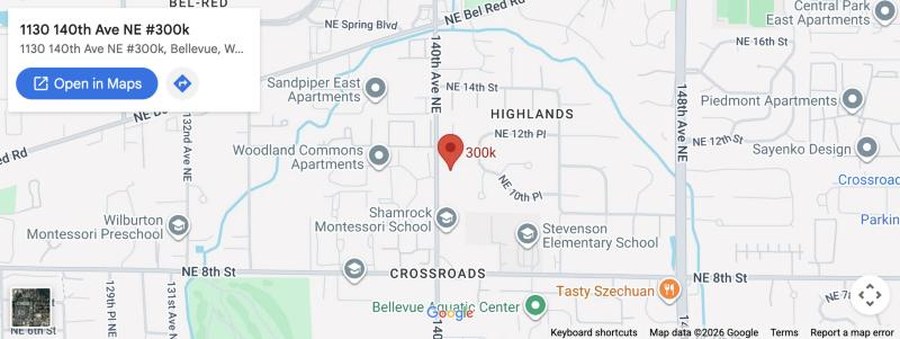
Elsner Law Firm, PLLC helps people hit by a car while walking in Bellevue. We’ve guided people through Washington injury claims since 2007. Our Bellevue office is at 1130 140th Ave NE, Suite 300K, Bellevue, WA 98005. Justin and his team guide you from the crash to getting back to normal life.
We can’t promise a result. We can promise a plan. We find every insurance policy that might pay. We answer the fault story with evidence. And we handle the insurers so you can focus on healing.
Talk to a Bellevue pedestrian accident attorney about what happened. Call (425) 409-0305 for a free consultation. There’s no fee until we recover money for you. To see how we help across the Eastside, visit our Bellevue personal injury lawyer page.
Who Has the Right-of-Way? Washington Pedestrian Laws in Plain Words
In most crosswalks, the driver has to stop for you. Washington law gives pedestrians the right-of-way in marked and unmarked crosswalks and puts a duty of care on every driver. The insurer will still look for any rule you might have missed.
Drivers must stop at crosswalks. A driver must stop and stay stopped for a pedestrian in a marked or unmarked crosswalk. That applies when you are on the driver’s half of the road, or within one lane of it. It includes the road a driver is turning onto (RCW 46.61.235(1)). What’s an unmarked crosswalk? Under RCW 46.04.160, most intersections have one, even with no paint on the road.
No passing a stopped car. When a car stops for a pedestrian, the drivers behind it may not pass it (RCW 46.61.235(4)). On multi-lane Bellevue streets, this is a classic crash: one lane stops, and the next keeps going.
Drivers must take care. Every driver must use due care to avoid hitting a pedestrian. They must take extra care around children and people who seem confused or impaired (RCW 46.61.245(1)). Drivers must also yield to people on a sidewalk, including at driveways and parking-garage exits (RCW 46.61.261(1)). A failure to yield in any of these places points to the driver.
The rules insurers point to. Pedestrians have duties too. You may not step off the curb into a car too close to stop (RCW 46.61.235(2)). Outside a crosswalk, you must yield to vehicles. Between two signalized intersections, you may cross only in a marked crosswalk (RCW 46.61.240(1), (4)). Where there is a sidewalk, you must use it (RCW 46.61.250(1)). Insurers call this jaywalking and use it to cut your claim.
A 2025 change. In 2025, the legislature amended RCW 46.61.240. Those crossing rules no longer apply on a street a city designates as a “shared street.” There, vehicles must yield to pedestrians (RCW 46.61.197).
Partly at fault? You can still recover. Washington’s rule on comparative fault in Washington claims is set by RCW 4.22.005. If you share some of the blame, your award goes down by your share. It doesn’t go away. Our guide to Washington pedestrian right-of-way rules goes deeper. For the statewide picture, see our Washington pedestrian accident lawyer guide.
The adjuster doesn’t decide fault. The facts do.
Who Pays Your Medical Bills? PIP, UIM and Hit-and-Run Coverage for Pedestrians
The bills start right away, and you may not know which insurer should pay them. For a pedestrian, the answer is often more than one policy, including your own.
Your own policy can follow you on foot. Personal injury protection (PIP) is no-fault coverage. Under RCW 48.22.005(5)(a), the “insured” for PIP includes the named insured and relatives who live in the same household. So if you or a relative you live with carries PIP, it may pay your bills even though you were walking. Policy terms control, so have yours reviewed.
No car insurance of your own? The same law also covers “a pedestrian accidentally struck by the insured automobile” (RCW 48.22.005(5)(b)(ii)). So the driver’s PIP may help, if the driver bought it. Insurers must offer PIP, but a buyer can reject it in writing (RCW 48.22.085).
What PIP pays. At the minimum level insurers must offer, PIP pays $10,000 for medical and hospital bills, $2,000 for funeral costs, $10,000 in income continuation (capped at $200 a week) and $5,000 for loss of services (RCW 48.22.095). It covers medical bills incurred within three years of the crash (RCW 48.22.005(7)).
The at-fault driver’s coverage. Washington’s minimum liability coverage is 25/50/10 (RCW 46.29.090, required by RCW 46.30.020). That means up to $25,000 for one person’s injuries, up to $50,000 total for everyone hurt in the crash and $10,000 for property damage. Serious pedestrian injuries often cost more.
Underinsured motorist (UIM) coverage. Washington auto policies must include underinsured, hit-and-run and phantom vehicle coverage. A named insured can reject it only in writing (RCW 48.22.030(2), (4)). Your household UIM may fill the gap when the driver has too little insurance or none. See what to do if you were hit by an uninsured driver.
Phantom vehicle claims. Sometimes a driver causes your injury without touching you. Coverage then needs evidence beyond your own word and a police report within 72 hours (RCW 48.22.030(8)). Make that report right away.
Hit-and-run. Drivers must stop, give their name, insurer and policy number, and help the injured (RCW 46.52.020(1), (3)). Leaving an injury crash is a class C felony. Leaving a fatal one is a class B felony (RCW 46.52.020(4)). The criminal case is separate from your claim. See our steps to take after a hit-and-run.
We work on a contingency fee. There’s no fee until we recover money for you, and we front the case costs.
Where Pedestrians Get Hurt in Bellevue
More people walk in Bellevue every year, and the streets are getting more dangerous for them. The city’s own numbers show where and why.
The citywide picture. Bellevue’s 2024 Vision Zero Progress Report counts 232 people seriously injured and 22 killed in traffic collisions on Bellevue streets from 2015 to 2024. That’s about one person killed or seriously injured every 14 days. The city reported that 2024 had the decade’s highest count, with 2 deaths and 34 serious-injury collisions.
Walkers are taking more of the harm. The same report found that deaths and serious injuries among people walking and rolling rose 9.8%. Among people in vehicles, they rose 1.5%. Both figures compare 2015-2024 with the 2014-2023 average.
Failure to yield. The city studied ten years of police reports. Drivers failing to yield to pedestrians contributed to 41% of pedestrian deaths and serious injuries (City of Bellevue, 2022). The city answered with the walk signal head start. The walk signal turns on about five seconds before cars get a green light. In the city’s pilot, it cut close calls between vehicles and pedestrians by 42%. It now runs at many downtown signals.
A short list of streets. Bellevue’s Vision Zero program found that 68% of fatal and serious-injury collisions happen on 8% of city streets. And 43% of serious intersection crashes happen at 25% of arterial intersections.
Downtown and transit. Bellevue Downtown Station is a street-level 2 Line stop at 110th Ave NE and NE 6th St. It sits a block or two from the bus bays at Bellevue Transit Center. The 2 Line opened April 27, 2024, with stations at South Bellevue, East Main, Bellevue Downtown, Wilburton, Spring District and BelRed. Busy curbs, turning buses and rideshare pickups mean heavy foot traffic.
Neighborhood streets. Bellevue has adopted a 20 mph speed limit on local streets citywide, where many people walk to school, parks and bus stops.
When the Road Itself Is Part of the Problem: Claims Against the City
Sometimes the driver isn’t the only cause. A broken signal, a sidewalk hazard or a dangerous design can play a part. When it does, the City of Bellevue or another local agency may belong in the claim.
Cities answer for their own negligence. In Washington, a city is liable for its own negligence like a private party (RCW 4.96.010(1)).
There’s an extra step first. Before you sue a local government, you must present a claim for damages. It goes on the standard tort claim form, or the city’s own form, to the city’s designated agent. Then you wait 60 calendar days before filing suit. The deadline to sue is paused during that wait (RCW 4.96.020(2)-(4)).
How Bellevue takes claims. The city’s File a Claim for Damages page prefers online filing. You can also mail a claim to the Bellevue City Clerk, PO Box 90012, Bellevue, WA 98009. Or you can hand-deliver it to City Hall at 450 110th Ave NE.
What the city will say. The city’s page says it isn’t responsible for damage it didn’t cause, such as crashes by other drivers. So a city claim needs proof that the city itself was negligent. That’s why early evidence matters.
Watch the clock. The general three-year statute of limitations for injury claims still applies (RCW 4.16.080(2)). The city claim must be presented within it.
Pedestrian Injuries and What a Claim Can Cover
A person on foot has no protection against a car. Even a slow turn can break bones or injure the brain.
Common injuries. Broken bones in the legs and pelvis are common. So are head injuries, spinal injuries and internal injuries. Learn more about traumatic brain injury claims and broken bone injury claims.
Emergency care. Overlake Medical Center at 1035 116th Ave NE is the Eastside’s first Level III Trauma Center. Get checked even if you feel “mostly fine.” Our guide on what to do after getting hit by a car covers the first days.
What a claim can include.
- Medical bills and future care
- Lost wages and lost earning capacity
- Help at home while you recover
- Pain and suffering
Washington doesn’t cap pain and suffering damages. The state Supreme Court struck down the cap in Sofie v. Fibreboard Corp. in 1989.
When a loved one dies. The personal representative may bring a wrongful death action for the family’s economic and noneconomic damages (RCW 4.20.010). The beneficiaries are a spouse or registered domestic partner and children. If there are none, parents or siblings may recover (RCW 4.20.020). See our page on wrongful death claims.
We don’t quote average settlements. Success means getting back to normal life.
How Justin and His Team Build a Bellevue Pedestrian Claim
The insurer’s story is usually the same: you stepped out without looking. Our job is to answer it with evidence while you heal.
Evidence first. We document the crosswalk and its markings and check the signal timing. We gather photos, witnesses and business, bus and transit video before it’s recorded over.
The reports. For city streets, we request the Bellevue Police collision report through the city’s Public Records Center. For state highways and ramps, we use the Washington State Patrol’s WRECR.
The insurance map. We list every source: your PIP, the at-fault driver’s PIP and liability limits, household UIM, and any other driver or the city. We take on complicated claims too: more than one insurer, disputed fault, pre-existing injuries and PIP questions. Comparative fault reduces a claim; it doesn’t end it.
We deal with the adjuster. Justin and his team handle the insurance adjuster and every statement or records request.
Who you’ll work with. Justin G. Elsner, WSBA #39251, was admitted in Washington on Oct. 29, 2007, and is also licensed in Oregon and Idaho. He holds an Avvo 10.0 rating and was named a Super Lawyers Rising Star in 2016-2017. Our clients have left 136 Google reviews averaging 5.0 across the firm’s 4 profiles.
Hurt in a car or on a bike? See our Bellevue car accident lawyer and Bellevue bicycle accident lawyer pages.
There’s no fee until we recover money for you, and we front the case costs.
Bellevue Pedestrian Accident FAQs
What percentage do most accident lawyers take?
We work on a contingency fee. There’s no fee until we recover money for you, and we front the case costs. We explain the fee terms in writing during your free consultation.
How long does a pedestrian accident settlement take?
It depends on your treatment, the insurance limits and whether fault is disputed. A claim usually shouldn’t settle until your doctors know what care you’ll need. We can’t promise a timeline.
How much compensation do you get if a pedestrian is hit by a car?
There’s no reliable average. What’s available depends on the at-fault driver’s limits (as low as 25/50/10), your PIP and any household UIM, and on your injuries and losses.
How much of a $25,000 settlement will I get?
$25,000 is often the at-fault driver’s limit for one person’s injuries. Medical liens and PIP reimbursement may have to be paid from a settlement. We walk you through the numbers first.
Can I recover if I wasn’t in a crosswalk?
Possibly, yes. Outside a crosswalk, a pedestrian must yield to vehicles (RCW 46.61.240). But comparative fault (RCW 4.22.005) reduces a recovery by your share of fault. It doesn’t bar it.
What happens to a driver who hits a pedestrian and leaves?
Leaving an injury crash is a felony under RCW 46.52.020(4). That criminal case is separate from your claim. Even if the driver is never found, your own UIM or hit-and-run coverage may still pay.
Talk to a Bellevue Pedestrian Accident Lawyer
You were just walking. We’ll help with everything that came after, from the first insurance call to the day you’re back to normal life. Tell us what happened in a free consultation, and we’ll explain your options in plain words.
Elsner Law Firm, PLLC 1130 140th Ave NE, Suite 300K, Bellevue, WA 98005 (425) 409-0305
Call or schedule a free consultation. Learn more about our Bellevue personal injury lawyer team.