Call Today!

 CALL US NOW
 TEXT US NOW

A driver fell asleep at the wheel and hit you. You did nothing wrong. Now you face medical bills, missed paychecks, and an insurance adjuster who calls it “just an accident.”
A drowsy driver accident lawyer in Seattle can hold that driver responsible. In Washington, a driver who keeps driving while too tired to stay alert can be found negligent. You can seek money for medical bills, lost wages, and pain and suffering.
Proof is the hard part. Drivers rarely say “I dozed off,” and key evidence, like vehicle crash data and camera footage, can disappear within days. That is why speed matters.
Elsner Law Firm helps commuters, night-shift workers, and families hurt on I-5, I-90, SR 520, and roads across King County and Snohomish County. Your first consultation is free. You pay no fee unless we recover money for you.
Call or text 206-447-1425 now, any hour, for a free case review. Not ready to talk? Keep reading to see how these claims work.
Can I Sue a Driver Who Fell Asleep at the Wheel in Washington?
Yes. Washington law holds drivers responsible when careless driving hurts other people. A driver who falls asleep is often found negligent, because drowsiness usually gives warning signs first.
To win a drowsy driver injury claim, we must show four things:
- Duty: Every driver must drive with reasonable care.
- Breach: The driver kept driving while too tired to stay alert.
- Causation: That tiredness caused your crash.
- Damages: You were hurt and lost money because of it.
Washington has no law written only for drowsy driving. Only two states, Arkansas and New Jersey, have traffic laws that name it, according to the Governors Highway Safety Association. That gap does not protect the driver. Your claim rests on negligence, the same test our car accident lawyer in Seattle team uses in most car crash cases.
Washington’s negligent driving law, RCW 46.61.525, defines “negligent” as failing to use ordinary care. It is a traffic infraction. You do not need the driver to get a ticket to bring a civil claim.
We also look for proof the driver knew they were too tired. Long shifts, little sleep, missed exits, and drifting between lanes all point to a driver who kept going anyway.
How Do You Prove a Driver Was Drowsy?
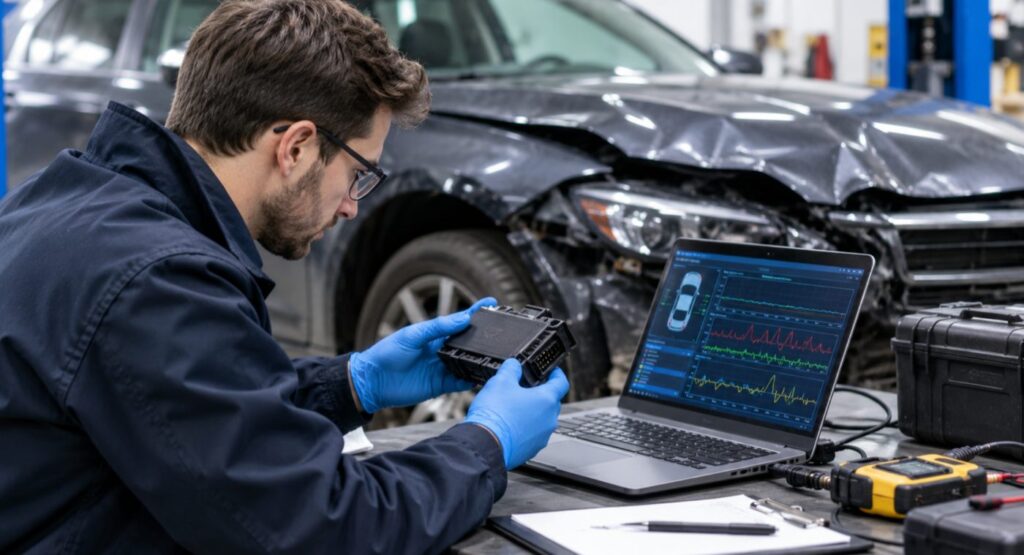
We prove it with data, records, and witnesses. Most drowsy drivers do not say “I fell asleep,” so the evidence has to tell the story.
| Evidence | What It Can Show |
|---|---|
| Event data recorder (“black box”) | Speed, braking, and steering in the seconds before impact. No braking can mean the driver never reacted. |
| Scene marks | No skid marks before the crash point to a driver who did not see it coming. |
| Lane drift and rumble strips | The car drifted across lanes or onto the shoulder before the crash. |
| Driver statements | Words like “I dozed off” said at the scene, to police, or to an insurer. |
| Work and shift schedules | Overtime, double shifts, or night work before the crash. |
| Cell phone records | Where the driver was and how long they had been on the road. They also help rule out other explanations. See how phone records help prove fault. |
| Dashcam and camera footage | Weaving or late-night driving before the crash, where footage exists. |
| Police crash report and witness statements | Officer notes and what other drivers saw. |
| Accident reconstruction expert | How the crash happened, based on the vehicle and scene data. |
| Sleep medicine expert | How little sleep or an untreated sleep problem affects reaction time and alertness. |
| Time-of-crash pattern | Late-night, early-morning, and mid-afternoon crashes fit known drowsiness patterns. |
What if the driver says they were not asleep?
Then the evidence speaks. A car that drifts and hits you with no braking tells a clear story. Our experts can explain what the data shows. The driver’s own work schedule and sleep history can show the rest.
How fast do we need to act on evidence?
Quickly. Vehicle data can be overwritten or erased when a car is repaired, sold, or scrapped. Many businesses keep camera footage for only a short time. We send preservation letters early. These letters demand that the driver and insurer keep the vehicle, its data, and all related records.
Why Is Drowsy Driving So Hard to Prove, and How Often Does It Happen?
Official counts miss most drowsy crashes. That makes strong evidence matter more.
The National Highway Traffic Safety Administration (NHTSA) found that at least 633 people died in 2023 in crashes involving drowsy drivers. That count comes from police reports. The AAA Foundation for Traffic Safety looked deeper at in-depth crash investigations. It estimates that 17.6% of all U.S. fatal crashes from 2017 to 2021 involved a drowsy driver. That is about 29,834 deaths in five years.
In February 2026, the Governors Highway Safety Association (GHSA) applied that rate to 2023. It estimated 6,326 drowsy-driving deaths, about ten times the police-based count.
What the numbers say about when and where:
- 55% of U.S. adults said they had fallen asleep while driving, in an NHTSA national survey. This is self-reported.
- The most common times were midnight to 5:59 a.m. (27%) and 6 p.m. to midnight (25%).
- Among drivers who fell asleep most often, 62% said their last episode happened on a multilane highway with a speed limit above 55 mph.
- The AAA Foundation found the most fatal drowsy crashes between 11 p.m. and 2:59 a.m. The highest share of drowsy drivers was among crashes at 3:00 to 6:59 a.m.
These are national figures, not Seattle figures. They still match what we see on I-5, I-90, and SR 520 during late-night and early-morning commutes. Want to spot the signs of drowsy driving before they cause a crash? Read our safety guide.
In Washington, the State Patrol investigated 64 fatal collisions and 308 serious-injury collisions from 2011 through 2015 where a drowsy driver was involved. That is older data, but the problem is the same today: the Governors Highway Safety Association says police reports substantially underestimate drowsy driving. That is why we build the proof ourselves.
Who Can Be Held Responsible for a Drowsy Driver Crash?
The driver comes first. Sometimes another party shares the blame.
- The drowsy driver. Their insurance is usually the first source of payment.
- The driver’s employer. If the driver was working when the crash happened, such as on a work errand or between job sites, the employer may be responsible for their employee’s driving.
- Other parties, only when the facts support it. We check each case before naming anyone.
Under RCW 4.22.070, each at-fault party generally pays only its own share of fault. The exception is when you bear no fault at all. Then the defendants are responsible together for the total of their shares. We identify every party early so every insurance policy is in play.
If a commercial truck driver caused your crash, different rules apply. Our truck accident lawyer in Seattle team handles those cases.
What If I Was Partly at Fault?
You can still recover money. Washington is a pure comparative fault state. Under RCW 4.22.005, your share of fault lowers your award but does not bar your claim.
If a jury finds you partly at fault, your award is reduced by your share of fault. Insurers often try to shift blame onto the injured person. We push back with evidence.
What Compensation Can I Recover After a Drowsy Driver Accident?
You can seek economic damages and non-economic damages.
Economic damages cover money you lost:
- Medical bills, past and future
- Lost wages
- Loss of earning capacity if you cannot return to your old work
- Rehabilitation and care costs
- Vehicle repair or replacement
Non-economic damages cover harm that has no receipt:
- Pain and suffering
- Emotional distress
- Loss of enjoyment of daily life
Washington has no cap on non-economic damages. Washington does not allow punitive damages in injury cases, so we focus on the full value of your real losses.
A sleeping driver does not brake. Impacts can happen at full speed, and that can mean serious harm, including broken bones. Learn how a traumatic brain injury lawyer, a spinal cord injury lawyer, an internal injury lawyer in Seattle, and a back and neck injury lawyer can help with these claims. If your injuries change your life for good, a catastrophic injury lawyer can explain your long-term options. We wait until your doctors can describe your long-term needs before we put a number on your claim.
See what your injury claim can include and read about Washington car accident settlement amounts.
How Do Insurance Companies Handle Drowsy Driver Claims?
Expect a fast call, a friendly tone, and a request for a recorded statement. The adjuster works for the at-fault driver’s insurer, not for you.
Common moves to watch for:
- A quick, low settlement offer before your treatment is done
- Questions that try to place part of the blame on you
- Requests for wide medical releases
- A claim that the crash was unavoidable
Know your options:
- Policy limits. The at-fault driver’s policy may be too small for serious injuries.
- Underinsured motorist (UIM) coverage. Your own policy may fill the gap.
- Personal injury protection (PIP). If you have it, it may help pay medical bills while the claim moves forward.
If your own insurer unreasonably denies or underpays a UIM or PIP claim, we handle that too. Washington’s Insurance Fair Conduct Act (IFCA) may apply. Do not give a recorded statement or sign anything until you speak with us. Not sure you need a lawyer? See why having a lawyer matters.
What Should I Do After a Crash With a Drowsy Driver?
- Call 911. Ask for police and medical help.
- Get checked by a doctor, even if you feel fine. Some injuries show up later.
- Write down what the driver says. Words like “I fell asleep” or “I was so tired” matter.
- Take photos. Capture vehicle damage, the road, lane markings, and any skid marks.
- Get names and numbers for witnesses and the other driver, plus their insurance details.
- Ask nearby businesses whether a camera caught the crash.
- Do not give a recorded statement to any insurer yet.
- Call a lawyer fast so we can send preservation letters before the evidence is gone.
How Long Do I Have to File a Drowsy Driver Accident Claim in Washington?
You generally have three years from the date of the crash to file a lawsuit. That limit comes from RCW 4.16.080(2). If someone died, a wrongful death claim generally also has a three-year limit.
Three years sounds long. The evidence does not last that long. If a government vehicle or employee was involved, special notice rules can apply, so call us as soon as you can.
What If a Drowsy Driver Killed My Loved One?
Washington law lets the estate’s personal representative bring a wrongful death claim for the family. The right to sue comes from RCW 4.20.010, and RCW 4.20.020 names who can recover, starting with a spouse, state-registered domestic partner, and children.
A claim can seek funeral and burial costs, lost income and support, and the loss of care, guidance, and companionship. No payment replaces a person. We make sure the driver’s insurer is held to the full value of what your family lost, so you can focus on your family.
How Much Does a Drowsy Driver Accident Lawyer Cost in Seattle?
Your first consultation is free. We charge no fee unless we recover money for you. You will not get an hourly bill from us.
Ask us anything about fees on your first call. Money should never be the reason you wait to protect your claim.
Why Seattle Families Call Elsner Law Firm After a Drowsy Driver Crash
- Washington injury law, and only that. We have handled personal injury cases across Washington since 2007. We know the state’s comparative fault rules and how Seattle-area insurers handle claims.
- Free consultations, any hour. Call, text, or schedule online. Meet in person, by video, or at your home if you cannot travel.
- Built for trial. We prepare every case as if it will reach a jury. That preparation shows insurers we are ready to go to court.
- An expert network. Accident reconstruction specialists, medical professionals, therapists, and vocational experts help us prove fatigue and show the full cost of your injuries.
- Care for the whole person. We treat you as a person, not a case number. We offer culturally sensitive support, including for Hispanic clients and families.
- Local reach. Offices in Seattle, Brier, Ellensburg, and Pullman.
Where We Help: Seattle, King County, and Snohomish County
We handle drowsy driver crashes on city streets and on I-5, I-90, SR 520, and county roads. Seattle cases are usually filed in King County Superior Court. Our Brier personal injury lawyer office is in Snohomish County. We also serve clients through our Ellensburg personal injury lawyer and Pullman personal injury lawyer offices. We request police reports from the Seattle Police Department, King County Sheriff’s Office, or Washington State Patrol, depending on where the crash happened.
Drowsy drivers hit more than other cars. If you were on foot, our pedestrian accident lawyer team can help. If you were on two wheels, talk to a bicycle accident lawyer or a motorcycle accident lawyer. If you were a passenger in an Uber or Lyft, a rideshare accident lawyer can explain your options.
Drowsy Driver Accident FAQs
Does the driver have to admit they fell asleep for me to win?
No. We can prove it from vehicle data, scene marks, shift records, camera footage, witnesses, and expert opinions.
What if the police report does not mention sleep?
You can still have a strong claim. Police reports often miss fatigue, and the Governors Highway Safety Association says they substantially underestimate drowsy driving. We investigate beyond the report.
Is falling asleep at the wheel considered negligence in Washington?
Often, yes. Drowsiness usually gives warning, and a driver who ignores it may fail to use ordinary care. An attorney will review the facts of your crash.
What if the drowsy driver has little or no insurance?
Your own underinsured motorist (UIM) coverage may help. We review every policy that could apply.
Should I talk to the other driver’s insurance company?
Not before you talk to a lawyer. Adjusters may use your words to lower your claim.
How long does a drowsy driver accident claim take?
It depends on your injuries and the insurer. Claims with serious injuries often take a year or more, because we wait until your treatment shows the full cost.
What if the driver was on the job?
The employer may share responsibility. We look into the driver’s schedule and employer records early.
Can I still file if I was partly to blame?
Yes. In Washington, your fault lowers your award but does not bar your claim.
Talk to a Seattle Drowsy Driver Accident Lawyer Today
If a driver who fell asleep at the wheel hurt you or someone you love, you do not have to prove it alone. Evidence disappears fast. A free case review costs you nothing, and you pay no fee unless we recover money for you.
Call or text 206-447-1425 now, any hour. Or fill out the free case review form on this page and our team will follow up.
Elsner Law Firm: your Seattle drowsy driver accident lawyer, with offices in Seattle, Brier, Ellensburg, and Pullman.