Call Today!

 CALL US NOW
 TEXT US NOW

In Washington, the drunk driver is the first person legally responsible after a crash. The bar or restaurant that served that driver can be responsible too. So the answer to “who pays?” is often both.
A licensed seller that served someone “apparently under the influence” can be liable to an injured third party (RCW 66.44.200(1); Barrett v. Lucky Seven Saloon, 152 Wn.2d 259 (2004)). A jury gives each defendant a percentage of fault. If you are not at fault, you can collect the defendants’ combined shares from any defendant who has a judgment entered against them (RCW 4.22.070(1)(b)).
That rule matters because a driver may have little money or little insurance. Washington’s minimum liability limits are only $25,000 per person. A severe injury can cost far more. This guide shows who is responsible for a drunk driving accident in Washington and every source that may pay.
Who can pay after a drunk driving crash in Washington
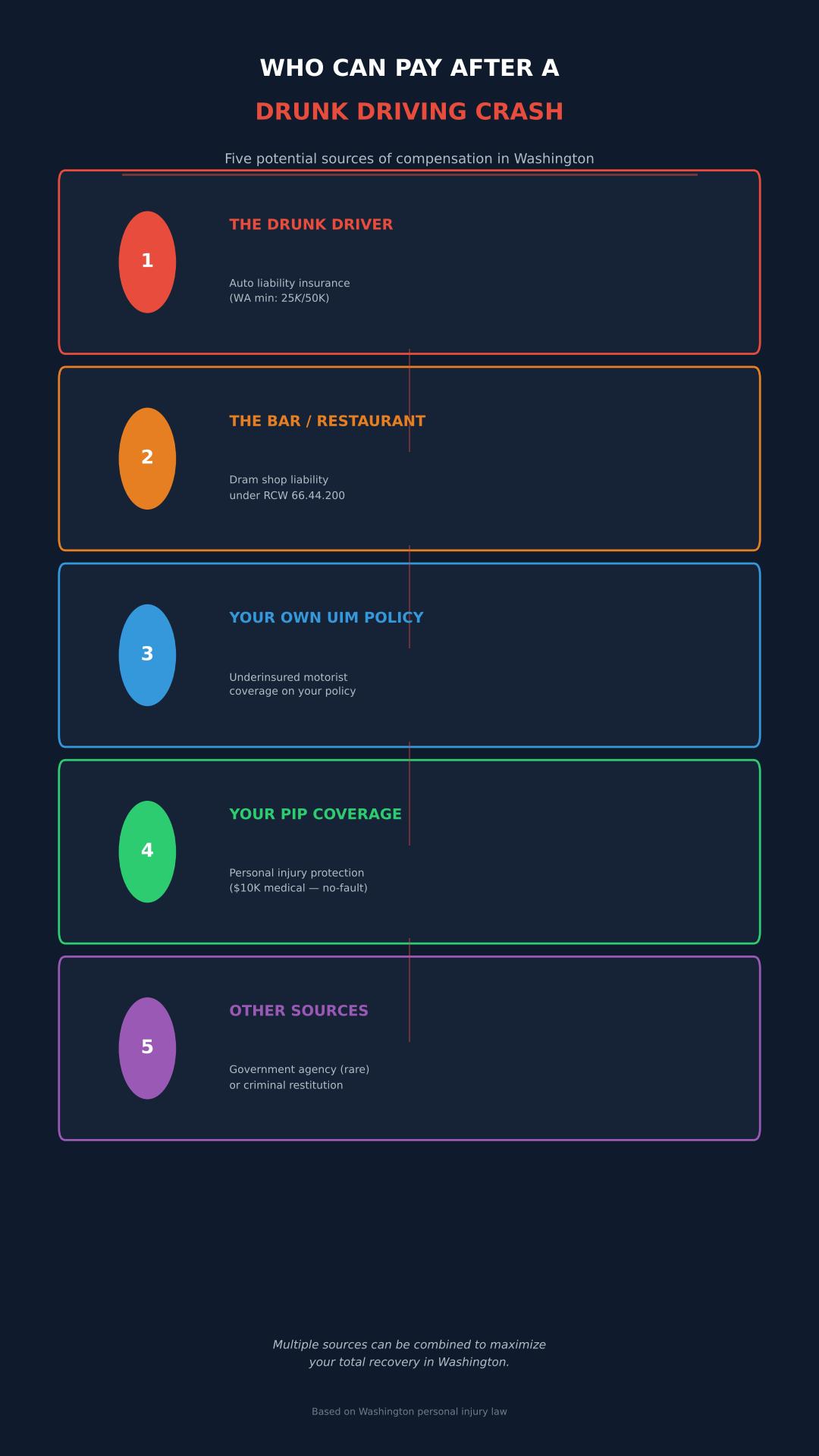
| Source | When it may pay | Key point |
|---|---|---|
| The drunk driver | Always the first target | Negligence per se; minimum limits are low |
| The bar or restaurant | It served a driver who was apparently under the influence | Liable to injured third parties |
| A social host | Only when the host served someone under 21, and then the duty runs to the minor | Not liable to third parties; not liable for serving adults |
| An employer | A drunk employee drove after an event held for the employer’s benefit | Depends on scope of employment |
| Your own insurance | Driver is uninsured or underinsured, or you need early medical bills paid | UIM and PIP coverage |
| A government agency | Rare cases where it failed to enforce probation conditions | One Seattle case settled for $13 million |
| Criminal restitution | The court orders the driver to repay losses | Covers only easily ascertainable losses |
The drunk driver: the first person responsible
The driver is the first person you can hold responsible. In a Washington civil case, driving under the influence of intoxicating liquor or any drug is negligence per se (RCW 5.40.050(4)). That means the law treats the act itself as careless. The criminal threshold is a 0.08 breath or blood alcohol level within two hours of driving (RCW 46.61.502).
Payment usually starts with the driver’s auto liability insurance. But Washington’s minimum limits are low: $25,000 per person, $50,000 per accident, and $10,000 for property damage (RCW 46.29.090). A serious injury can cost far more than that.
When coverage runs out, the driver’s personal assets are exposed. The driver also cannot wipe out the debt by filing for bankruptcy. A debt for injury caused by driving while intoxicated cannot be discharged (11 U.S.C. 523(a)(9)). A driver may have few assets to collect. That is why the other sources below matter.
The bar or restaurant: Washington’s dram shop law
A bar or restaurant can be liable to a third party hurt by a driver it overserved (RCW 66.44.200(1); Barrett v. Lucky Seven Saloon, 152 Wn.2d 259 (2004)). People often call this a dram shop claim. The key question is whether the driver looked “apparently under the influence” when the staff kept serving.
In Faust v. Albertson, 167 Wn.2d 531 (2009), the Washington Supreme Court reinstated a $14 million jury verdict against a Bellingham Moose Lodge. The court held that blood alcohol test results can back up what witnesses saw firsthand about how the person looked when served. So the claim often rests on what staff and other patrons saw: slurred speech, stumbling, loud behavior, and how many drinks were served.
There is one limit. The drunk driver cannot sue the bar for his own injuries (Estate of Kelly v. Falin, 127 Wn.2d 31 (1995)). The claim belongs to the people the driver hurt.
Time matters here. Surveillance video can be recorded over within days. A dram shop injury lawyer can send a letter asking the bar to keep its video, receipts, and server records before they are gone. A bar usually carries liability insurance, and that insurer is often the practical source of payment in these claims.
Social host liability and employer liability in Washington
Social hosts. A host who supplies liquor to someone under 21 can face liability (RCW 66.44.270(1)), but that duty runs to the minor who was served. Social hosts generally are not liable for serving adults. There is a twist: a host who serves a minor owes a duty to the minor, not to third parties the minor later injures (Hansen v. Friend, 118 Wn.2d 476 (1992); Reynolds v. Hicks, 134 Wn.2d 491 (1998)). So for an injured third party, this route is narrow.
Employers. An employer can be pulled in when a worker drinks at a work event and then drives. In Dickinson v. Edwards, 105 Wn.2d 457 (1986), the Washington Supreme Court sent claims against an employer back for trial. An employee had driven drunk after a company-sponsored banquet held for the employer’s benefit. The court said such an event can fall within the scope of employment. Each case turns on the facts: whether the employer hosted the event, whether it helped the business, and whether attendance was expected.
If the driver has no insurance: your own UIM and PIP coverage
Your own policy is often the first money that comes in, especially when the driver has no insurance or only the minimum.
- Underinsured motorist (UIM) coverage: Insurers must provide UIM coverage in the amount of the liability limits, unless the named insured rejects it in writing (RCW 48.22.030). It covers you when the driver’s coverage is missing or too small.
- Personal injury protection (PIP): Insurers must offer PIP (RCW 48.22.085). It carries $10,000 in medical and hospital benefits (RCW 48.22.095). It can help pay early medical bills while the fault claims are still open.
Check your policy early. If you rejected UIM or PIP in writing, that choice can change which sources are open to you.
Government agencies and criminal restitution
Government agencies, in rare cases. In a lawsuit by the Schulte family, the City of Seattle and its insurers paid $13 million to settle claims over a March 25, 2013 crash in Seattle’s Wedgwood neighborhood. The City paid $6.5 million, and its insurance carriers paid the rest. The driver was a repeat DUI offender. The claim said the City failed to enforce his probation conditions, including an ignition interlock (Fox 13 Seattle, May 22, 2018). No bar was involved. Cases like this are unusual, but they show that the list of payers can go beyond the driver and the bar.
Criminal restitution. Courts must order restitution absent extraordinary circumstances (RCW 9.94A.753). But restitution covers only easily ascertainable losses, such as treatment costs and lost wages. It does not cover pain and suffering. It also does not limit your civil remedies, so a restitution order does not close the door on a civil claim.
Real Washington drunk driving settlement examples: who paid
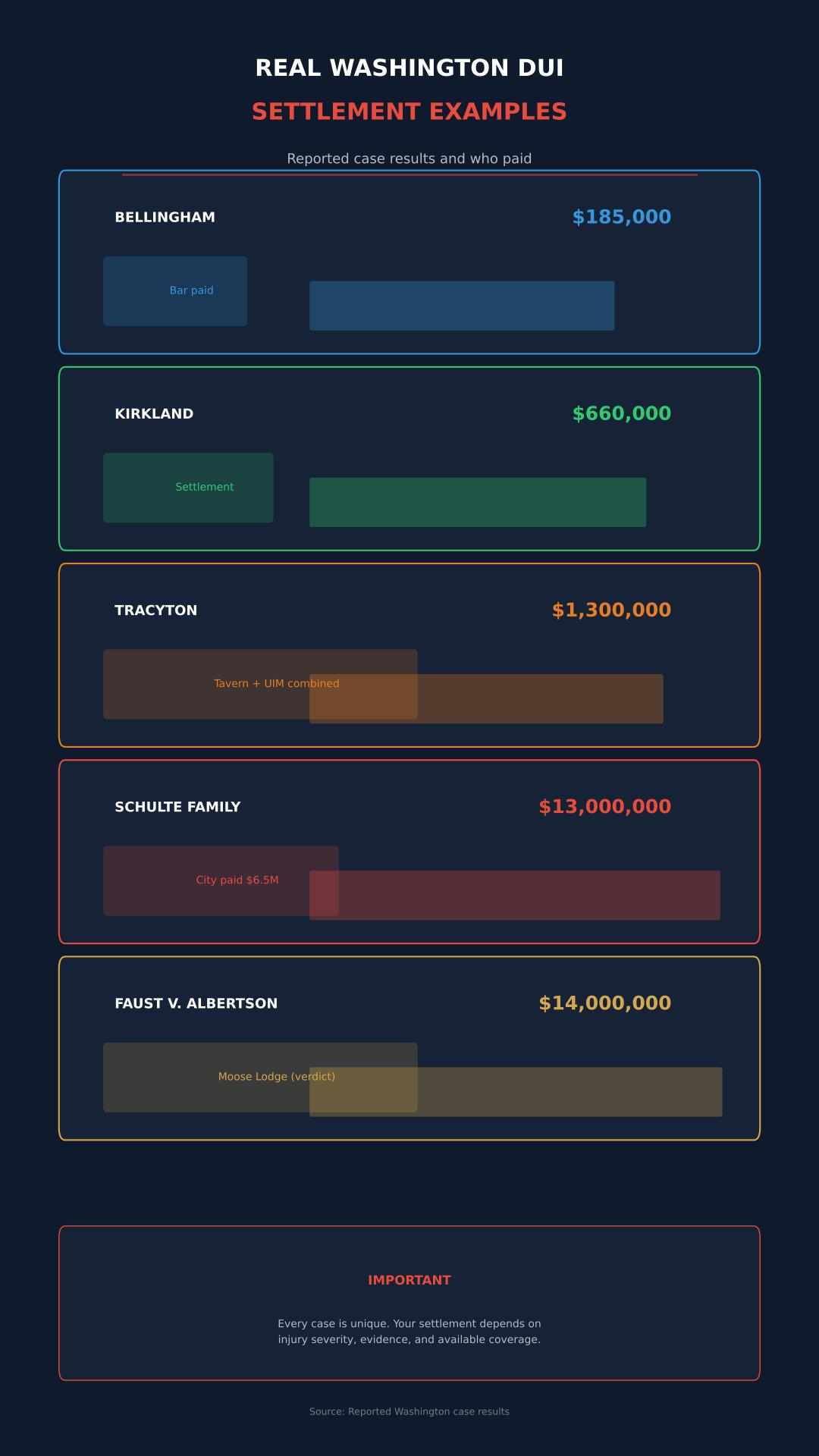
These are past results. They are not predictions. Every case depends on its own facts, insurance, and proof.
| Case | Where and when | Who paid or was held responsible | Amount |
|---|---|---|---|
| Faust v. Albertson | Bellingham (Whatcom County); Washington Supreme Court decision, 2009 | A jury found the Bellingham Moose Lodge and its bartender responsible after a crash by a patron who died. The Supreme Court reinstated that verdict. | $14 million (jury verdict) |
| Tracyton | Kitsap County; announced Sept. 10, 2015 | The tavern and the injured man’s own uninsured motorist coverage, combined, with no breakdown. A drunk driver hit two people walking home from the tavern, and one died. The injured man’s attorney said the tavern overserved the driver (Kitsap Daily News). | $1.3 million |
| Bellingham | Firm-reported by Lehmbecker Law; no date given | The driver was uninsured. The client first recovered through their own uninsured motorist coverage, then settled with the bar. | $185,000 from the bar |
| Kirkland | Firm-reported by Davis Law Group; 2012 head-on crash | Settlement after a driver with a 0.161 breath test had spent several hours at a nearby bar. The firm’s page does not say who paid. | $660,000 |
| Schulte family lawsuit | Seattle; settled in 2018 | The City of Seattle ($6.5 million) and its insurers (the rest), over a repeat DUI offender’s crash. No bar was involved. | $13 million |
Two lessons stand out. First, several of these cases involved a payer other than the driver: a bar, a victim’s own coverage, or a city. Second, the victim’s own uninsured motorist coverage played a part when the driver had no insurance. For more reported results, see our guide to Seattle dram shop injury settlement amounts.
Drunk driving accident compensation in Washington: fault, deadlines, and damages
Fault rules. Washington uses pure comparative fault. If you share some blame, your own fault reduces your damages, but it does not bar recovery (RCW 4.22.005). One rule is harsher: if an injured person was under the influence, that condition helped cause the injury, and the person is found more than 50% at fault, that is a complete defense. The defense does not apply against an impaired driver whose impairment was a proximate cause of the crash, as long as the injured person’s own impairment was not a proximate cause of it (RCW 5.40.060).
Filing deadline. You have three years to file a personal injury lawsuit (RCW 4.16.080(2)). Evidence at a bar can disappear much sooner, so do not wait.
What you can recover. Washington does not cap non-economic damages (Sofie v. Fibreboard, 1989). It generally does not allow punitive damages without statutory authorization (Dailey v. North Coast Life, 1996). So compensation is measured by your actual losses: medical bills, lost income, and pain and suffering.
Why this matters. The Washington Traffic Safety Commission reports preliminary 2025 data of 659 traffic deaths. Of those, 297 (45%) involved an impaired driver, and alcohol was found in 57% of the impaired drivers (Washington State Standard, citing WTSC). These figures are preliminary and may change as lab results come in. Nationally, NHTSA counted 11,904 deaths in 2024 in crashes involving a driver with a blood alcohol level of 0.08 or higher. That is 30% of the 39,254 total traffic deaths.
What to do next, and how a Seattle drunk driving accident lawyer can help
If a drunk driver hurt you or someone you love, a few early steps protect every source of payment:
- Get medical care and keep every record and bill.
- Write down where the driver was drinking, if you know. Keep any receipts or photos.
- Find your own auto policy and check for UIM and PIP coverage.
- Do not wait to talk to a Seattle drunk driving accident lawyer. Bar video and server records can be erased.
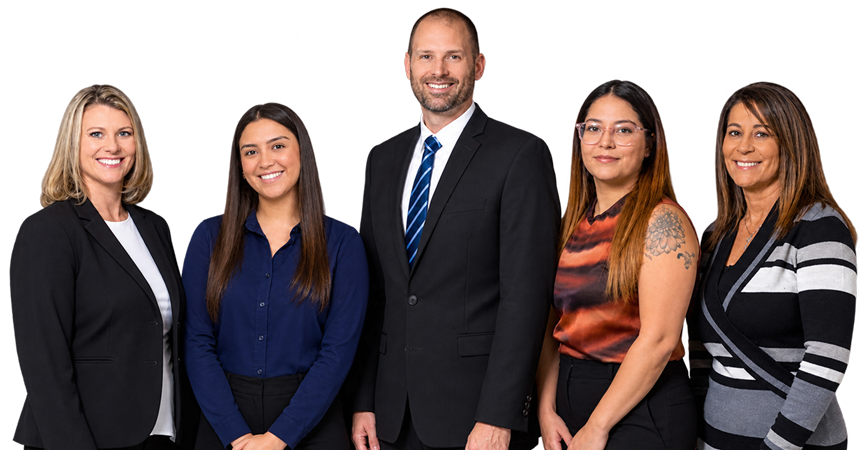
Seattle personal injury attorney Justin Elsner founded Elsner Law Firm in 2007 and focuses only on personal injury law in Washington State. The firm investigates every liable party, including bars, restaurants, employers, and vehicle owners, and it looks at your own UIM coverage too. It prepares every case as if it is going to trial, which puts pressure on insurers to offer fair settlements.
- Available 24/7. Call, text, or book online. Consultations are free, and you can meet in person, by video, or at your home.
- No fee unless you win. The firm works on contingency and advances all case expenses.
- Local offices. Seattle, Brier, Ellensburg, and Pullman, serving clients across Washington.
- A team of experts. The firm works with medical professionals, therapists, accident reconstruction specialists, and vocational experts.
Call or text (206) 447-1425 for a free case review. The Seattle office is at 2130 Westlake Ave N #3, Seattle, WA 98109 (by appointment only).
Attorney advertising. This article gives general legal information for Washington State, not legal advice. Reading it does not create an attorney-client relationship. Past results do not guarantee a similar outcome.
Frequently asked questions
Who pays if a drunk driver hits me in Washington?
The driver is first. The driver’s auto liability insurance usually pays first, up to its limits. A bar, an employer, or your own UIM coverage may add more.
Can you sue a bar for a drunk driving accident in Washington?
Yes, if the bar served the driver while he was apparently under the influence (RCW 66.44.200(1)). Blood alcohol test results can back up what witnesses saw about how the driver looked (Faust v. Albertson).
Can I sue a social host who served the driver?
Generally not. Washington does not hold social hosts liable to third parties for serving adults. A host who serves a minor owes a duty to the minor, not to the people the minor later injures (RCW 66.44.270(1); Hansen v. Friend; Reynolds v. Hicks).
What if the drunk driver has no insurance or only minimum coverage?
Your own underinsured motorist coverage may apply (RCW 48.22.030), and PIP can help with early medical bills. You can also go after the driver’s personal assets, and the debt cannot be erased in bankruptcy.
How long do I have to file?
Three years for a personal injury claim (RCW 4.16.080(2)).
Does criminal restitution cover everything?
No. It covers easily ascertainable losses such as treatment costs and lost wages. It does not cover pain and suffering, and it does not limit a civil claim (RCW 9.94A.753).