CALL US NOW
 TEXT US NOW
Seattle Nursing Home Abuse Lawyer
Placing a loved one in a nursing home or care facility is one of the most difficult decisions a family can make. You trust that facility to provide safety, dignity, and compassionate care. Discovering that your loved one has instead suffered abuse, neglect, or exploitation at the hands of the people responsible for their care is devastating and it is wrong.
A Seattle nursing home abuse lawyer at Elsner Law Firm is here to help you understand your legal rights, hold negligent facilities accountable, and recover the full compensation your family deserves. Our attorneys serve victims and families throughout Seattle, King County, and surrounding communities including Bellevue, Redmond, Kirkland, Renton, and Tacoma.
What Is Nursing Home Abuse? The Washington State Legal Definition
Under Washington State law, nursing home residents and care facility occupants are classified as “vulnerable adults” and receive specific legal protections. Revised Code of Washington (RCW) § 74.34.020 defines abuse as “any injury, unreasonable confinement, intimidation, or punishment” inflicted on a vulnerable adult. This definition explicitly encompasses:
- Physical abuse: hitting, slapping, restraining, or injuring a resident
- Mental and emotional abuse: threats, humiliation, intimidation, and verbal cruelty
- Sexual abuse: any non-consensual sexual contact or exploitation
- Financial exploitation: unauthorized use of a resident’s funds or assets
- Neglect: failure to provide adequate food, water, medical care, hygiene, or supervision
Washington law under RCW § 74.34.020 also covers “vulnerable adults” broadly including any adult over age 60 with physical or mental limitations, adults of any age with developmental disabilities, and any person admitted to a care facility, regardless of age.
Criminal reporting duty: Under RCW § 74.34.053, any operator or employee of a nursing home facility who knowingly fails to report suspected abuse or neglect can face criminal charges. This law makes nursing homes legally responsible not just for preventing abuse but for reporting it when it occurs.
Meet Your Seattle Nursing Home Abuse Lawyer
Justin Elsner founded Elsner Law Firm in 2007 after graduating cum laude from Seattle University School of Law. He is a member of the Washington State Bar Association, a member of the Washington State Association for Justice (WSAJ), and admitted to practice in the U.S. District Court for the Western District of Washington. Justin has spent nearly two decades fighting for vulnerable adults and their families against nursing homes and care facilities that failed in their duty of care, serving clients across King County, Snohomish County, and Pierce County.
Justin’s path to this work is personal. He watched a close family member spend their final years in a Seattle-area care facility and witnessed firsthand how quickly a vulnerable person can be failed by the very institution entrusted with their safety. When that facility was never held accountable, the harm did not end with his family member’s death. It stayed with him. That experience, combined with his own family’s earlier struggle navigating the insurance system after a serious car crash, became the foundation for everything he built at Elsner Law Firm: a practice rooted in the belief that the most vulnerable people deserve an advocate who fights just as hard for them as the insurance companies and nursing home corporations fight against them.
He has authored two client guides: “What Washington Families Must Do When They Suspect Nursing Home Abuse” and “5 Mistakes Families Make After Discovering Nursing Home Neglect” because informed families consistently reach better outcomes. His caseload covers bedsores and pressure ulcers, medication errors, physical and sexual abuse by staff, malnutrition and dehydration, financial exploitation, elopement and fall injuries, and wrongful death claims against skilled nursing facilities, assisted living facilities, and adult family homes throughout the Seattle metro area.
If your loved one was abused or neglected in a nursing home in Seattle, call or text Elsner Law Firm at 206-447-1425 for a free consultation.
Professional Recognition & Credentials
- Washington State Bar Association: Active Member
- Washington State Association for Justice (WSAJ) : Member
- U.S. District Court, Western District of Washington : Admitted to Practice
- Author: “What Washington Families Must Do When They Suspect Nursing Home Abuse”
- Author: “5 Mistakes Families Make After Discovering Nursing Home Neglect”
- Nearly two decades of dedicated elder abuse and nursing home malpractice litigation in Washington State
Nursing Home Abuse and Neglect Injuries in Seattle: What Families Need to Know
Nursing home abuse injuries are among the most preventable and most serious harms that occur in care settings. Understanding the types of physical and psychological harm caused by nursing home abuse and neglect helps families recognize warning signs, document harm, and take timely legal action. Many of these injuries result from systematic neglect rather than a single incident, which is why the pattern of care matters as much as any individual event.
Physical Injuries from Nursing Home Abuse
Bedsores (Pressure Ulcers / Decubitus Ulcers): One of the most preventable and most common consequences of nursing home neglect. When staff fail to reposition immobile residents, sustained pressure cuts off blood flow to the skin, causing painful sores that can quickly become infected, reach bone, and prove fatal. Stage 3 and Stage 4 bedsores are almost always evidence of neglect and are among the most common grounds for nursing home malpractice claims in Washington State.
Broken Bones and Fractures: Unexplained fractures particularly of the hip, wrist, and shoulder can indicate physical abuse, improper transfers, or neglect of a resident’s fall-prevention needs. Hip fractures in elderly nursing home residents are associated with dramatically increased mortality risk.
Traumatic Brain Injuries (TBI): Unattended falls, pushing, or direct physical violence can cause severe head injuries, including subdural hematomas, in elderly residents who are already at elevated risk.
Malnutrition and Dehydration: Failure to adequately feed, hydrate, or monitor residents with swallowing difficulties leads to dangerous weight loss, organ failure, and susceptibility to infection.
Infections from Poor Hygiene: Urinary tract infections (UTIs), sepsis, MRSA, and pneumonia are all preventable with proper hygiene protocols. Repeated infections are a red flag for systemic neglect and a basis for nursing home malpractice litigation.
Medication Errors: Wrong dosage, wrong medication, missed doses, or deliberate over-sedation (“chemical restraint”) are forms of harm that can cause strokes, organ failure, or death.
Psychological and Financial Harm
- Severe depression, anxiety, and PTSD caused by verbal abuse, threats, or isolation
- Sudden unexplained changes to wills, bank accounts, or property titles
- Missing cash, jewelry, or personal belongings
- Unauthorized use of debit/credit cards or forged signatures
Wrongful Death from Nursing Home Abuse
When nursing home abuse or neglect causes a resident’s death, surviving family members may pursue a wrongful death claim under Washington law. These claims can recover compensation for funeral costs, loss of companionship, and the pain and suffering the resident endured prior to death. Wrongful death claims arising from nursing home abuse are subject to Washington’s three-year statute of limitations under RCW 4.20.010.
Warning Signs of Nursing Home Abuse and Elder Neglect: What to Look For
Because many elderly residents fear retaliation, feel ashamed, or are unable to communicate due to cognitive decline, abuse often goes unreported for months. Family members who visit regularly are the most important first line of defense.
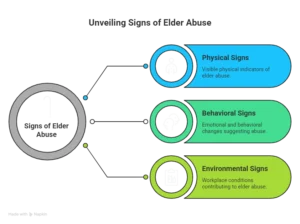
Physical Warning Signs
- Unexplained bruises, burns, cuts, or welts- especially in unusual locations
- Bedsores or pressure wounds at any stage
- Significant and unexplained weight loss
- Signs of dehydration: dry lips, sunken eyes, confusion
- Frequent, recurrent infections (UTIs, skin infections, pneumonia)
- Broken bones with implausible or inconsistent explanations
- Unwashed body, soiled clothing or bedding, unkempt appearance
- Overuse of sedatives or tranquilizers (excessive drowsiness)
Behavioral and Emotional Warning Signs
- Sudden withdrawal, silence, or refusal to talk, especially around specific staff members
- Unusual fearfulness, anxiety, or agitation
- Rocking, mumbling, or other self-soothing behaviors new to the resident
- Depression, tearfulness, or flat affect that is new or worsening
- A loved one’s reluctance to discuss their care or to be left alone
Environmental and Administrative Warning Signs
- Medication missing or unaccounted for
- Unexplained changes to financial documents, powers of attorney, or beneficiaries
- Facility staff who are evasive, dismissive, or hostile to family inquiries
- High staff turnover, frequent understaffing, or unhygienic common areas
- Inconsistent care plans or missing documentation

Nursing Home Abuse in Seattle and King County: Local Context
Seattle and King County are home to more than 200 licensed long-term care facilities, including skilled nursing facilities, assisted living facilities, and adult family homes in neighborhoods from Capitol Hill and Beacon Hill to Rainier Valley, Magnolia, Northgate, and Burien. Washington State’s Department of Social and Health Services (DSHS) regulates and inspects these facilities
but inspections do not prevent every incident of abuse, and many violations go undetected between inspection cycles.
According to the National Center on Elder Abuse (NCEA), nearly one in three U.S. nursing homes has been cited for violating federal standards meant to prevent harm to residents. In Washington State, DSHS Long-Term Care survey data consistently identifies staffing levels, infection control, and resident rights violations as the most frequently cited deficiencies in King County facilities with staffing-related citations appearing in a disproportionate share of facilities rated below average on Medicare’s Care Compare tool.
As Washington’s population continues to age with more than 15% of state residents now over 65, and that figure projected to surpass 20% by 2050. The need for qualified nursing home abuse and malpractice attorneys in Seattle has never been greater. Elsner Law Firm has represented families from across the King County area, including clients whose loved ones were harmed in facilities in Redmond, Bellevue, Kirkland, Renton, and Tacoma.
If your loved one is in a Seattle-area care facility, you can look up a facility’s inspection history, staffing ratings, and complaint history on Medicare’s Care Compare tool (medicare.gov/care-compare) or by contacting the Washington State DSHS Long-Term Care Ombudsman program.
Elder Abuse and Nursing Home Neglect Attorney: Seattle-Area Communities We Serve
Elsner Law Firm represents families across the greater Seattle metro area and Western Washington. If you or a loved one was harmed in any of the following communities, we are ready to help:
- Seattle (all neighborhoods, including Capitol Hill, Rainier Valley, Beacon Hill, Magnolia, Northgate, West Seattle, and Ballard)
- Redmond: Elsner Law Firm serves as a Redmond nursing home abuse lawyer resource for families on the Eastside, handling cases from facilities throughout the Redmond area and Eastside corridor
- Bellevue, Kirkland, and Issaquah
- Renton, Burien, and Tukwila
- Tacoma and Pierce County
- Everett and Snohomish County
Nursing Homes vs. Assisted Living vs Adult Family Homes in Washington
Washington State is home to three distinct types of residential care settings, each governed by different laws and subject to different legal standards. Understanding which type of facility your loved one is in affects your reporting options and your legal claims.
Skilled Nursing Facilities (Nursing Homes)
Licensed under RCW 18.51, these provide 24-hour medical care and are subject to both state DSHS oversight and federal Medicare/Medicaid regulations. Residents in nursing homes have the fullest set of legal protections. Federal standards (42 CFR Part 483) establish minimum staffing, care planning, and residents’ rights requirements.
Assisted Living Facilities
Licensed under RCW 18.20, assisted living facilities provide residential services with personal care assistance but are not required to have licensed nursing staff on site at all times. Abuse or neglect claims in assisted living facilities are governed by Washington’s Vulnerable Adult Act (RCW 74.34) and may involve different negligence standards than traditional nursing home malpractice claims.
Adult Family Homes: Unique to Washington State
Washington is one of the few states with a robust adult family home (AFH) system, governed by RCW 70.128. These are small residential homes typically single-family residences licensed to care for up to six adults with disabilities, dementia, or other care needs. Adult family homes are one of the most common care settings in the Seattle area, and they are among the most underregulated. Abuse and neglect in adult family homes is both common and chronically underreported.
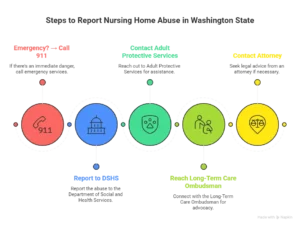
How to Report Nursing Home Abuse in Washington State
If you suspect your loved one is being abused or neglected in a Seattle-area care facility, you have several reporting options and you should pursue legal counsel at the same time you report.
- In an Emergency Call 911. If your loved one is in immediate danger, has been physically assaulted, or requires emergency medical attention, call 911 first.
- Report to Washington DSHS Complaint Resolution Unit. File a complaint online at dshs.wa.gov or call 1-800-562-6078. DSHS will investigate and may conduct an unannounced inspection.
- Contact Adult Protective Services (APS). Call APS at 1-877-734-6277 or contact your local DSHS Community Services Office in King County.
- Contact the Long-Term Care Ombudsman. Call 1-800-562-6028. The program is free and confidential and can mediate disputes with facilities.
- Contact a Seattle Nursing Home Abuse Attorney. Reporting to regulators is important but it does not automatically result in compensation for your loved one’s injuries. Regulatory investigations can also allow critical evidence to be lost while you wait. Contacting an attorney as soon as possible ensures that medical records, surveillance footage, staff records, and witness testimony are preserved.
Your Legal Rights Under Washington’s Vulnerable Adult Act
Washington’s Vulnerable Adult Act (RCW Chapter 74.34) is one of the strongest elder protection statutes in the country. It creates a civil cause of action meaning the right to sue for any vulnerable adult harmed by abuse, neglect, or financial exploitation. Key provisions:
- You do not need to prove that abuse was intentional. Negligent care failing to meet the standard of care owed to a nursing home resident is legally sufficient to support a claim.
- Nursing homes cannot retaliate against a resident for filing a complaint or lawsuit. Under Washington law, any retaliatory action against a resident for asserting their rights is itself a legal violation.
- Family members and legal guardians have standing to bring claims on behalf of incapacitated residents who cannot advocate for themselves.
- The facility, its ownership entity, and individual staff members can all be held liable depending on the facts of the case.
These protections exist because lawmakers recognized that vulnerable adults need a legal pathway to justice when the people and facilities responsible for their care fail them. If your loved one was abused or neglected in a nursing home in Seattle, call or text Elsner Law Firm at 206-447-1425.
Compensation Available in a Seattle Nursing Home Abuse Case
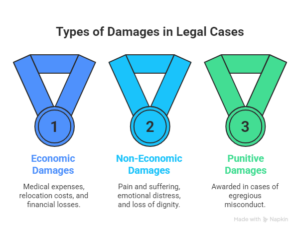
Washington law permits nursing home abuse victims and their families to seek compensation for all harm caused by the facility’s negligence or misconduct. Recoverable damages may include:
Economic Damages
- Medical expenses: emergency treatment, hospitalization, surgery, wound care, rehabilitation
- Future medical costs for ongoing or permanent conditions caused by the abuse
- Costs of relocating your loved one to a different, safer facility
- Costs of in-home care if the resident leaves institutional care
- Financial losses from exploitation: stolen funds, unauthorized asset transfers
Non-Economic Damages
- Physical pain and suffering endured by the resident
- Emotional distress, trauma, anxiety, and depression
- Loss of dignity and loss of enjoyment of life
- Loss of companionship (in wrongful death cases, for surviving family members)
Punitive Damages
In cases of especially egregious or intentional misconduct such as deliberate physical violence, sexual abuse, or willful financial exploitation. Washington courts may award punitive damages designed to punish the wrongdoer and deter future misconduct.
Wrongful Death Damages
If nursing home abuse or neglect caused your loved one’s death, surviving family members may pursue a wrongful death claim under RCW 4.20.010. Available damages include funeral and burial expenses, loss of companionship for a surviving spouse, and any pain and suffering the resident experienced before death.
The Seattle Nursing Home Abuse Lawsuit Process: Step by Step
Filing a nursing home abuse lawsuit in Washington is a multi-stage process that requires specialized legal knowledge, medical expertise, and the resources to take on large nursing home corporations. Here is what the process looks like when you work with Elsner Law Firm:
- Free Consultation: Your first step is a no-obligation consultation with our team. We listen to your situation, evaluate the facts, and give you an honest assessment of your legal options.
- Investigation and Evidence Preservation: We immediately move to obtain and preserve all available evidence: medical records, care plans, medication logs, staffing records, facility inspection history, DSHS complaint files, and any available surveillance footage.
- Filing the Complaint: Once we have documented the facility’s liability, we file a formal civil complaint in Washington Superior Court, initiating the lawsuit and putting the nursing home and its insurer on notice.
- Discovery Phase: Both sides exchange documents, records, and information. We conduct depositions of nursing home staff, administrators, and corporate officials.
- Expert Witnesses: Nursing home malpractice cases require testimony from qualified experts: nurse consultants, wound care specialists, geriatric physicians, pharmacologists, and financial forensics experts. We front all expert costs.
- Settlement Negotiations:The majority of nursing home abuse cases settle before trial. Nursing home insurers know that juries in King County treat these cases seriously and that our firm is prepared to go to trial.
- Trial: If a fair settlement is not reached, we take the case to trial. We are not a settlement-only firm. The nursing home corporation and its insurers know this and it gives our clients leverage throughout the process.
How Long Do You Have to File a Seattle Nursing Home Abuse Lawsuit?
Washington’s statute of limitations for personal injury and nursing home abuse claims is three years from the date the injury occurred (RCW 4.16.080). This means if your loved one was harmed in a Seattle nursing facility, you generally have three years from the date of the abuse or injury to file a lawsuit in civil court.
Discovery rule: In some cases, the three-year period begins when the family discovered the abuse or reasonably should have discovered it rather than the exact date it occurred. This is especially relevant in cases of financial exploitation or gradual neglect.
Wrongful death: Claims for wrongful death in Washington must be filed within three years of the date of death.
Incapacitated adults: Special tolling rules may apply if the victim was legally incapacitated and could not bring a claim.
Why Seattle Families Choose Elsner Law Firm for Nursing Home Abuse and Elder Neglect Cases
Every large personal injury firm in Seattle will tell you they care about clients. Justin Elsner can tell you why he built his entire practice around nursing home and elder abuse cases specifically and why that difference matters for your family.
When Justin’s own family member spent their final years in a Seattle-area care facility and was failed by the very people responsible for their safety, that facility was never held accountable. That experience personal, not theoretical is why every nursing home case at Elsner Law Firm is handled with the same urgency Justin wished someone had brought on behalf of his own family. This is not a marketing line. It is why he chose this practice, and it shows in how he works.
When families across Seattle, Redmond, Bellevue, and King County need an attorney to fight against negligent care facilities, they choose Elsner Law Firm because:
- Nearly two decades of experience dedicated to nursing home abuse, malpractice, and elder neglect. this is not a sideline practice
- You work directly with Justin Elsner not a case manager, not a junior associate, not a call center
- In-house and affiliated nurse consultants who review medical records and establish the standard of care before a single filing
- Relationships with top national expert witnesses: geriatric physicians, wound care specialists, pharmacologists, and financial forensics experts
- We advance all case costs expert fees, deposition costs, record retrieval with zero out-of-pocket expense to your family
- We are a trial firm: nursing home corporations and their insurers know we will go to court if needed, which produces better settlements for our clients
- Active member of the Washington State Bar Association and Washington State Association for Justice (WSAJ)
- Serving Seattle, Redmond, Kirkland, Bellevue, Renton, Tacoma, and communities throughout Western Washington
Frequently Asked Questions About Nursing Home Abuse in Seattle
Q: What qualifies as nursing home abuse under Washington State law?
Under RCW § 74.34.020, nursing home abuse includes any physical injury, unreasonable confinement, intimidation, or punishment of a vulnerable adult. The definition covers physical, emotional, and sexual abuse, financial exploitation, and neglect including failure to provide adequate food, water, medication, or hygiene. You do not need to prove intent; negligent care that falls below the standard owed to a resident is legally sufficient.
Q: What is the difference between nursing home abuse and nursing home malpractice?
Nursing home abuse typically refers to intentional or willful harmful acts hitting, restraining, threatening, or exploiting a resident. Nursing home malpractice (also called nursing home negligence) refers to failures to meet the professional standard of care, such as ignoring bedsore prevention protocols, administering incorrect medications, or failing to prevent falls. In Washington State, both can support a civil claim under the Vulnerable Adult Act (RCW 74.34), and both are handled by the attorneys at Elsner Law Firm.
Q: What are the odds of winning a lawsuit against a nursing home?
Plaintiffs win approximately 63% of nursing home jury trials, according to data published by the Bureau of Justice Statistics (BJS). However, 88–95% of nursing home abuse cases are settled out of court before trial, according to nursing home litigation research published in Health Affairs and reviewed by the American Association for Justice (AAJ). The average nursing home settlement is around $400,000 as of 2025, according to AAJ nursing home litigation data, though severe cases involving wrongful death, Stage 4 bedsores, or sexual abuse can result in settlements or verdicts of $1 million or more depending on the nature and severity of injuries. It’s worth noting that in 61% of personal injury cases, plaintiffs who rejected settlement offers and went to trial received less compensation than if they had settled, making settlement often the more practical option for families seeking justice and financial relief.
Q: How much does it cost to sue a nursing home?
When you work with a nursing home abuse attorney on contingency (as most do), it costs you nothing upfront. Your attorney covers all case costs including court filing fees ($240 in Washington State superior courts), service of process fees, expert witness fees, and investigation costs and you only pay if they win your case. If there’s no recovery, you owe nothing. This contingency arrangement allows families to pursue justice without worrying about out-of-pocket legal expenses during an already difficult time. The attorney’s fee (typically 33-40% of any settlement or verdict) and case costs are deducted from the final recovery, meaning you receive compensation without ever having to pay hourly rates or advance costs.
Q: Do nursing homes get sued a lot?
Yes, nursing homes face significant litigation in the United States. Thousands of civil lawsuits are filed against nursing homes annually, with claims per nursing home bed more than tripling from the early 1990s to the early 2000s. Average settlements increased from $216,428 in 2018 to $251,296 in 2024, while cases involving severe neglect or wrongful death can reach $1 million or more.
The frequency of lawsuits reflects serious underlying issues. Research shows that 44% of nursing home residents reported experiencing abuse, and 95% had been neglected or witnessed neglect of another resident. The National Council on Aging estimates that as many as 5 million older Americans experience abuse annually, many in nursing facilities.
These legal actions serve as important accountability mechanisms, helping families seek compensation for medical costs and damages while pressuring facilities to improve care standards and prevent future neglect. (source: Nursing Home Abuse Center)
Contact a Seattle Nursing Home Abuse Lawyer Today
Your loved one trusted the facility they lived in. That trust was violated. Now it is time to act.
At Elsner Law Firm, we understand the pain, confusion, and anger that comes with discovering nursing home abuse because this work is personal to us. We also know that the time immediately following the discovery of abuse is the most critical window for preserving evidence and protecting your legal rights.
Our attorneys serve families throughout King County, Seattle, Bellevue, Redmond, Kirkland, Renton, Tacoma, and across Western Washington. We offer free consultations, we work on contingency, and we do not rest until your family has justice.
Don’t wait another day. If your loved one was abused or neglected in a nursing home in Seattle, call or text Elsner Law Firm at 206-447-1425.