CALL US NOW
 TEXT US NOW
Soft Tissue Injury Settlement Amounts
A sprain or strain may not show up on an X-ray, but it can leave you in pain for months, unable to work, and struggling with medical bills while the insurance company calls it a “minor injury.”
Soft tissue injury settlement amounts in Washington range from a few thousand dollars to well over $100,000. What you receive depends on your injury grade, your medical records, and how the claim is handled from day one.
Here is what this guide covers:
- How Washington law affects your soft tissue claim
- What factors raise or lower your settlement value
- How insurers calculate and minimize offers
- What evidence protects your payout
- Realistic settlement ranges by injury type
What Counts as a Soft Tissue Injury?
Soft tissue injuries affect muscles, tendons, and ligaments, not bones. They are the most common injuries from car accidents, slip and falls, and workplace incidents, and they are also the most undervalued by insurers.
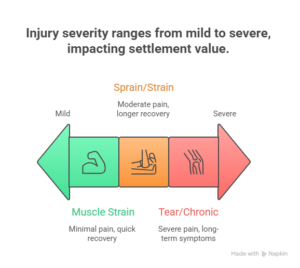
Common types include sprains (ligament damage), strains (muscle or tendon damage), whiplash, rotator cuff tears, and herniated discs. Severity is graded on three levels:
| Grade | Description | Common Outcome |
| Grade 1 | Mild fiber stretching | Resolves in days to weeks |
| Grade 2 | Partial tear | Weeks to months of treatment |
| Grade 3 | Complete rupture | May require surgery; long recovery |
Grade 3 injuries produce the highest settlements. Grade 1 claims are the most frequently undervalued by adjusters.
How Does Washington Law Affect Your Settlement?
Washington uses a pure comparative negligence rule (RCW 4.22.005). Your payout is reduced by your share of fault, but you can still recover compensation even if you were mostly at fault.
Two rules you must know:
- Three-year statute of limitations (RCW 4.16.080): You have three years from the date of injury to file a lawsuit. Miss this deadline and you lose your right to recover anything.
- Personal injury protection (PIP): Washington requires PIP coverage, which pays your medical bills regardless of fault while your liability claim is pending.
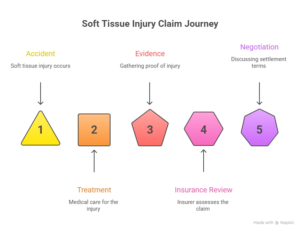
One timing issue that kills claims fast: if you wait more than 14 days after a car accident to see a doctor, insurers will argue your injuries were not caused by the crash. Delayed treatment is one of the most common reasons soft tissue claims lose value.
What Factors Determine Soft Tissue Injury Case Worth?
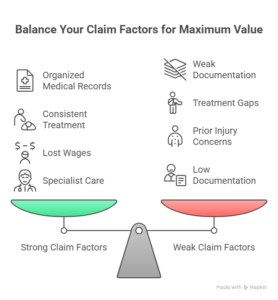
Your settlement value comes from the facts of your specific case, not a formula. These are the factors that move the number up or down:
- Injury grade – Grade 3 tears settle for far more than Grade 1 strains
- Medical records -ER visits, MRI and CT scan results, specialist diagnoses, and physical therapy notes tell the story of your injury
- Treatment consistency -gaps in your treatment timeline give insurers ammunition to claim you recovered
- Lost wages – missed workdays, reduced hours, and future earnings loss all add to economic damages
- Pre-existing conditions – prior injuries to the same area require clear documentation showing the accident made things worse
- Pain and suffering – limited mobility, chronic discomfort, headaches, and daily life disruptions are compensable as non-economic damages
Ligament sprain damages and tendon injury settlement values are typically higher than basic muscle strain claims because ligament and tendon injuries take longer to heal and carry a greater risk of long-term limitation.
Source: Washington Courts Personal Injury Overview
What Are Realistic Settlement Ranges in Washington?
There is no single average. Every case is different, but these ranges reflect common outcomes based on injury type:
| Injury Type | Typical Range |
| Minor muscle strain (Grade 1) | $3,000 to $15,000 |
| Moderate sprain or strain (Grade 2) | $15,000 to $75,000 |
| Severe ligament or tendon tear (Grade 3) | $75,000 to $250,000+ |
| Whiplash with chronic or recurring symptoms | $20,000 to $100,000+ |
| Rotator cuff injury | $50,000 to $200,000+ |
These figures also depend on the at-fault party’s policy limits. If their coverage is $25,000 but your damages are higher, your attorney may pursue your own underinsured motorist coverage for the difference.
The numbers shift significantly based on legal representation. The Insurance Research Council found that injury victims with an attorney received settlements nearly 3.5 times higher than those who negotiated alone, even after attorney fees were deducted.
If you are dealing with a lowball offer anywhere in Washington, Elsner Law Firm offers free 24/7 case evaluations so you know what your claim is actually worth before you respond to anything.
How Do Insurers Minimize Soft Tissue Offers?
Insurers use the multiplier method: they add your economic damages (medical bills, lost wages, out-of-pocket costs) and multiply by 1.5 to 5 to estimate pain and suffering. For soft tissue claims, they almost always choose the lowest multiplier they can justify.
They do this by pointing to:
- No MRI or CT scan confirming objective damage
- Gaps in your medical treatment timeline
- Low vehicle property damage from the collision
- Social media posts showing physical activity
- Prior injuries or pre-existing conditions
This is why having a demand package prepared before you respond to any offer matters. A demand package is a documented summary of your injuries, treatment history, economic losses, and the compensation you are requesting. It shifts where the negotiation starts.
Source: NHTSA Crash Data
What Evidence Strengthens Your Claim?
Strong documentation is the difference between a fair settlement and a denied or underpaid one. Start collecting this from day one:
What builds your claim:
- Emergency room records from the day of the incident
- Follow-up appointments with your doctor and specialists
- MRI, CT scan, and X-ray results (even when they show soft tissue rather than fractures)
- Physical therapy progress notes tracking pain levels, mobility, and recovery milestones
- Missed work documentation: pay stubs, employer letters, tax records
- Witness statements from people who saw the accident or observed how your injury changed your daily life
- Expense receipts for medication, transportation, and any out-of-pocket costs
What hurts your claim:
- Gaps in medical treatment
- Inconsistent pain descriptions across medical records
- Social media activity that contradicts your reported symptoms
- Failing to follow the treatment plan prescribed by your doctor

Why Choose Elsner Law Firm for Your Soft Tissue Injury Claim in Washington
For more than 17 years, we have helped injury victims throughout Washington State pursue fair compensation for soft tissue injuries that insurers often try to minimize or ignore. As experienced Seattle soft tissue injury attorneys, we understand how insurance companies undervalue sprains, strains, and ligament damage, and we know how to push back effectively.
We Know How Insurers Undervalue Soft Tissue Claims
Insurance adjusters are trained to label your injury as “minor” and offer the lowest possible payout. We understand every tactic they use from disputing causation to pointing at low vehicle damage and we build your case specifically to counter them. Our team knows Washington’s pure comparative negligence rules, PIP requirements, and how local courts evaluate soft tissue damages. That knowledge directly affects what you recover.
We Build the Medical Record That Wins Your Case
Soft tissue injuries are harder to prove than broken bones. The difference between a strong claim and a denied one often comes down to documentation. We connect you with trusted medical professionals, physical therapists, and specialists who create the treatment records and expert testimony that support your injury, your pain, and your long-term limitations. We do not let a gap in paperwork cost you a fair settlement.
We Handle the Insurance Company So You Do Not Have To
Adjusters, demand letters, recorded statements, lowball offers we manage all of it. From the moment you hire us, we take over every interaction with the insurer so you are not pressured into accepting less than your claim is worth. You focus on recovery. We handle the legal fight.
No Fees Until We Win
You pay nothing upfront. We only get paid when we recover money for you, and we advance all case expenses along the way. Soft tissue cases can take months to develop fully our fee structure means you never have to settle early just to cover bills. Our goal is the same as yours: the maximum compensation your injury deserves.
Frequently Asked Questions
How long does a soft tissue settlement take in Washington?
Most cases settle in three to twelve months. Cases with surgery, disputed liability, or ongoing treatment take longer.
Can I recover compensation if I had a pre-existing condition?
Yes. Washington law allows you to recover for any worsening of a prior condition caused by the accident. Medical records that document the change are what make this case.
Will my case go to trial?
Most settle before trial. Building the case as if it will go to trial is what pressures insurers into making fair offers.
What is the difference between economic and non-economic damages?
Economic damages are measurable losses: medical bills, lost wages, future care costs. Non-economic damages cover pain, suffering, limited mobility, and emotional distress. Both are recoverable under Washington law.
Does low vehicle damage mean a lower settlement?
No. Low-speed collisions still generate forces that cause Grade 2 and Grade 3 soft tissue injuries. Accident reconstruction experts can establish this when insurers try to use minimal property damage against you.
Conclusion
Washington gives you three years to file a soft tissue injury claim, but the decisions you make in the first days, whether you see a doctor, document your injuries, and respond to initial offers, shape your entire settlement outcome.
Document consistently, treat as prescribed, and get legal guidance before you respond to any offer.
Contact Elsner Law Firm today. Call or text 206-447-1425 or visit elsnerlawfirm.com for a free case review, available 24/7. No fees unless we win.