CALL US NOW
 TEXT US NOW
Truck Accident Lawyer Seattle
A truck accident on I-5, I-90, or any Seattle roadway can destroy lives in seconds. The injuries are catastrophic. The medical bills pile up fast. And while you’re still processing what happened, the trucking company’s legal team is already building a case against you.
You need a Seattle truck accident attorney who moves just as fast – and fights even harder.
At Elsner Law Firm, we have represented truck accident victims across Seattle, King County, and Washington State since 2007. We understand the devastating consequences of commercial trucking collisions. We also understand the complex federal regulations, the multi-party liability chains, and the aggressive tactics that trucking companies and their insurers use to minimize your claim.
Our experienced truck accident lawyers have recovered millions for injured clients. We work on a contingency fee basis – you pay nothing unless we win. Daily commuters, commercial drivers, weekend travelers, families – whoever you are, we fight for you.
Evidence disappears. Witnesses forget. Trucking companies start protecting themselves immediately. Call us today at 206-447-1425 for a free case review.

Why Elsner Law Firm for Your Seattle Truck Accident Case
A collision with a semi-truck is not a bigger version of a car accident. It is a fundamentally different legal battle. The trucking industry has corporate legal teams, rapid-response investigators, and insurance carriers with billions in reserves. You need a law firm with the strength, resources, and experience to match them.
Elsner Law Firm brings that fight. Here is what sets us apart as Seattle truck accident attorneys.
We Preserve Critical Evidence Immediately
The most important evidence in a truck accident case – the truck’s black box data recorder, electronic logging device records, driver logs, maintenance records, and GPS data – is controlled by the trucking company. This evidence can be altered, overwritten, or destroyed if not preserved quickly.
When you hire us, we immediately send a spoliation letter to the trucking company demanding preservation of all crash-related evidence. This legal notice is the first and most critical step in building a powerful case. We then obtain and analyze ELD data, fuel receipts, driver qualification files, and post-crash inspection reports.
We Know Seattle’s Trucking Corridors
Our attorneys handle truck accident cases across Seattle’s most dangerous routes. We understand the constant flow of commercial trucks from the Port of Seattle through the SoDo district and the Duwamish industrial area. We handle cases involving jackknife accidents on wet I-5 pavement, brake failures on the steep grades of I-90, and wide-turn collisions on congested streets like Aurora Avenue, Mercer Street, and the Ship Canal Bridge.
This local knowledge – from Capitol Hill to Ballard, from West Seattle to Tukwila – allows us to build stronger, more detailed claims that account for road conditions, traffic patterns, and weather factors specific to our community.
We Have the Resources to Fight the Trucking Industry
We work with accident reconstruction experts, trucking safety specialists, medical professionals, life care planners, and economists to build the strongest possible case. We invest our own resources into every claim. We are not intimidated by the trucking industry’s legal might – we prepare every case as though it is going to trial.
Our personal injury attorney team includes lawyers who previously worked for insurance companies and corporate defendants. We use that insider knowledge to anticipate their strategies and counter their moves.
Proven Track Record of Results
Our track record includes numerous substantial settlements and verdicts against major trucking companies and their insurers. We have recovered millions in compensation for clients who suffered spinal cord injuries, traumatic brain injuries, and other catastrophic injuries in truck collisions throughout Seattle and Washington State.
The Devastating Reality of Truck Accidents in Seattle
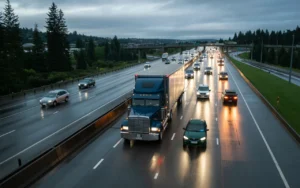
Truck accidents occur with alarming frequency across the Seattle metropolitan area. The Washington State Department of Transportation reports that truck collisions involving fatal injuries have increased in recent years. Data from WSDOT shows that King County alone recorded over 2,300 crashes involving large trucks in a single recent year – with roughly one in four causing injuries.
The physics explain the devastation. A fully loaded commercial truck can weigh up to 80,000 pounds. The average passenger vehicle weighs about 4,000 pounds. That is a 20-to-1 weight ratio. When these vehicles collide, occupants of smaller vehicles absorb catastrophic force – force that causes traumatic brain injuries, spinal cord damage, crushed limbs, and death.
Interstate 5, Interstate 90, State Route 99, and the industrial corridors near the Port of Seattle see heavy commercial truck traffic daily. These routes create a persistent risk for all motorists, pedestrians, and cyclists sharing the road with semi-trucks, tanker trucks, flatbeds, and delivery vehicles in the Puget Sound region.
Common Causes of Truck Accidents in Seattle
Driver Fatigue
Driver fatigue remains the leading cause of serious truck accidents in Seattle. The FMCSA enforces strict hours-of-service rules that limit how long a driver can be behind the wheel before taking a mandatory rest break. Drowsy driving is as dangerous as drunk driving – it impairs reaction time, decision-making, and lane control. Yet some trucking companies pressure drivers to violate these rules to meet delivery deadlines.
Distracted Driving
Distracted driving has become increasingly problematic as truck drivers use cell phones, GPS devices, and dispatch systems while operating 80,000-pound vehicles. Federal regulations prohibit handheld device use by commercial motor vehicle operators. Violations are common and often contribute to devastating collisions.
Speeding and Aggressive Driving
Commercial trucks require significantly longer stopping distances than passenger vehicles. At highway speeds, a loaded semi-truck needs 525 feet or more to come to a complete stop. Speeding eliminates the margin of safety and makes collisions unavoidable when traffic conditions change suddenly.
Improper Cargo Loading
Overloaded or improperly secured cargo causes trucks to become unstable. Cargo that shifts during transport can cause rollovers, jackknife accidents, or lost loads that create multi-vehicle pileups. Federal cargo securing rules exist for a reason – and loading companies that violate them can be held liable.
Vehicle Maintenance Failures
Brake failures, tire blowouts, and steering system malfunctions cause preventable accidents every year. FMCSA regulations require regular documented inspections and maintenance. Trucking companies that skip inspections or defer repairs to cut costs put every driver on the road at risk.
Impaired Driving
Drug and alcohol impairment among truck drivers creates extreme danger. Federal regulations require pre-employment, random, and post-accident testing. Despite these requirements, violations still occur and frequently result in catastrophic collisions.
Weather and Road Conditions
Seattle’s frequent rain, fog, and occasional snow create hazardous conditions for commercial trucks. Wet pavement increases stopping distances. Reduced visibility demands slower speeds. Some drivers fail to adjust their driving to these conditions.
Who Is Liable in a Seattle Truck Accident?
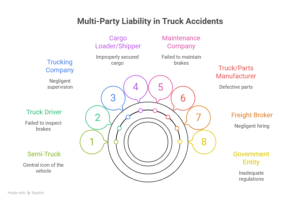
Truck accident cases often involve multiple liable parties. Identifying every responsible party is critical because it opens additional sources of insurance coverage and maximizes your compensation.
The Truck Driver
A driver who was distracted, fatigued, speeding, or impaired is directly responsible for the harm they cause. Evidence of hours-of-service violations, positive drug tests, or cell phone records can establish driver negligence.
The Trucking Company (Motor Carrier)
The trucking company may be liable for negligent hiring, inadequate training, pressure to violate safety rules, or failure to maintain its fleet. Under the legal doctrine of respondent superior, a company can be held responsible for the actions of its employees acting within the scope of employment.
Cargo Loaders and Shippers
The company responsible for loading the trailer can be at fault if cargo was unbalanced, overloaded, or improperly secured. Shifting cargo is a leading cause of rollover accidents.
The Maintenance Company
If a third-party maintenance provider failed to properly repair brakes, tires, or other critical components, that company may share liability for the crash.
The Truck or Parts Manufacturer
If a defective truck component – such as the braking system, steering mechanism, or tires – failed and caused the crash, the manufacturer may be liable under product liability law.
The Freight Broker
In some cases, a freight broker who negligently hired a trucking company with a known history of safety violations can also bear partial responsibility for the crash.
Government Entities
If the accident was caused by a dangerous road condition – such as poor signage, inadequate lighting, or a highway defect on a public road like I-5 or I-90 – the responsible government agency may be liable. Claims against government entities in Washington have stricter notice requirements and shorter filing deadlines than standard personal injury claims.
Washington State Laws That Affect Your Truck Accident Claim
Understanding Washington’s legal framework is essential to protecting your rights after a truck accident. Several key state laws directly impact how your claim is valued and how liability is determined.
Three-Year Statute of Limitations (RCW 4.16.080)
Washington law gives you three years from the date of the accident to file a personal injury lawsuit. Miss this deadline and you permanently lose your right to seek compensation. Revised Code of Washington § 4.16.080 governs this limitation period.
Three years may sound like enough time, but truck accident cases require extensive investigation, evidence preservation, expert analysis, and medical documentation. Starting early protects your claim.
For wrongful death claims, the three-year clock generally starts from the date of death, which may differ from the date of the accident.
Pure Comparative Fault (RCW 4.22)
Washington follows a pure comparative fault system under RCW 4.22. This means you can still recover compensation even if you were partially at fault for the accident. Your total award is simply reduced by your percentage of fault.
For example, if a jury determines you were 20% at fault and your total damages are $1,000,000, you would receive $800,000. There is no threshold that bars recovery – even at 99% fault, you can still recover 1% of your damages.
Under RCW 4.22.005, fault is apportioned among all parties – including the truck driver, trucking company, maintenance provider, and any other responsible entity.
No Cap on Noneconomic Damages
Unlike many states, Washington does not impose a cap on noneconomic damages. There is no statutory limit on compensation for pain and suffering, emotional distress, loss of enjoyment of life, or other intangible losses. This is critically important in catastrophic truck accident cases where the human cost of injuries is immense.
Government Entity Claims – Special Rules
If your truck accident was caused by a dangerous road condition maintained by a government agency, special rules apply. Claims against the State of Washington or municipalities like the City of Seattle require filing a formal tort claim notice within strict deadlines – often much shorter than the three-year statute of limitations. Failure to comply with these notice requirements can forfeit your claim entirely.
What to Do After a Truck Accident in Seattle
The steps you take after a truck accident directly affect the strength of your claim. While the trucking company’s investigators and lawyers begin working to protect their interests within hours, you deserve someone protecting yours.
Seek Medical Attention Immediately
Your health comes first. See a doctor within 72 hours of the accident – even if you feel fine initially. Some injuries, including traumatic brain injuries and internal bleeding, may not show symptoms right away. Prompt medical attention also creates documentation that links your injuries to the collision. Insurance companies will use any delay in treatment to argue your injuries are not serious.
Call the Police and Get a Report
Contact law enforcement immediately. The police report documents the scene, identifies the parties involved, and may include the responding officer’s observations about fault. This report is a foundational piece of evidence in your truck accident claim.
Document Everything at the Scene
If you are physically able, photograph the accident scene – vehicle damage, skid marks, road conditions, traffic signals, and any visible injuries. Get contact information from eyewitnesses. Write down everything you remember about the moments before impact as soon as possible. Details fade quickly.
Keep a Pain and Symptom Journal
Document your physical pain, emotional state, sleep disruptions, and daily activities you can no longer perform. Note specifics: “I cannot walk my dog around Green Lake,” “I cannot carry groceries,” “I wake up three times each night from pain.” This journal becomes powerful evidence of how the accident has diminished your quality of life.
Do Not Give a Recorded Statement to the Insurance Company
The trucking company’s insurance adjuster will contact you. They may sound sympathetic. They may say it is routine. Do not give a recorded statement without legal representation. Adjusters are trained to extract statements that can be used to reduce or deny your claim.
Stay Off Social Media
Do not post about the accident, your injuries, or your daily activities on social media. Insurance companies actively monitor social media accounts. A photograph of you smiling at a family event can be used to argue your injuries are not as severe as you claim.
Contact a Seattle Truck Accident Lawyer
Call an experienced truck accident attorney before speaking with anyone else involved in the claim. Your lawyer will send a spoliation letter to preserve critical evidence, handle all insurance correspondence, and begin building your case while you focus on healing.
Your injuries deserve full compensation. Your recovery starts with one call: 206-447-1425.
Proving Negligence in a Seattle Truck Accident Case
Can you sue after being hit by a commercial truck? Yes – if you can prove negligence. Washington law requires you to establish four elements.
Duty of Care
Every truck driver and trucking company has a legal duty to operate safely and follow all applicable federal and state regulations. This includes obeying speed limits, maintaining the vehicle, complying with hours-of-service rules, and exercising reasonable care for other motorists.
Breach of Duty
You must show the defendant breached their duty. Common breaches include: driving while fatigued, texting behind the wheel, failing to inspect brakes, exceeding weight limits, or violating FMCSA hours-of-service regulations. Evidence of the breach may come from electronic logging device data, surveillance video, witness statements, police reports, and photographs of the accident scene.
Causation
You must prove the breach directly caused your injuries. This is often the most contested element. Trucking companies will argue that something else caused the crash – weather, road conditions, or your own driving. Accident reconstruction experts analyze physical evidence, black box data, skid marks, and impact patterns to establish causation with scientific precision.
Damages
You must prove that the truck driver’s negligence caused real, compensable harm – medical expenses, lost wages, pain and suffering, and other losses. Medical records, expense receipts, employment documentation, and expert testimony all support your damages claim.
Our Seattle truck accident lawyers handle every element of this process. We investigate, we gather evidence, we retain experts, and we build the case that holds negligent parties fully accountable.
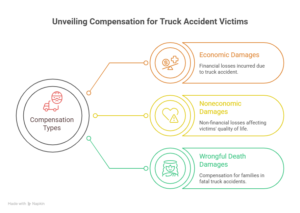
Compensation Available After a Seattle Truck Accident
A collision with an 80,000-pound commercial truck causes injuries that alter lives permanently. The compensation you receive must address a lifetime of needs – not just today’s medical bills.
Economic Damages
Economic damages cover your direct financial losses with specific dollar amounts attached.
Current and future medical bills encompass hospital stays, surgeries, rehabilitation, physical therapy, medication, in-home nursing care, and assistive devices. Lost wages cover income you have already lost from being unable to work. Loss of future earning capacity addresses permanent disability that prevents you from returning to your previous career or earning potential. Property damage includes the full replacement value of your vehicle and personal belongings destroyed in the collision. Home and vehicle modifications cover wheelchair ramps, accessible bathrooms, and adapted vehicles if your injuries require them.
Noneconomic Damages
These losses are devastating but do not come with a receipt. Washington imposes no cap on noneconomic damages.
Pain and suffering compensates for the physical agony you endure during treatment and recovery. Emotional distress and mental anguish cover anxiety, depression, PTSD, and other psychological trauma. Loss of enjoyment of life addresses your inability to participate in activities you once loved – biking, hiking, playing with your children. Permanent scarring and disfigurement compensate for visible, lasting physical changes. Loss of consortium allows your spouse to pursue a separate claim for the impact on your marriage – lost companionship, affection, and intimacy.
Wrongful Death Damages
When a truck accident takes a life, surviving family members may pursue a wrongful death claim for funeral and burial expenses, loss of the decedent’s income and financial support, loss of companionship, and the pain and suffering the decedent experienced before death.
Our legal team works with life care planners, vocational rehabilitation experts, and economists to calculate the full lifetime cost of your injuries. We build comprehensive demand packages that account for every past, present, and future loss.
How Insurance Companies Fight Your Truck Accident Claim
The insurance company for the trucking company is not on your side. Their sole objective is to protect their profits by paying you as little as possible – or nothing at all.
The Quick, Low Settlement Offer
Within days of the crash, an adjuster may call with what seems like a generous offer. This is almost always a fraction of your claim’s true value – extended before anyone knows the full extent of your injuries and future medical needs. Accepting it means signing away your right to any additional compensation forever.
The Recorded Statement Trap
The adjuster will ask for a recorded statement. They will say it is routine. In reality, they are looking for anything you say that can be twisted to minimize your injuries or assign blame to you. You have no legal obligation to provide one.
Delay, Deny, Defend
Insurers drag out the process hoping you become desperate enough to accept a low offer. They deny claims on technicalities. They blame your injuries on pre-existing conditions. They hire their own medical experts to contradict your doctors.
Surveillance and Social Media Monitoring
Insurance companies hire private investigators and monitor your social media accounts. A photograph of you at a family gathering, a comment about feeling “okay,” or any public activity can be used as evidence that your injuries are exaggerated.
Having a Seattle truck accident lawyer from Elsner Law Firm levels the playing field. We handle all insurance correspondence, reject premature settlement offers, and shield you from these tactics while building the strongest possible case.
Understanding FMCSA Regulations and Commercial Vehicle Standards
The trucking industry is one of the most heavily regulated industries in the United States. The Federal Motor Carrier Safety Administration (FMCSA), a division of the U.S. Department of Transportation, establishes and enforces rules designed to reduce crashes, injuries, and fatalities involving commercial motor vehicles.
Violations of these regulations are powerful evidence of negligence. Our Seattle truck accident lawyers investigate every potential regulatory violation.
Hours-of-Service Rules
FMCSA hours-of-service regulations limit how long a commercial truck driver can operate before taking a mandatory rest break. Drivers are required to log their hours using electronic logging devices (ELDs), which replaced paper logs to reduce falsification. We obtain ELD data and cross-reference it with GPS records, fuel receipts, and delivery schedules to uncover any violations.
Driver Qualification Standards
Commercial truck drivers must hold a valid Commercial Driver’s License (CDL), pass regular medical examinations, and submit to pre-employment, random, and post-accident drug and alcohol testing. Trucking companies must maintain driver qualification files documenting compliance. Negligent hiring – putting an unqualified or unsafe driver behind the wheel – is a common basis for trucking company liability.
Vehicle Maintenance and Inspection Requirements
Federal law requires regular documented inspections of brakes, tires, lights, steering systems, and other critical components. Maintenance records must be retained. When a brake failure, tire blowout, or steering malfunction causes an accident, these records become central evidence. Post-crash inspection reports conducted by law enforcement also reveal mechanical deficiencies.
Cargo Securement and Weight Limits
FMCSA regulations govern how cargo must be loaded, secured, and distributed. Federal weight limits cap gross vehicle weight at 80,000 pounds. Overloaded or improperly secured cargo creates unstable vehicles prone to rollovers, jackknife accidents, and lost loads. Loading companies, shippers, and freight brokers can all share liability when cargo violations contribute to a crash.
Types of Truck Accidents We Handle
Jackknife Accidents
A jackknife occurs when the trailer swings out at a sharp angle to the cab, often blocking multiple lanes of traffic. Sudden braking on wet roads, worn brake components, and excessive speed through curves are common causes. These accidents frequently involve multiple vehicles.
Underride Collisions
Underride collisions happen when a smaller vehicle slides underneath a truck’s trailer. They are among the deadliest truck accidents because the passenger compartment is crushed. Inadequate underride guards – and failure to meet current safety standards – often contribute to these tragedies.
Rollover Accidents
Rollovers occur when drivers take curves too fast, encounter high winds, or lose control due to unbalanced cargo or mechanical failures. A rolling semi-truck can crush everything in its path and trigger chain-reaction pileups.
Rear-End Collisions
A commercial truck that rear-ends a passenger vehicle at speed can cause catastrophic injuries. Brake failure, distracted driving, and following too closely are frequent causes.
Head-On Collisions
Head-on collisions between trucks and passenger vehicles are among the most fatal crash types. They typically occur when truck drivers cross center lines due to fatigue, distraction, or impairment.
Wide-Turn and Blind-Spot Accidents
Commercial trucks have significant blind spots on all four sides. Wide-turn accidents occur when a truck swings into adjacent lanes. Truck drivers are trained professionals with a legal duty to check their blind spots before turning or changing lanes – failure to do so is negligence, not the fault of surrounding drivers.
Multi-Vehicle Pileups
Pileups involving commercial trucks can affect dozens of vehicles. Poor weather, reduced visibility, and heavy traffic on corridors like I-5 and I-90 create conditions for catastrophic chain-reaction collisions.
Tire Blowout Crashes
Poor maintenance, overloading, and excessive heat cause tire blowouts that send truck drivers into uncontrolled skids across multiple lanes. These are preventable failures caused by negligent maintenance.
Injuries from Seattle Truck Accidents
The force generated by a collision with a commercial truck causes injuries far more severe than those in typical car accidents. Our Seattle truck accident lawyers have represented victims with every type of catastrophic injury.
Traumatic Brain Injuries
Traumatic brain injuries range from concussions to severe brain damage affecting cognitive function, memory, personality, and the ability to work. The long-term care costs for severe TBI can exceed millions of dollars over a lifetime.
Spinal Cord Injuries
Spinal cord injuries can result in partial or complete paralysis – paraplegia or quadriplegia. Victims may require lifetime medical care, home modifications, assistive devices, and round-the-clock personal care assistance.
Broken Bones and Orthopedic Injuries
Complex fractures may require multiple surgeries, metal hardware implantation, and months of physical therapy. Some victims never regain full function or range of motion.
Internal Organ Damage
Internal bleeding and organ damage can be life-threatening and require emergency surgery. Even survivors may face chronic health complications.
Amputation and Crush Injuries
The crushing force of a truck collision can cause traumatic amputations or injuries so severe that surgical amputation becomes necessary. Victims face lifetime adaptation, prosthetic devices, and ongoing rehabilitation.
Burn Injuries
Truck accidents involving fuel fires, chemical cargo spills, or electrical failures can cause severe burns requiring extensive treatment, skin grafts, and reconstructive surgery.
Permanent Scarring and Disfigurement
Severe lacerations and burns leave permanent visible scars. These injuries cause physical limitations and significant emotional distress.
Emotional Trauma and PTSD
Post-traumatic stress disorder, anxiety, depression, and sleep disorders are common after truck accidents. The psychological impact can be as debilitating as physical injuries and requires professional treatment.
Frequently Asked Questions About Seattle Truck Accidents
How long do I have to file a truck accident lawsuit in Washington?
Three years from the date of the accident. RCW 4.16.080 establishes this statute of limitations. If a government entity is involved – for example, a dangerous road condition on a state highway – you may face shorter notice deadlines. Do not wait. Contact an attorney as soon as possible to protect your rights.
Can I still recover compensation if I was partially at fault?
Yes. Washington follows pure comparative fault under RCW 4.22. Your compensation is reduced by your percentage of fault, but you are not barred from recovery. Even if you were 50% or more at fault, you can still recover damages.
How much does it cost to hire a Seattle truck accident lawyer?
At Elsner Law Firm, we handle truck accident cases on a contingency fee basis. You pay no upfront costs and no attorney fees unless we successfully recover compensation for you. The fee is a percentage of the total recovery.
Who can be held liable for a truck accident?
Multiple parties may share liability: the truck driver, the trucking company, the cargo loading company, the maintenance provider, the truck or parts manufacturer, the freight broker, and in some cases, a government entity responsible for road conditions.
Is there a cap on damages in Washington truck accident cases?
No. Washington does not impose a cap on noneconomic damages. There is no statutory limit on compensation for pain and suffering, emotional distress, or other intangible losses.
What if the trucking company blames me for being in the truck’s blind spot?
This is a common defense tactic. Truck drivers are professionally trained and licensed operators with a legal duty to check their blind spots before turning or changing lanes. We counter this defense with evidence – witness statements, the truck’s internal data, and accident reconstruction analysis – to prove the driver’s negligence.
How long will my truck accident case take?
Timelines vary based on injury severity, case complexity, and whether the case settles or goes to trial. Some cases resolve in months. Complex cases with severe injuries may take a year or more. Our priority is to secure the best possible outcome – not the fastest one.
What is a spoliation letter?
A spoliation letter is a formal legal notice sent to the trucking company demanding preservation of all evidence related to the crash – including black box data, driver logs, maintenance records, ELD data, and communications. Without this letter, critical evidence can be destroyed or overwritten. We send spoliation letters immediately upon engagement.
Seattle Truck Accident Lawyer – Take Action Today
The road to recovery after a commercial truck accident is long. But you do not have to travel it alone.
Elsner Law Firm provides the strength, resources, and experience to hold negligent trucking companies, drivers, and insurers fully accountable. We handle every detail – evidence preservation, insurance correspondence, expert consultations, settlement negotiations, and trial preparation – so you can focus on healing.
We have been fighting for injured people in Seattle, King County, and across Washington State since 2007. We understand the unique challenges of truck accident litigation. We know the local roads, the local courts, and the tactics the opposition will use.
You pay nothing unless we win. Free consultation. No obligation.
Whether you are a daily commuter injured on I-5, a family devastated by a crash on I-90, or a commercial driver hurt in the Duwamish industrial corridor – we are here for you.
Call 206-447-1425 now for your free case review. Or text us. Or fill out our online contact form. The sooner you call, the stronger your case.
Seattle truck accident attorneys at Elsner Law Firm. Fighting for you since 2007.
Areas We Serve in Washington State