CALL US NOW
 TEXT US NOW
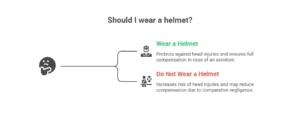
Does not wearing a helmet in Washington State affect your injury claim? The answer is: No, you can still file a claim, but it may impact your compensation.
Riding a motorcycle gives you freedom, but it also comes with risks especially if you’re not wearing a helmet. Washington State has a universal helmet law that all riders must follow, but even if you choose not to wear one, you’re still entitled to seek compensation for injuries caused by an accident. However, Washington’s pure comparative negligence law allows your compensation to be reduced based on your level of fault, including the decision to ride without a helmet. If you have been injured, a Motorcycle Accident Lawyer Seattle can help you navigate these complex legal issues.
In this blog, we’ll explain how Washington’s helmet law affects your injury claim, the penalties for not wearing a helmet, how your compensation might be impacted, and what steps you can take to ensure you get the recovery you deserve.By the end of this blog, you’ll learn:
- You can file a claim, but not wearing a helmet may reduce your compensation.
- Fines for not wearing a helmet range from $124 to $275.
- Pure comparative negligence can lower your settlement based on fault.
- Helmets significantly reduce the risk of severe injuries, especially head trauma.
- An experienced attorney can help ensure you receive fair compensation, even with the helmet defense.
By reading on, you’ll gain clarity on how Washington’s helmet laws affect your injury claim and how to navigate them to protect your rights.
What Is Washington’s Motorcycle Helmet Law?
Washington State’s motorcycle helmet law is governed by RCW 46.37.530, which mandates that all riders, both operators and passengers, must wear a helmet while riding on a motorcycle. The law requires that the helmet be properly fitted, fastened, and meet the standards set by the U.S. Department of Transportation (DOT).
Key Requirements:
- The helmet must be DOT-certified.
- It must have a secure chin strap.
- All riders, whether operators or passengers, are required to wear a helmet.
DOT-compliant helmet features include:
- A solid, sturdy outer shell.
- A thick inner foam layer for impact absorption.
- Proper chin straps to keep the helmet in place.
Because protective gear is vital, we have previously offered free bike helmets for safety to help protect our community. Failing to meet these requirements could result in being cited for a civil infraction, meaning a fine could be imposed on the rider.
What Are the Penalties for Not Wearing a Helmet in Washington?
Not wearing a helmet while riding in Washington can result in a civil infraction, which typically comes with a fine of approximately $124–$275. Unlike some states, there are no demerit points added to your driving record for this infraction. However, there are still consequences to consider.
Penalties for not wearing a helmet include:
- Base fine: $124–$275 (depending on the court and location).
- No demerit points: This violation does not affect your driving record.
- Insurance impacts: Insurers may view you as more negligent, potentially leading to a rate hike or reduced compensation in case of an accident.
Violation Base Fine Other Penalties No Helmet $124–$275 No points, insurance hike possible No Helmet + Other Violations Varies by offense Additional fines, possible higher penalties Understanding these penalties is essential when considering your safety and potential legal consequences.
Can You Still File an Injury Claim If You Weren’t Wearing a Helmet?
Yes, you can still file an injury claim if you weren’t wearing a helmet. Washington operates under a pure comparative negligence law, meaning that your failure to wear a helmet doesn’t bar you from pursuing compensation. Instead, your recovery may be reduced based on the percentage of fault assigned to you.
Key Points:
- Pure Comparative Negligence: Unlike contributory negligence states, Washington allows you to file a claim even if you are partly at fault. The compensation you receive will be reduced by your percentage of fault (e.g., 20-40% for not wearing a helmet).
- Reassurance: We understand that this concern can add stress after a crash, but it’s important to know that the absence of a helmet doesn’t eliminate your right to seek justice.
By working with a skilled attorney, we can help prove that you should receive full compensation for your injuries, regardless of helmet use.

How Does Not Wearing a Helmet Affect Your Compensation in Washington?
Not wearing a helmet can reduce the amount of compensation you receive for your injuries, as it may be seen as contributing to the severity of your injuries. In Washington’s comparative fault system, the degree of your fault (for example, not wearing a helmet) will reduce your overall settlement by that percentage.
Example of Comparative Fault in Action:
- If your total damages amount to $100,000, and you are found to be 20% at fault for not wearing a helmet, your compensation would be reduced by $20,000, leaving you with $80,000.
Damage Breakdown Example:
Fault (%) Total Damages ($100,000) Compensation After Fault 0% $100,000 $100,000 20% $100,000 $80,000 40% $100,000 $60,000 Head Injury Compensation vs. Non-Head Injury:
Head injuries, such as traumatic brain injury (TBI), are more severe without a helmet, and you could be awarded less compensation for these types of injuries compared to injuries like road rash or broken bones.
What Injuries Are More Common Without a Helmet – And How Are They Compensated?
Riding without a helmet increases the risk of severe injuries, especially head trauma. Motorcyclists who don’t wear helmets are at a higher risk of traumatic brain injuries (TBI), facial fractures, and spinal cord injuries.
Common Injuries for Unhelmet Riders:
- Traumatic Brain Injury (TBI): Helmets reduce head injury risk by about 69%.
- Facial Injuries: Fractured bones, deep lacerations.
- Spinal Injuries: Severe injuries leading to potential paralysis.
- Road Rash and Broken Bones: More common and often painful, though less catastrophic. If you suffer skin abrasions, knowing how to treat road rash is essential for a proper recovery.
With more severe injuries, you can expect higher medical expenses for surgeries, rehabilitation, and long-term care. Compensation for these injuries is critical for recovery, and the law provides a way to pursue financial support.
NHTSA Helmet Effectiveness:
Helmets are 37% effective in preventing fatalities and reduce the risk of head injuries by 69%. This means that wearing a helmet significantly impacts the severity of injuries and the costs associated with them.How Can Other Safety Gear (Like ATGATT) Help Your Claim?
While helmets are the most critical safety gear, wearing All the Gear, All the Time (ATGATT) can help reduce injury severity and even strengthen your claim. ATGATT includes other protective gear such as jackets, gloves, and boots.
Benefits of Other Safety Gear:
- Jackets: Provide full-body protection and reduce road rash.
- Gloves: Protect hands from abrasions and fractures.
- Boots: Prevent foot and ankle injuries in case of a crash.
Visual Comparison: Helmet vs. Full Gear Protection:
A helmet alone offers significant protection, but full gear increases your chances of minimizing injuries and improving your claim outcome.How Can a Skilled Attorney Fight the “No Helmet” Defense?
A skilled personal injury attorney can help counter the argument that not wearing a helmet should reduce your compensation. We gather evidence, consult with medical experts, and negotiate with insurance companies to ensure that your case is treated fairly.
Steps Your Attorney Can Take:
- Gather Evidence: Document the accident scene, medical records, and expert testimony.
- Consult Medical Experts: Use medical testimony to show that your injuries were not solely due to not wearing a helmet.
- Negotiate with Insurers: Fight for a fair settlement, avoiding lowball offers.
If you’re unsure about the impact of not wearing a helmet on your case, we offer free consultations 24/7 to help you navigate your options.
Why Choose Elsner Law Firm for Your Washington Motorcycle Claim?
At Elsner Law, we specialize exclusively in personal injury law in Washington State, and we’re committed to helping motorcycle riders like you recover the compensation you deserve.
Why Choose Us:
- 17+ Years of Experience: Focused solely on personal injury claims in Washington State.
- Contingency Fees: No upfront costs. We only get paid if you win.
- 24/7 Free Consultations: Call, text, or schedule an appointment at your convenience.
- Expert Network: Access to medical professionals, accident reconstruction specialists, and more.
- Higher Settlements: We often secure 3.5x the average settlement, and in some cases, up to 6x initial offers.
We’re here to help you heal while we fight for your full recovery.
Frequently Ask Questions
What are the consequences of not wearing a helmet?
In Washington, not wearing a helmet results in a civil infraction with fines between $124 and $275. This violation does not add points to your driving record, but it could affect your insurance rates.
What are the helmet laws in Washington State?
RCW 46.37.530 requires all motorcycle riders and passengers to wear a DOT-approved helmet that is fastened securely.
Is not wearing a helmet contributory negligence?
No, Washington operates under pure comparative negligence, meaning you can still file an injury claim, but your compensation may be reduced by the percentage of fault.
What is the penalty for no helmet?
The base fine ranges from $124 to $275, depending on the court, with possible additional fees for other violations.
What injuries are caused by not wearing a helmet?
Common injuries include traumatic brain injuries (TBI), facial fractures, spinal injuries, and road rash.
Conclusion
Not wearing a helmet in Washington State doesn’t automatically bar you from seeking compensation, but it can affect your claim. Helmets save lives, reduce injury severity, and help ensure you receive a fair settlement. At Elsner Law Firm, we’re here to fight for your rights and maximize your compensation no matter the circumstances.
Don’t let insurers undervalue your case. Contact Elsner Law for a free 24/7 consultation. No fees unless we win. Call, text, or schedule online today.