CALL US NOW
 TEXT US NOW
Why Seattle workers call Elsner Law Firm after a serious workplace injury
Work-injury review for unsafe conditions, falls, equipment failures, contractor negligence, falling objects, vehicle incidents, and serious on-the-job injuries.
Blame-shifting support when employers, contractors, property owners, equipment companies, or insurers dispute fault or minimize how the injury happened.
Evidence preservation guidance for photos, incident reports, safety records, witness accounts, medical records, wage loss, work restrictions, and ongoing limitations.
Washington personal injury focus for workers hurt by negligent third parties, unsafe job sites, dangerous equipment, motor-vehicle incidents, or unsafe premises.
Free case review by phone at 206-447-1425.
A Seattle workplace injury lawyer represents workers who suffer injuries or occupational diseases on the job by pursuing workers’ compensation benefits and third-party personal injury claims. Elsner Law Firm helps injured workers in Seattle and across Washington State recover the compensation they are entitled to under the law.
Workplace injuries in Seattle happen across construction sites, industrial facilities, warehouses, logging operations, and office environments every day. When an employer, contractor, equipment manufacturer, or property owner fails to maintain a reasonably safe workspace, workers bear the physical and financial consequences. A workplace accident can result in traumatic brain injuries, spinal cord injuries, broken bones, burns, amputations, and other catastrophic harm that changes your life permanently.
At Elsner Law Firm, our Seattle workplace injury attorneys understand the complexity of Washington’s workers’ compensation system and the legal pathways available to injured workers. We handle everything from filing claims with the Department of Labor & Industries to pursuing third-party lawsuits against negligent parties. We operate on a contingency fee basis, meaning you pay nothing unless we recover compensation for your injuries.
Injured at work in Seattle? Call Elsner Law Firm at 206-447-1425 for a free case evaluation. We fight for maximum compensation for your workplace injuries.
Why Do You Need a Workplace Injury Lawyer in Seattle?
A workplace injury lawyer in Seattle is needed because Washington’s workers’ compensation system is a no-fault system that limits employer liability, and navigating the intersection of workers’ compensation claims, third-party claims, and personal injury lawsuits requires specialized legal knowledge to maximize your financial recovery.
After a workplace accident, injured workers face pressure from insurance companies and employers to accept minimal settlements. The Department of Labor & Industries process involves strict deadlines, medical documentation requirements, and procedural steps that can overwhelm someone recovering from a serious injury. A work injury lawyer in Seattle handles these legal complexities while you focus on healing.
Your workplace injury attorney investigates the accident, identifies all liable parties, gathers evidence including incident reports, medical records, and witness statements, and determines whether your case qualifies for additional compensation beyond workers’ compensation benefits. This investigation often reveals third-party liability from subcontractors, equipment manufacturers, or property owners that the injured worker would not have identified on their own.
What Types of Workplace Injuries Qualify for Compensation in Seattle?
Workplace injuries that qualify for compensation in Seattle include any physical harm or occupational disease that occurs during the course of employment. Washington workers’ compensation covers both sudden traumatic injuries from workplace accidents and conditions that develop gradually through repetitive motion, toxic exposure, or prolonged hazardous working conditions.
What Are the Most Common Traumatic Workplace Injuries?
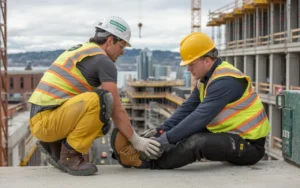
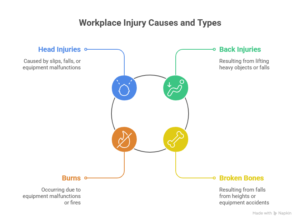
The most common traumatic workplace injuries in Seattle include traumatic brain injuries, spinal cord injuries, broken bones, burns, amputations, soft tissue damage, neck injuries, and electrocutions. These injuries typically result from sudden workplace accidents such as falls, equipment malfunctions, struck-by objects, or vehicle accidents at construction sites, industrial facilities, and commercial properties.
Traumatic brain injuries are among the most severe workplace injuries, often caused by falls from heights, falling objects, or equipment-related impacts on construction sites and industrial sites. Spinal cord injuries can result in partial or permanent disability, requiring extensive medical treatment and long-term rehabilitation. Broken bones, burns, and amputations frequently occur in industries where workers interact with heavy machinery, power tools, and hazardous materials without adequate safety protocols.
What Occupational Diseases and Repetitive Injuries Are Covered?
Occupational diseases covered under Washington workers’ compensation include conditions caused by toxic exposure, repetitive motion injuries, heatstroke, occupational illness from hazardous materials, and respiratory conditions from prolonged exposure to harmful substances. These conditions develop over time and have a separate two-year filing deadline from the date a physician provides written diagnosis.
Repetitive motion injuries affect workers across many Seattle industries, from warehouse workers and construction laborers to office employees performing repetitive tasks. Toxic exposure claims arise in industrial settings, manufacturing facilities, and construction sites where workers contact hazardous materials such as asbestos, chemical solvents, or industrial dust without proper protective equipment.
What Causes Workplace Accidents in Seattle?
Workplace accidents in Seattle are caused by slips and falls, equipment malfunctions, falling objects, improper training, exposure to hazardous materials, lack of safety protocols, human error, vehicle accidents, defective equipment, and unsafe working conditions. The specific causes vary by industry, but employer negligence and safety code violations are underlying factors in most preventable workplace injuries.
Construction sites account for a significant portion of workplace accidents in the Seattle area. The absence of guardrails, slippery surfaces, improperly maintained power tools, and defective equipment create hazardous conditions that lead to serious injuries. Logging operations in Washington State present additional dangers from heavy machinery failure, falling trees, and remote working environments where emergency medical response times are longer.
Industrial sites and warehouses expose workers to struck-by objects, equipment malfunctions, and repetitive motion hazards. Workplace violence, vehicle accidents on roadways during work duties, and exposure to toxic chemicals at hazardous premises are additional causes of workplace injuries that may give rise to both workers’ compensation claims and third-party personal injury lawsuits.
How Does Workers’ Compensation Work in Washington State?
Workers’ compensation in Washington State is a no-fault system administered by the Department of Labor & Industries that provides medical benefits and partial wage replacement to employees injured on the job, without requiring the worker to prove employer negligence. In exchange for these guaranteed benefits, the employee generally gives up the right to sue their employer directly for the workplace injury.
The Washington workers’ compensation system covers the vast majority of employees in the state, including temporary and part-time workers. When a workplace injury occurs, the injured worker must report the incident to the employer and file a claim with the Department of Labor & Industries within the applicable deadline. Once a claim is accepted, the worker receives medical benefits covering approved treatment and partial wage replacement for time missed from work due to the injury.
What Benefits Does Workers’ Compensation Provide?
Workers’ compensation in Washington provides medical benefits for approved treatment related to the workplace injury, partial wage replacement known as time-loss compensation for workers unable to perform their job, vocational rehabilitation services, permanent partial disability awards for lasting impairment, and death benefits for families of workers killed in workplace accidents.
Medical benefits cover doctor visits, hospital stays, surgery, prescription medications, physical therapy, and rehabilitation costs directly related to the workplace injury or occupational disease. Partial wage replacement through time-loss compensation provides a portion of the worker’s regular wages during the recovery period. These benefits are essential for covering immediate expenses, but they do not compensate for non-economic damages such as pain and suffering, emotional distress, or loss of enjoyment of life.
What Is the Difference Between Workers’ Compensation and a Third-Party Claim?
The difference between workers’ compensation and a third-party claim is that workers’ compensation is a no-fault benefit system filed through the Department of Labor & Industries, while a third-party claim is a personal injury lawsuit filed against a party other than your employer whose negligence caused or contributed to your workplace injury.
Workers’ compensation provides limited benefits focused on medical expenses and wage replacement. A third-party personal injury lawsuit allows the injured worker to seek full economic damages including all medical expenses and lost wages, plus non-economic damages such as pain and suffering, emotional distress, anxiety, depression, loss of enjoyment of life, and in rare cases, punitive damages. If a subcontractor, property owner, equipment manufacturer, or other third party contributed to your workplace accident, you may be able to pursue both a workers’ compensation claim and a third-party lawsuit simultaneously.
Third-party claims are common on Seattle construction sites where multiple contractors work alongside each other, on roadways where vehicle accidents involve non-employer drivers, and in cases involving defective equipment or product defects manufactured by a third-party company.
What Compensation Can You Recover for a Workplace Injury in Seattle?
Compensation recoverable for a workplace injury in Seattle includes economic damages such as medical expenses, rehabilitation costs, lost wages, out-of-pocket expenses, and property damage, as well as non-economic damages including pain and suffering, emotional distress, anxiety and depression, loss of enjoyment of life, permanent disability, and disfigurement through a third-party personal injury lawsuit.
What Economic Damages Are Available for Workplace Injuries?
Economic damages available for workplace injuries include all medical expenses related to the injury, future medical costs, rehabilitation costs, lost wages during recovery, loss of earning capacity for workers with permanent disability, out-of-pocket expenses, and property damage. These damages are calculated based on documented financial losses and are recoverable through both workers’ compensation and third-party personal injury claims.
Workers’ compensation provides partial wage replacement and covers approved medical treatment, but a third-party lawsuit allows recovery of the full amount of economic losses, including future medical expenses and diminished earning capacity that workers’ compensation does not fully address. Your Seattle workplace injury attorney documents every economic loss to build a comprehensive claim.
What Non-Economic Damages Can You Claim?
Non-economic damages available through a third-party workplace injury claim include pain and suffering, emotional distress, anxiety and depression, loss of enjoyment of life, permanent disability, disfigurement, and loss of consortium. These damages are not available through the workers’ compensation system and require filing a personal injury lawsuit against a negligent third party.
Non-economic damages compensate injured workers for the personal, non-financial impact of a workplace accident. A worker who suffers a spinal cord injury on a construction site may experience chronic pain, the inability to participate in activities they previously enjoyed, and lasting psychological effects such as anxiety and depression. These human costs are real and significant, and a workplace injury attorney quantifies them as part of the overall claim for compensation.
How Does Fault Affect Your Workplace Injury Claim in Washington?
Fault affects workplace injury claims differently depending on the type of claim. Workers’ compensation in Washington is a no-fault system where the injured worker receives benefits regardless of who caused the accident. Third-party personal injury lawsuits in Washington follow the pure comparative fault rule, which means a worker can recover compensation even if they are partially at fault, with the recovery amount reduced by their percentage of fault allocation.
Washington’s pure comparative fault system is one of the most favorable for injured workers in the United States. Unlike states that bar recovery when the injured party exceeds 50% or 51% fault, Washington allows recovery as long as the worker is not 100% at fault. If an injured worker is found 30% at fault for a workplace accident and the total damages are $500,000, the worker can still recover $350,000. This makes pursuing third-party claims worthwhile even when the worker shares some responsibility for the accident.
Insurance companies and opposing parties will attempt to shift blame onto the injured worker to reduce their financial liability. A workplace accident lawyer in Seattle protects against these tactics by building strong negligence proof through evidence gathering, expert testimony, and thorough investigation of safety code violations and unsafe conditions at the worksite.
What Are the Filing Deadlines for Workplace Injury Claims in Seattle?
The filing deadlines for workplace injury claims in Seattle depend on the type of claim. Workers’ compensation claims for industrial injuries must be filed within one year of the injury date. Occupational disease claims must be filed within two years of written physician notification. Third-party personal injury lawsuits have a three-year statute of limitations for negligence claims under Washington State law.
What Is the Workers’ Compensation Filing Deadline in Washington?
The workers’ compensation filing deadline in Washington is one year from the date of a sudden workplace injury for industrial injury claims, filed under RCW 51.28.050. For occupational disease claims, the deadline is two years from the date a physician or nurse practitioner provides written notice of the diagnosis and the worker’s right to file a claim, under RCW 51.28.055. Injured workers must also report the incident to their employer within 30 days.
Missing these deadlines can permanently bar access to workers’ compensation benefits, even when the injury is clearly work-related. The Department of Labor & Industries enforces these deadlines strictly. An employer report filing should happen immediately after the accident, and the injured worker should seek medical treatment and file the official claim as soon as possible to preserve all available benefits.
What Is the Statute of Limitations for Third-Party Workplace Injury Claims?
The statute of limitations for third-party workplace injury claims in Washington State is three years from the date of the injury for negligence-based claims and two years for claims involving intentional injuries. This three-year limitation period applies to personal injury lawsuits filed against subcontractors, property owners, equipment manufacturers, and other negligent third parties.
If the workplace accident results in a wrongful death, the statute of limitations for the wrongful death claim is also three years from the date of death. Missing these deadlines eliminates the ability to file a lawsuit and recover compensation through the court system. A Seattle workplace injury attorney monitors all applicable deadlines from the moment you begin your case to ensure no filing opportunity is lost.
What Industries Have the Highest Workplace Injury Rates in Seattle?
The industries with the highest workplace injury rates in Seattle and Washington State include construction, logging operations, manufacturing, warehousing and distribution, transportation, and healthcare. These industries expose workers to physical hazards including heavy equipment, elevated work surfaces, hazardous materials, repetitive tasks, and interactions with the public that increase the risk of workplace accidents.
Construction sites in Seattle are particularly dangerous due to multi-story building projects, infrastructure development, and the number of subcontractors working simultaneously on a single site. Falls from heights, struck-by objects, electrocutions, and caught-in or caught-between accidents account for the majority of construction injuries. Logging operations across Washington State involve heavy machinery, chain saws, falling trees, and remote locations that compound injury severity.
Industrial sites, warehouses, and transportation jobs involve equipment malfunctions, vehicle accidents, repetitive motion injuries, and exposure to toxic substances. Workers in these industries face daily hazards that employers are legally obligated to mitigate through proper training, safety equipment, guardrails, and adherence to safety protocols. When employers fail in this duty, injured workers have legal recourse.

How Does Elsner Law Firm Handle Workplace Injury Cases in Seattle?
Elsner Law Firm handles workplace injury cases in Seattle through a comprehensive process that begins with a free case evaluation and continues through investigation, claim filing, settlement negotiation, and trial representation when necessary. Our Seattle workplace injury attorneys identify every source of compensation available to you and pursue the maximum recovery for your injuries.
Our approach to workplace injury cases starts with a thorough investigation of the accident. We review the incident report, collect medical records, interview witnesses, inspect the accident site, and identify all potentially liable parties. If safety code violations, product defects, or negligence by a third party contributed to your injury, we pursue a personal injury lawsuit in addition to your workers’ compensation claim.
Throughout the process, we handle all communications with insurance companies, the Department of Labor & Industries, and opposing legal teams. We advance all costs related to your case and operate on a contingency fee basis, you pay nothing unless we win compensation for you. If settlement negotiation does not produce a fair result, our attorneys are prepared to take your case to trial.
Ready to fight for the compensation you deserve? Contact Elsner Law Firm at 206-447-1425 or schedule a free consultation online. We serve injured workers in Seattle, Tacoma, and across Washington State.
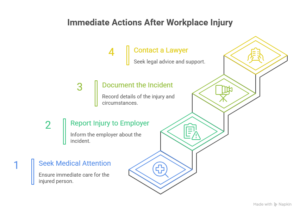
What Should You Do After a Workplace Injury in Seattle?
After a workplace injury in Seattle, you should seek immediate medical attention, report the injury to your employer within 30 days, document the accident scene and your injuries, preserve all evidence, and contact a Seattle workplace injury lawyer before speaking with insurance adjusters or signing any documents that could affect your claim.
Immediate medical treatment creates the documentation needed to connect your injuries to the workplace accident. Request that your treating physician file an L&I claim on your behalf or file the Report of Industrial Injury or Occupational Disease yourself through the Department of Labor & Industries. Photograph the accident scene, your injuries, and any equipment or conditions that contributed to the incident. Collect contact information from witnesses who observed the accident.
Do not give recorded statements to insurance companies without legal representation. Insurance adjusters work for the insurer, not for you, and statements you make can be used to minimize or deny your claim. Contact a work injury lawyer in Seattle as early as possible to protect your rights and ensure all filing deadlines are met.
What Evidence Strengthens a Workplace Injury Claim?
Evidence that strengthens a workplace injury claim includes the incident report filed with the employer, medical records documenting injuries and treatment, witness statements from coworkers and bystanders, photographs and video of the accident scene, safety code violation documentation, product defect evidence for faulty equipment, employer training records, and expert testimony establishing negligence.
Medical records are the foundation of any workplace injury claim. Consistent, detailed documentation from your treating physicians establishes the nature and severity of your injuries, the treatment required, and the causal connection between the workplace accident and your medical condition. Gaps in medical treatment or inconsistencies in reporting can be exploited by insurance companies to challenge your claim.
Safety code violations by the employer, contractor, or property owner provide powerful evidence of negligence in third-party claims. OSHA citations, Washington Industrial Safety and Health Act (WISHA) violations, and documented failure to follow industry safety standards demonstrate that the responsible party failed to maintain a reasonably safe workspace. Product defect evidence is equally important when defective equipment or machinery caused or contributed to the workplace accident.
Can You File a Wrongful Death Claim for a Fatal Workplace Accident?
Yes, a wrongful death claim can be filed when a workplace accident in Seattle results in the death of a worker due to the negligence of a third party. The surviving family members or the personal representative of the deceased worker’s estate can pursue a wrongful death lawsuit to recover compensation for medical expenses incurred before death, funeral costs, loss of financial support, loss of companionship, and other damages.
A wrongful death claim for a fatal workplace accident is separate from the death benefits available through workers’ compensation. Workers’ compensation death benefits provide financial support to surviving dependents, but they do not cover the full range of losses a family suffers. A third-party wrongful death lawsuit allows recovery of both economic damages and non-economic damages, including the emotional impact of losing a family member to a preventable workplace accident.
The statute of limitations for wrongful death claims in Washington is three years from the date of death. Elsner Law Firm represents families who have lost loved ones in construction site accidents, industrial incidents, transportation-related workplace deaths, and other fatal workplace injuries throughout Seattle and Washington State.
Why Choose Elsner Law Firm as Your Workplace Injury Lawyer in Seattle?
Elsner Law Firm is the right choice for a workplace injury lawyer in Seattle because we combine deep knowledge of Washington’s workers’ compensation system with aggressive personal injury litigation experience, provide personalized attention to every client, and fight for maximum compensation through settlement negotiation and trial representation on a contingency fee basis.
Our attorneys have a proven track record of recovering significant compensation for injured workers in Seattle, Tacoma, and throughout Washington State. We understand the physical, emotional, and financial toll that a workplace injury takes on workers and their families. Every case begins with a free case evaluation where we assess your legal options and explain the process in clear, straightforward terms.
We are available 24/7 to our clients and respond to calls, texts, and emails promptly. You can reach us at 206-447-1425, text us at the same number, or schedule a consultation online. From the moment you hire Elsner Law Firm, you will have a dedicated legal team working to protect your rights, meet all filing deadlines, and secure the best possible outcome for your workplace injury case.
Do not wait to get the legal help you need. Contact Elsner Law Firm today at 206-447-1425 for your free workplace injury case evaluation. We handle cases on a contingency fee basis — no fees unless we win.
Frequently Asked Questions About Workplace Injuries in Seattle
How Much Does It Cost to Hire a Workplace Injury Lawyer in Seattle?
Hiring a workplace injury lawyer at Elsner Law Firm costs nothing upfront. We work on a contingency fee basis, which means our legal fees are a percentage of the compensation we recover for you. If we do not win your case, you owe us nothing. All case-related costs are advanced by our firm during the process.
Can You Sue Your Employer for a Workplace Injury in Washington?
In most cases, you cannot sue your employer directly for a workplace injury in Washington because the workers’ compensation system provides the exclusive remedy against employers. However, you can file a third-party personal injury lawsuit against parties other than your employer, such as subcontractors, property owners, or equipment manufacturers, whose negligence caused your injury.
What If Your Workers’ Compensation Claim Is Denied?
If your workers’ compensation claim is denied by the Department of Labor & Industries, you have the right to protest or appeal the decision within 60 days of receiving the denial notice. A Seattle workers’ compensation lawyer can review the denial, identify the reasons for rejection, gather additional medical evidence, and represent you through the appeals process to fight for the benefits you are entitled to.
Can You Receive Workers’ Compensation and File a Lawsuit at the Same Time?
Yes, you can receive workers’ compensation benefits and file a third-party personal injury lawsuit simultaneously in Washington State. If someone other than your employer or coworker caused your workplace injury, you have the right to pursue both avenues of recovery. A workplace injury attorney coordinates both claims to maximize your total compensation.
What Is the Average Settlement for a Workplace Injury in Seattle?
The average settlement for a workplace injury in Seattle varies significantly based on the severity of the injury, the type of claim, the liable parties involved, and the specific circumstances of the accident. Settlements range from tens of thousands to millions of dollars depending on the extent of medical expenses, lost wages, permanent disability, and non-economic damages. A free case evaluation with a workplace injury lawyer provides a more accurate assessment based on the specific facts of your case.
What Areas Does Elsner Law Firm Serve for Workplace Injury Cases?
Elsner Law Firm serves workplace injury clients across Seattle, Tacoma, and all of Washington State. Our office is located in Seattle, and we represent injured workers from Brier, Pullman, Ellensburg, and communities throughout the state. We offer free consultations by phone, video, and in person to make legal representation accessible regardless of your location.