CALL US NOW
 TEXT US NOW
Catastrophic Injury Settlement Amounts
Catastrophic injury settlement amounts in Washington range from hundreds of thousands to multiple millions of dollars, depending on injury severity, permanent disability, and available insurance coverage. Washington’s pure comparative negligence law under RCW 4.22.005 and the absence of caps on non-economic damages give seriously injured victims a strong foundation for maximum recovery. This guide breaks down what life-altering injury settlements are worth in Washington for 2026, what factors drive compensation higher, and how to protect your claim from day one.
Introduction: The Profound Impact of Catastrophic Injuries in Washington State
A catastrophic injury does not just change your body. It changes everything. Your ability to work, care for your family, and live the life you planned can disappear in a single moment on a Seattle roadway, a Tacoma job site, or anywhere across Washington State. Medical bills pile up. Income stops. And the full cost of a life-altering injury, including future medical treatment, lost earning capacity, and permanent disability, often runs into the millions. If you or a loved one is facing this reality, speaking with a Seattle catastrophic injury lawyer can help you understand your legal options and pursue the compensation you may be entitled to.
Washington law gives catastrophic injury victims the right to pursue full compensation for every loss, economic and non-economic. But insurance companies do not pay fair settlements voluntarily. They evaluate claims to minimize payouts, not to reflect the true value of your suffering and long-term needs. Without the right legal strategy, victims routinely receive a fraction of what their catastrophic injury case is actually worth.
This guide gives you the information you need to understand catastrophic injury compensation in Washington for 2026, before you speak to an insurance adjuster, before you sign anything, and before you make a decision that affects the rest of your life.
Understanding the Scope of Life-Altering Injuries
Life-altering injuries affect every part of a victim’s existence. In Washington State, thousands of people suffer catastrophic injuries each year from car accidents on Seattle roadways, workplace incidents in Tacoma, and drunk driving crashes across King County. The CDC reports that traumatic brain injuries alone account for approximately 223,000 hospitalizations annually across the United States.
These are not injuries you recover from in weeks. Spinal cord injuries, amputations, severe burns, and permanent organ damage reshape a victim’s daily reality permanently. The financial impact follows the same pattern. A single catastrophic injury can generate $500,000 to several million dollars in lifetime medical costs, lost wages, and out-of-pocket expenses. Families in Washington face this financial reality while simultaneously dealing with the emotional weight of watching a loved one’s life change forever.
Why 2026 Matters: A Forward Look at Settlement Amounts
Catastrophic injury settlement amounts in Washington are rising in 2026. Medical inflation is a primary driver. The cost of long-term care, rehabilitation therapy, adaptive equipment, and specialized treatment has increased significantly over the past three years. Higher medical bills directly increase economic damage totals, which pushes overall settlement values higher.
Insurance companies are also adjusting their evaluation methods. Carriers are applying stricter scrutiny to catastrophic injury claims, particularly around permanent disability documentation and future medical treatment projections. Victims without strong legal representation are receiving lower initial offers in 2026 than in previous years. At the same time, Washington juries are demonstrating greater willingness to award substantial verdicts in life-altering injury cases, creating stronger negotiation leverage for plaintiffs with trial-ready legal teams.
The Importance of Expert Legal Guidance in Washington
Expert legal guidance is not optional in a catastrophic injury case. It is the single most important factor in determining your final settlement amount. Data consistently shows that injury victims represented by an experienced attorney recover an average of 3.5 times more than those who negotiate alone. In catastrophic injury cases, that difference can mean hundreds of thousands of additional dollars.
Elsner Law focuses exclusively on personal injury law in Washington State. With over 17 years of dedicated experience handling life-altering injury claims in Seattle, Tacoma, King County, and across Washington, the firm knows exactly how insurance companies evaluate catastrophic injury cases and how to counter their strategies. Every case is built as if it is going to trial. That preparation creates real pressure on insurance carriers to settle fairly.
Free consultations are available 24 hours a day, 7 days a week, by call 206-447-1425, text, or online scheduling. No upfront costs. No fees unless your case is won. If you cannot travel, home visits and virtual consultations are available. You have nothing to lose by getting a professional evaluation of your catastrophic injury claim today.
Defining a Catastrophic Injury in Washington: More Than Just Severe
A catastrophic injury is not simply a serious injury. It is an injury that permanently alters the way you live, work, and function. In Washington State, catastrophic injuries are those that result in permanent impairment, long-term disability, or a lifetime of medical treatment and care.
Characteristics of a Catastrophic Injury: Permanent Impairment and Life-Long Consequences
A catastrophic injury carries three defining characteristics. First, it causes permanent impairment that does not fully heal with treatment. Second, it disrupts the victim’s ability to work, earn income, or perform basic daily functions. Third, it requires ongoing medical care, rehabilitation, or adaptive living support for years or decades.
Washington courts and insurance companies evaluate injury claims using a tiered system. Tier 1 injuries are minor, such as soft tissue injuries, sprains, strains, and contusions. These typically resolve within weeks or months. Tier 2 injuries are serious but recoverable, including broken bones, disc herniations, lacerations, muscle tears, ligament tears, and dislocations. Tier 3 injuries are catastrophic. They are permanent, life-changing, and carry the highest catastrophic injury settlement amounts.
Tier 3 injuries produce the largest settlement ranges because their financial and human impact extends over an entire lifetime. A 35-year-old victim with a spinal cord injury in Seattle may require 40 or more years of in-home care, adaptive equipment, and ongoing medical treatment. That lifetime cost becomes the foundation of their catastrophic injury compensation claim.
Common Types of Life-Altering Injuries
The most common catastrophic injuries seen in Washington personal injury cases include traumatic brain injuries, spinal cord injuries, amputations, severe burns, and serious organ damage leading to chronic illness.
Traumatic brain injuries affect cognitive function, memory, personality, and physical coordination. They range from moderate impairment to a permanent vegetative state. Spinal cord injuries cause partial or complete paralysis, requiring adaptive living modifications, wheelchair equipment, and round-the-clock care in severe cases. Amputations result in permanent loss of limb function and require prosthetics, reconstruction specialists, and long-term physical adaptation.
Severe burns cause extensive scarring, require multiple surgeries, and produce significant psychological trauma. Organ damage from accidents involving high-speed collisions or drunk driving can lead to chronic illness requiring continuous medication and medical care for life.
Each of these injury types falls into the catastrophic category because recovery is never complete. The injuries are permanent. The costs are lifelong. And the impact on quality of life is profound.
Washington also recognizes permanently disfiguring injuries as catastrophic in many contexts, particularly when scarring affects visible areas of the body and causes lasting psychological harm. Sexual assault cases resulting in severe psychological trauma and permanent disability are also treated as catastrophic injury claims under Washington law.
Unpacking Damages: What Catastrophic Injury Settlements Cover in Washington
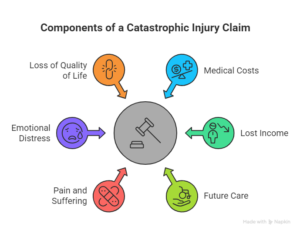
Catastrophic injury settlements in Washington cover two primary categories of damages: economic and non-economic. Together, these two categories determine the full value of your life-altering injury settlement. Understanding what each covers helps you recognize the true worth of your claim.
Economic Damages: Quantifiable Financial Losses
Economic damages are the measurable financial losses caused directly by your catastrophic injury. They are documented with medical records, pay stubs, invoices, and expert projections. Washington law allows full recovery of all economic damages with no caps or limits.
Medical bills are the largest component. These include emergency room treatment, hospitalization, surgeries, rehabilitation therapy, adaptive equipment, prescription medication, and ongoing specialist care. In catastrophic injury cases involving spinal cord injuries or traumatic brain injuries, lifetime medical costs routinely exceed $1 million. A young victim in Seattle with complete paralysis may require $4 million or more in lifetime care costs according to data from the Christopher and Dana Reeve Foundation.
Lost wages cover every workday missed during recovery. For victims who cannot return to their previous role or any meaningful employment, reduced earning capacity becomes a separate and significant damage category. A vocational expert calculates the difference between what the victim could have earned over their working lifetime and what they can realistically earn after the injury. This gap, documented precisely, adds substantial value to a catastrophic injury claim.
Out-of-pocket expenses are also fully recoverable. Home modification costs, transportation to medical appointments, in-home care services, and adaptive living equipment all qualify. Keep every receipt. Every dollar spent because of your injury belongs in your claim.
Non-Economic Damages: Compensation for Intangible Losses
Non-economic damages cover the human losses that do not appear on a medical bill. Washington law allows full recovery of these damages with no statutory cap, making the state one of the most favorable jurisdictions in the country for catastrophic injury victims.
Pain and suffering is the most recognized non-economic damage category. It compensates victims for the physical pain endured during treatment, recovery, and permanent impairment. In catastrophic cases involving severe burns, amputations, or permanent paralysis, pain and suffering awards alone can reach hundreds of thousands of dollars.
Emotional distress covers the psychological impact of the injury. Victims who develop depression, anxiety, PTSD, or a persistent fear of activities they once enjoyed are entitled to compensation for those losses. Psychological trauma following a catastrophic injury is well-documented and taken seriously by Washington courts and insurance companies alike.
Loss of enjoyment of life addresses the activities, relationships, and experiences a victim can no longer participate in because of their injuries. A parent in King County who can no longer play with their children, a worker in Tacoma who can no longer pursue their passion, or a young adult in Seattle whose independence is permanently reduced all have legitimate claims for this category of damages.
Loss of consortium compensates a victim’s spouse or partner for the loss of companionship, affection, and support caused by the catastrophic injury. Washington courts recognize this as a legitimate and often substantial component of life-changing injury compensation.
Key Factors Driving Settlement Value for Catastrophic Injuries in Washington 2026

Catastrophic injury settlement amounts do not follow a fixed formula. Several specific factors determine where your case lands within the settlement range. Understanding these factors helps you build a stronger claim and set realistic expectations for your catastrophic injury compensation.
The Severity of Injury and Documented Permanent Impairment
Injury severity is the most direct driver of catastrophic injury settlement value. The more permanent and disabling the injury, the higher the settlement range. Washington courts and insurance companies evaluate severity through medical records, imaging results, surgical reports, and specialist assessments.
Documented permanent impairment carries the most weight. An injury that fully heals produces a limited claim. An injury that leaves a victim with permanent paralysis, cognitive impairment, or loss of limb function produces a claim worth hundreds of thousands to multiple millions of dollars. The permanence of the injury directly affects future medical cost projections, lost earning capacity calculations, and non-economic damage valuations.
Injury permanence documentation begins at the moment of treatment. Every diagnosis, every specialist referral, and every prognosis statement in your medical records builds the foundation of your catastrophic injury case value. Gaps in medical treatment hurt claims. Consistent, well-documented care strengthens them significantly.
Establishing Negligence and Clear Liability: Who is at Fault?
Clear liability produces higher settlements. When fault determination is straightforward, insurance companies face stronger pressure to settle fairly and quickly. When liability is disputed, settlement negotiations become longer and more complex, and final amounts can be reduced.
Proof of fault in Washington catastrophic injury cases relies on evidence strength. Medical records, witness statements, accident reconstruction reports, police reports, and physical evidence from the scene all contribute to liability assessment. In high-speed collision cases on Seattle roadways or drunk driving incidents in Tacoma, establishing defendant fault percentage is typically stronger than in low-speed collision cases where liability is less clear.
Negligence per se claims, where a defendant violated a specific Washington law and that violation caused the injury, produce particularly strong liability arguments. A drunk driver in King County who caused a spinal cord injury, a property owner in Seattle who ignored a known hazard, or a medical provider whose negligence resulted in permanent organ damage all face clear liability exposure that supports maximum catastrophic injury compensation.
Washington’s Pure Comparative Negligence Law and Its Impact
Washington follows pure comparative negligence under RCW 4.22.005. This law allows you to recover compensation even if you were partially at fault for your injury. However, your catastrophic injury settlement amount is reduced by your fault percentage.
If your total damages are valued at $1 million and you are found 20% at fault, your recovery is reduced to $800,000. Insurance companies use this rule aggressively. Adjusters look for any evidence of plaintiff fault to justify a fault percentage reduction during settlement negotiation. Speeding, distraction, failure to follow safety protocols, or any behavior that contributed to the accident can be used to reduce your payout.
Your attorney’s job is to minimize your assigned fault percentage and maximize the defendant’s. Strong evidence, witness statements, and accident reconstruction specialists all serve this purpose. In catastrophic injury cases where millions of dollars are at stake, even a 10% difference in fault apportionment can mean $100,000 or more in additional recovery.
Available Insurance Coverage Limits
Insurance policy limits set a practical ceiling on many catastrophic injury settlements. Washington requires minimum liability coverage for drivers, but minimum coverage is rarely sufficient in catastrophic injury cases. Serious injuries involving permanent disability, lifetime medical treatment, and significant lost earning capacity quickly exceed standard policy limits.
Commercial liability policies and umbrella coverage expand available recovery significantly. A commercial truck driver in Washington who causes a catastrophic injury may carry $1 million or more in liability coverage. A property owner in Seattle may carry commercial liability policies with limits far above standard homeowner coverage.
When damages exceed available insurance coverage limits, your attorney pursues every additional source of recovery. This includes underinsured motorist coverage, employer liability policies, and in some cases, personal assets of the defendant. Identifying the full insurance picture early in your claim is essential to maximizing your catastrophic injury payout.
The Venue and Jurisdiction of Your Injury Claim
Where your case is filed affects its settlement value. Washington’s urban areas, particularly Seattle and King County, have jury pools that tend to award higher verdicts in catastrophic injury cases than rural jurisdictions. Insurance companies know this. Cases filed in Seattle courts carry stronger negotiation leverage than identical cases filed in smaller jurisdictions.
Venue also affects the timeline of your case. Courts in Seattle and Tacoma have established procedures for handling complex personal injury cases, including catastrophic injury claims involving multiple expert witnesses and extensive medical documentation. An attorney with deep knowledge of local courts, regional insurers, and jurisdiction-specific tendencies uses venue strategically to maximize your settlement amount.
Elsner Law maintains offices in Seattle, Brier, Ellensburg, and Pullman, giving the firm direct knowledge of courts and insurers across Washington State. That local expertise translates into stronger negotiation positioning for every catastrophic injury claim the firm handles.
The Expertise of Your Personal Injury Lawyers and Legal Strategy
Your attorney’s experience and legal strategy directly affect your catastrophic injury settlement amount. Insurance companies track which law firms consistently build trial-ready cases and which firms settle quickly for low amounts. A firm with a reputation for taking cases to trial when necessary creates real defendant pressure during settlement negotiation.
Elsner Law builds every catastrophic injury case as if it is heading to trial. This means complete documentation, expert witness coordination, demand package preparation, and a clear strategy for maximizing recovery at every stage. Clients of Elsner Law have recovered up to 6 times the initial insurance offer in some cases. Data shows that victims with experienced legal representation recover an average of 3.5 times more than those who negotiate alone.
Legal strategy also determines how non-economic damages are presented. Pain and suffering, emotional distress, and loss of enjoyment of life are subjective losses that require skilled presentation to reach their full value. An experienced catastrophic injury attorney knows how to document, frame, and argue these losses to insurance adjusters and juries alike.
Age of the Injured Party and Life Expectancy
Age is a significant factor in catastrophic injury case value. Younger victims typically recover higher settlements because their injuries affect a longer period of life. A 25-year-old victim with a traumatic brain injury in Seattle has 40 or more years of lost earning capacity, future medical treatment costs, and reduced quality of life ahead of them. That extended timeline produces substantially higher economic and non-economic damage calculations than an identical injury suffered by a 60-year-old victim.
Life expectancy projections are used by both life care planners and vocational experts to calculate the full lifetime cost of a catastrophic injury. Actuarial tables, medical prognosis reports, and expert testimony all contribute to this calculation. In multimillion-dollar catastrophic injury cases, age and life expectancy often determine whether a case settles in the high hundreds of thousands or crosses into multimillion-dollar recovery territory.
Child victims in Washington receive particular attention in catastrophic injury claims. Courts and juries respond strongly to evidence of a child’s diminished future, and settlement amounts in child catastrophic injury cases reflect that reality consistently.
Valuing Specific Life-Altering Injuries in Washington: A Deeper Dive (2026 Outlook)

Different catastrophic injuries produce different settlement ranges. Each injury type carries unique medical costs, functional limitations, and long-term care needs that directly shape catastrophic injury compensation amounts in Washington for 2026.
Traumatic Brain Injury (TBI) Valuation: Cognitive, Physical, and Behavioral Costs
Traumatic brain injury settlements in Washington are among the highest of any catastrophic injury category. TBIs affect cognitive function, memory, behavior, physical coordination, and emotional regulation. The full impact often takes months or years to fully surface, making early settlement offers particularly dangerous to accept.
Mild TBIs with full recovery produce limited claims. Moderate to severe TBIs with permanent cognitive impairment produce catastrophic injury settlement amounts ranging from $500,000 to several million dollars. A victim in Seattle with a severe TBI who can no longer work, requires daily care assistance, and experiences permanent personality changes may have a life-changing injury compensation claim worth $3 million or more when lifetime care costs and lost earning capacity are fully calculated.
Medical costs for severe TBI cases include neurology specialist care, neuropsychological evaluations, cognitive rehabilitation therapy, psychiatric treatment, and long-term in-home care. Future medical costs for a young TBI victim can exceed $2 million over their lifetime. These projections, documented by a life care planner and supported by medical specialists, form the economic foundation of a high-value TBI claim in Washington.
Behavioral and psychological changes following TBI also support substantial non-economic damage claims. Victims who lose their ability to maintain relationships, experience severe emotional dysregulation, or develop permanent depression and anxiety have documented losses that Washington courts treat seriously.
Spinal Cord Injuries (SCI) Valuation: Paralysis, In-Home Care, and Adaptive Living
Spinal cord injury settlements are consistently among the largest catastrophic injury payouts in Washington. Complete spinal cord injuries resulting in paraplegia or quadriplegia produce lifetime care costs that dwarf almost every other injury category.
According to data from the National Spinal Cord Injury Statistical Center, the average lifetime cost for a 25-year-old victim with high tetraplegia exceeds $5 million. In Washington, where medical costs in Seattle and other urban areas trend above national averages, these figures are often higher. Catastrophic injury settlement amounts for complete SCI cases in Washington regularly reach into the multimillion-dollar range.
Economic damages in SCI cases include emergency surgery, intensive care hospitalization, rehabilitation therapy, adaptive vehicle modifications, wheelchair equipment, home modification costs, and round-the-clock in-home care for severe cases. Lost earning capacity for a young victim with complete paralysis can exceed $1.5 million when calculated over a full working lifetime.
Non-economic damages in SCI cases are equally substantial. Permanent loss of mobility, sexual function, independence, and quality of life produces pain and suffering and loss of enjoyment of life claims that Washington courts and juries take seriously. A Tacoma resident whose spinal cord injury prevents them from ever walking, working, or living independently again carries a non-economic damage claim worth hundreds of thousands of dollars on its own.
Amputations Valuation: Prosthetics, Reconstruction Specialists, and Adaptation
Amputation settlements in Washington reflect both the immediate surgical costs and the lifetime expense of prosthetic devices, maintenance, and physical adaptation. Modern prosthetic technology is effective but expensive. A high-quality prosthetic limb costs between $5,000 and $70,000 depending on the type and technology level. Victims require replacement prosthetics every three to five years on average throughout their lifetime.
A young amputation victim in King County may require 10 or more prosthetic replacements over their lifetime, producing prosthetic costs alone of $500,000 or more. Add surgical costs, rehabilitation therapy, psychological treatment for body image and adjustment challenges, and lost earning capacity, and amputation catastrophic injury case values in Washington regularly reach $1 million to $3 million for working-age victims.
Reconstruction specialist costs are another significant component. Revision surgeries, wound care, and physical therapy following amputation add substantially to the economic damage total. Phantom limb pain, a documented chronic condition following amputation, supports ongoing pain and suffering claims throughout the victim’s lifetime.
Severe Burns Valuation: Extensive Surgeries, Scarring, and Psychological Trauma
Severe burn injury settlements in Washington reflect one of the most physically and psychologically devastating injury categories. Burns covering large body surface areas require multiple surgeries, extended hospitalization, skin grafting procedures, and years of reconstructive treatment.
The American Burn Association reports that severe burn treatment costs average $200,000 or more for initial hospitalization alone. For victims with burns covering 40% or more of their body surface area, total treatment costs including reconstructive surgeries and rehabilitation therapy regularly exceed $1 million. Washington catastrophic injury settlement amounts for severe burn cases reflect these medical realities.
Permanent scarring from severe burns produces significant non-economic damage claims. Visible scarring on the face, neck, or hands affects daily social interaction, professional opportunities, and psychological wellbeing permanently. Psychological trauma following severe burns, including PTSD, depression, and social withdrawal, is well-documented and strongly supported by psychological evaluation evidence.
Burn victims in Seattle and across Washington State who experienced their injuries due to workplace accidents, drunk driving crashes, or defective product failures have strong liability foundations for pursuing maximum catastrophic injury compensation. The combination of massive economic damages and profound non-economic losses makes severe burn cases among the highest-value catastrophic injury claims in Washington.
Organ Damage and Chronic Illness Valuation: Continuous Medical Care and Medication
Catastrophic organ damage resulting in chronic illness produces a different but equally serious category of life-altering injury settlement claims. Injuries causing permanent kidney damage, liver damage, heart damage, or respiratory impairment require continuous medical monitoring, ongoing medication, and in severe cases, organ transplant procedures.
The lifetime cost of managing chronic illness from catastrophic organ damage depends on the specific organ affected and the severity of impairment. A victim in Washington whose kidney damage requires dialysis three times per week faces lifetime treatment costs exceeding $500,000. A heart damage victim requiring ongoing cardiac medication, monitoring, and eventual surgical intervention faces comparable long-term medical expenses.
Lost earning capacity is a significant component of organ damage claims. Many victims with severe chronic illness cannot maintain full-time employment or must transition to lower-paying roles with reduced physical demands. Vocational experts document this earning capacity loss with precision, adding substantial value to the economic damage calculation.
Non-economic damages in chronic illness cases focus on the persistent, daily impact of living with permanent health limitations. The inability to exercise, travel, work at full capacity, or participate in family activities produces documented loss of enjoyment of life claims that support strong catastrophic injury compensation amounts in Washington.
Understanding Maximum Medical Improvement (MMI) and Future Needs Projections
Maximum Medical Improvement is the point at which a victim’s condition has stabilized and further significant recovery is not expected. In catastrophic injury cases, reaching MMI is a critical milestone for claim valuation. Before MMI, the full extent of permanent impairment is not yet established. After MMI, your attorney can document permanent limitations with precision and calculate future needs accurately.
Waiting for MMI before settling is essential in catastrophic injury cases. Insurance companies often push for early settlements before MMI is reached because early offers do not reflect the full lifetime cost of the injury. Accepting a settlement before MMI means waiving your right to compensation for future medical treatment costs, ongoing disability, and long-term care needs that have not yet been fully documented.
Once MMI is established, a life care planner projects all future medical needs over the victim’s expected lifetime. This projection covers future surgeries, ongoing therapy, medication costs, adaptive equipment replacement, and in-home care expenses. Combined with a vocational expert’s lost earning capacity analysis, the MMI-based future needs projection forms the foundation of the highest-value catastrophic injury settlement amounts in Washington.
The Indispensable Role of Expert Witnesses in Washington Catastrophic Injury Claims
Expert witnesses are not optional in catastrophic injury cases. They are essential. Insurance companies use their own experts to minimize claim values. Your legal team needs equally qualified professionals to counter those efforts and establish the true value of your life-altering injury settlement in Washington.
Life Care Planners: Projecting Long-Term Medical Treatment Costs and Needs
A life care planner is a specialized medical professional who projects every future care need a catastrophic injury victim will require over their lifetime. In Washington catastrophic injury cases, the life care plan is often the single most important document in the entire claim.
A thorough life care plan covers future surgeries, ongoing rehabilitation therapy, specialist appointments, prescription medication costs, adaptive equipment replacement schedules, home modification needs, and in-home care service costs. For a spinal cord injury victim in Seattle, a life care plan may project $3 million to $5 million in future needs. For a severe traumatic brain injury victim in King County, projected lifetime care costs documented in a life care plan can exceed $2 million.
Insurance adjusters scrutinize life care plans aggressively. They hire their own experts to challenge projections and argue for lower future cost estimates. A life care planner with strong credentials, documented methodology, and clear courtroom communication skills is essential to protecting the full value of your future needs projection. Elsner Law maintains access to a network of qualified life care planners who have experience in Washington catastrophic injury cases specifically.
Medical Specialists: Orthopedic Surgeons, Physiatrists, Neurologists, Psychologists
Medical specialist testimony establishes the permanent nature of catastrophic injuries and the ongoing treatment they require. Different injury types require different specialist involvement, and building the right expert team is a critical part of catastrophic injury claim preparation.
Orthopedic surgeons provide expert testimony on fractures, joint damage, and musculoskeletal injuries that result in permanent impairment. Physiatrists, specialists in physical medicine and rehabilitation, document functional limitations and long-term rehabilitation needs for victims with spinal cord injuries, traumatic brain injuries, and amputations. Neurologists establish the permanent neurological impact of brain injuries and spinal cord damage on cognitive and physical function.
Psychologists and psychiatrists document psychological trauma, PTSD, depression, and emotional distress following catastrophic injuries. Their evaluations transform subjective emotional suffering into documented clinical findings that support substantial non-economic damage claims. Insurance companies take psychological trauma claims far more seriously when they are backed by a licensed specialist’s formal evaluation than when they rely solely on the victim’s personal account.
Vocational Experts: Assessing Loss of Earning Capacity and Future Employment
A vocational expert evaluates a catastrophic injury victim’s pre-injury employment history, education, skills, and earning trajectory, then assesses what employment is realistically available after the injury. The difference between these two earning projections, calculated over the victim’s remaining working lifetime, produces the lost earning capacity figure that becomes a major component of economic damages.
In Washington, where median household incomes in Seattle and King County rank among the highest in the country, lost earning capacity calculations in catastrophic injury cases can be substantial. A 30-year-old software professional in Seattle whose traumatic brain injury prevents them from returning to their career faces a lost earning capacity claim potentially worth $2 million or more over a projected 35-year working lifetime.
Vocational experts also document the practical employment limitations imposed by the injury. A victim with permanent nerve damage, cognitive impairment, or physical disability may be limited to part-time work, sedentary roles, or positions paying significantly less than their pre-injury earnings. These documented limitations strengthen both the economic damage calculation and the broader narrative of how the catastrophic injury has permanently diminished the victim’s professional life.
Accident Reconstruction Specialists: Proving Liability and Negligence
Accident reconstruction specialists use physical evidence, vehicle data, road conditions, witness accounts, and engineering analysis to establish exactly how an accident occurred and who was at fault. In catastrophic injury cases where liability is disputed, their testimony is often the difference between a strong settlement and a reduced or denied claim.
In high-speed collision cases on Washington roadways, accident reconstruction specialists analyze skid marks, vehicle damage patterns, event data recorder information, and traffic camera footage to establish the defendant’s speed, reaction time, and fault percentage. In drunk driving cases in Tacoma or Seattle, reconstruction analysis combined with toxicology reports creates an overwhelming liability picture that pressures insurance companies toward fair settlement offers.
Accident reconstruction specialists are particularly valuable in cases where insurance companies argue comparative negligence against the victim. When an adjuster claims the victim was partially responsible for a catastrophic injury, a reconstruction specialist’s objective analysis can refute that argument with physical evidence. Reducing the plaintiff’s assigned fault percentage by even 10% in a $1 million catastrophic injury case means $100,000 in additional recovery.
Elsner Law works with experienced accident reconstruction specialists across Washington State. Their involvement in catastrophic injury cases sends a clear message to insurance carriers: this case is prepared for trial, and the liability evidence is strong.
Navigating the Catastrophic Injury Claim Process in Washington State

The catastrophic injury claim process in Washington follows a defined sequence of steps. Understanding each stage helps you make informed decisions, avoid costly mistakes, and maintain realistic expectations about your timeline and settlement outcome.
The Critical Statute of Limitations in Washington Law
Washington law gives catastrophic injury victims three years to file a personal injury claim. This three-year statute of limitations begins on the date of the injury under RCW 4.16.080. Missing this deadline means losing your right to compensation permanently, regardless of how severe your injuries are or how clear the defendant’s fault may be.
There are limited exceptions. Claims involving child victims allow the three-year clock to begin on the victim’s 18th birthday rather than the date of injury. Government entity claims in Washington require a separate notice of claim filing within a much shorter timeframe, sometimes as little as 60 days after the incident.
Do not wait. Evidence disappears. Witnesses relocate. Surveillance footage gets deleted. Medical records become harder to obtain. Every day that passes after a catastrophic injury makes building a strong claim more difficult. Starting the legal process early gives your attorney the maximum amount of time to gather evidence, consult experts, and build the strongest possible catastrophic injury case value before any deadline pressure appears.
Initial Injury Claim Filing and Communication with Insurance Companies
The first formal step in a catastrophic injury claim is notifying the relevant insurance company of your intent to pursue compensation. This communication establishes your claim and triggers the insurance company’s internal evaluation process.
Be careful here. Insurance adjusters contact catastrophic injury victims quickly, sometimes within 24 to 48 hours of an incident. Their goal is to gather information that minimizes the insurance company’s liability exposure. Recorded statements made without legal counsel present can be used to reduce your fault percentage, challenge your injury severity claims, or dispute the timeline of your medical treatment.
Do not give a recorded statement to any insurance company before consulting a Washington catastrophic injury attorney. Do not accept any early settlement offer before your injuries have reached maximum medical improvement. Early offers in catastrophic injury cases are almost always a fraction of the true claim value. Insurance companies make these offers precisely because they know victims do not yet understand the full lifetime cost of their injuries.
Elsner Law handles all insurance company communication on behalf of clients from the moment they are retained. This removes the risk of damaging statements, protects the integrity of the claim, and signals to the insurance carrier that the case is being handled by an experienced legal team.
Case Evaluation and Demand Letter Preparation
Once your attorney has gathered all necessary documentation, they calculate the full value of your catastrophic injury claim. This calculation covers every category of economic damages, including medical bills, future medical treatment costs, lost wages, and reduced earning capacity, as well as non-economic damages including pain and suffering, emotional distress, and loss of enjoyment of life.
The demand letter is the formal presentation of your claim to the insurance company. It is one of the most important documents in the entire settlement process. A strong demand letter establishes liability clearly, documents all damages with supporting evidence, references applicable Washington law including RCW 4.22.005 where comparative negligence is relevant, and states a settlement figure that reflects the full catastrophic injury case value.
Demand letters prepared by experienced Washington catastrophic injury attorneys carry significantly more weight than those prepared by victims representing themselves. Insurance adjusters recognize the difference between a professionally prepared demand package and an amateur submission. A well-constructed demand letter from a trial-ready firm like Elsner Law creates immediate negotiation leverage and sets the tone for the entire settlement discussion.
Negotiation and Settlement Discussions
Settlement negotiation in catastrophic injury cases is a structured process that typically involves multiple rounds of offers and counteroffers between your attorney and the insurance company’s adjusters and legal team. Initial insurance responses to demand letters are almost always lower than the stated demand. This is expected and is the beginning of the negotiation process, not the end.
Your attorney evaluates each counteroffer against the documented claim value and responds strategically. Strong evidence, expert witness reports, and trial readiness all create defendant pressure that moves insurance offers upward. Insurance companies factor trial risk heavily into their settlement calculations. A case backed by life care planner projections, vocational expert analysis, medical specialist testimony, and accident reconstruction evidence carries substantial trial risk for the defendant.
Confidential settlements are common in high-value catastrophic injury cases in Washington. Insurance companies often agree to settle for amounts significantly above their initial offers when facing a trial-ready legal team with strong evidence. Elsner Law clients have recovered up to 6 times the initial insurance offer in some cases, reflecting the firm’s consistent ability to shift negotiation dynamics through thorough case preparation.
Estimating Your Catastrophic Injury Settlement Amount: A Washington 2026 Perspective
Catastrophic injury settlement amounts in Washington for 2026 vary enormously. Understanding how claim values are calculated, what current economic factors are doing to settlement ranges, and how attorney experience affects final payouts gives you a realistic foundation for evaluating your own claim.
Why “Average” Settlement Amounts are Misleading for Catastrophic Injury Cases
There is no meaningful average catastrophic injury settlement amount. Stating an average figure for life-altering injury settlements is misleading because the variables between cases are too significant to produce a useful middle number.
A catastrophic injury case involving a minor permanent impairment with limited future medical needs may settle in the high hundreds of thousands. A catastrophic injury case involving complete paralysis, lifetime in-home care, and decades of lost earning capacity for a young victim in Seattle may settle for $5 million or more. Presenting these two cases under a single average obscures the reality of both.
What matters for your specific claim is not the average. It is the precise calculation of your documented economic damages, your projected future needs, your non-economic losses, and the strength of liability evidence in your case. That calculation, performed by an experienced Washington catastrophic injury attorney using life care planner projections, vocational expert analysis, and medical specialist documentation, produces the true value of your individual claim.
Insurance companies know this. They use average figures strategically to anchor early settlement offers at artificially low amounts. An experienced attorney rejects this framing entirely and builds your claim value from the ground up based on your specific losses.
How Settlement Value is Calculated: Considering Economic and Non-Economic Damages
Catastrophic injury claim valuation in Washington follows a structured methodology. Economic damages are calculated first because they are documentable with precision. Medical bills, future medical treatment cost projections, lost wages, and reduced earning capacity are totaled using medical records, expert reports, and actuarial analysis.
Non-economic damages are then calculated using a multiplier applied to the total economic damage figure. The multiplier method assigns a number between 1.5 and 5, or higher in severe cases, based on injury severity, permanence, pain levels, and life impact. A catastrophic injury case with $500,000 in economic damages and a multiplier of 4 produces $2 million in non-economic damages, bringing the total claim value to $2.5 million before any fault percentage reduction.
The multiplier assigned to a catastrophic injury case depends on several factors. Complete paralysis, permanent cognitive impairment, severe disfigurement, and profound loss of independence justify multipliers at the higher end of the range. Less severe permanent impairments with manageable ongoing care needs justify lower multipliers. An experienced Washington catastrophic injury attorney argues for the highest defensible multiplier based on documented evidence of the injury’s full human impact.
Washington’s pure comparative negligence rule under RCW 4.22.005 then applies any fault percentage reduction to the total calculated value. A $2.5 million claim where the victim is found 10% at fault produces a net recovery of $2.25 million. Minimizing the plaintiff’s assigned fault percentage is therefore a critical part of maximizing the final catastrophic injury payout.
Anticipating 2026 Economic Factors and Medical Inflation
Several economic forces are pushing catastrophic injury settlement amounts higher in Washington for 2026. Medical inflation is the most significant driver. The cost of hospitalization, specialist care, rehabilitation therapy, adaptive equipment, and in-home care services has increased substantially over the past three years across Washington State.
Higher medical costs produce higher economic damage totals. Higher economic damage totals produce higher non-economic damage calculations through the multiplier method. The compounding effect of medical inflation on catastrophic injury claim values in 2026 is measurable and significant.
Labor market conditions in Seattle and across Washington also affect lost earning capacity calculations. Rising median wages in King County and other urban areas mean the income gap between pre-injury and post-injury earning capacity is larger than it was three years ago for many victims. A wider earning capacity gap produces a higher economic damage figure and a correspondingly higher total claim value.
Insurance carriers are aware of these trends. They are applying more aggressive scrutiny to future cost projections and expert witness reports in 2026 specifically to counter the upward pressure on settlement amounts. Victims with experienced legal representation and well-documented expert evidence are better positioned to resist this scrutiny and secure settlements that reflect the true 2026 value of their catastrophic injury claim.
The Value of Attorney Experience in Maximizing Your Settlement Payout
Attorney experience is not just a credential. It is a direct financial factor in your catastrophic injury settlement amount. Data consistently shows that victims represented by experienced personal injury attorneys recover an average of 3.5 times more than those who negotiate alone. In catastrophic injury cases involving millions of dollars in potential recovery, that difference is transformative.
Experienced catastrophic injury attorneys know how to build claims that insurance companies cannot easily challenge. They know which expert witnesses produce the most credible and compelling testimony. They know how Washington courts in Seattle, Tacoma, and King County respond to specific injury types and liability arguments. They know when to push for a higher settlement and when trial preparation is the most effective negotiation tool available.
Elsner Law has spent over 17 years building catastrophic injury cases across Washington State. The firm’s exclusive focus on personal injury law means every case benefits from deep, specialized knowledge of Washington’s legal framework, insurance carrier behavior, and court dynamics. Cases are built trial-ready from day one. Expert networks are engaged early. Insurance companies receive a clear signal that lowball offers will be challenged at every stage.
Free case evaluations are available 24 hours a day, 7 days a week. No upfront costs. No fees unless your case is won. All case expenses are advanced by the firm. If you cannot travel to one of the firm’s offices in Seattle, Brier, Ellensburg, or Pullman, home visits and virtual consultations bring the legal team directly to you. Your catastrophic injury claim deserves the full weight of experienced legal representation. Get that evaluation today.
Taking Action After a Catastrophic Injury in Washington
The steps you take immediately after a catastrophic injury directly affect your recovery, your legal rights, and your final settlement amount. Acting quickly and deliberately protects everything.
Immediate Steps After an Accident
Get medical help first. Call 911 immediately after any accident involving serious injuries. Do not attempt to assess the severity of catastrophic injuries yourself. Spinal cord injuries, traumatic brain injuries, and internal organ damage are not always immediately apparent. Delaying medical treatment creates gaps in documentation that insurance companies use to challenge injury severity claims later.
At the hospital, be specific and thorough when describing your symptoms to medical staff. Every symptom recorded in your medical records becomes evidence in your catastrophic injury claim. Headaches, numbness, cognitive difficulties, vision changes, and emotional disturbances following an accident all have legal significance. Do not minimize or omit any symptom, no matter how minor it seems at the moment.
Contact law enforcement and ensure an official police report is filed. In Seattle and King County, law enforcement response to serious accident scenes is standard. In other areas of Washington, you may need to request a responding officer specifically. A police report establishes the basic facts of the incident, identifies witnesses, and creates an official record that supports fault determination.
Document everything you can from the accident scene if your condition allows. Photographs of vehicle damage, road conditions, hazardous premises, or any other physical evidence are valuable. Collect names and contact information from witnesses before they leave the scene. If you are unable to gather evidence personally due to your injuries, ask a trusted person present to do it on your behalf.
Do not speak to insurance company representatives without legal counsel. Do not post about your accident or injuries on social media. Insurance adjusters actively monitor social media accounts of injury victims looking for content that contradicts injury severity claims. A single photograph or post can be used to reduce your fault percentage or challenge your non-economic damage claims.
Start a personal injury journal as soon as you are physically able. Record your daily pain levels, functional limitations, emotional state, sleep disruption, and any activities you cannot perform because of your injuries. Consistent, detailed personal documentation supports pain and suffering claims and loss of enjoyment of life damages throughout your catastrophic injury case.
Why Legal Advice from an Experienced Catastrophic Injury Attorney is Crucial
Catastrophic injury cases are the most complex personal injury claims in Washington law. The stakes are high. The legal issues are sophisticated. The insurance company opposition is well-resourced and experienced. Attempting to handle a life-altering injury settlement without experienced legal representation puts millions of dollars in potential recovery at serious risk.
Insurance companies assign senior adjusters and experienced defense attorneys to catastrophic injury claims immediately. These professionals have one goal: minimize the payout. They know Washington’s pure comparative negligence rules under RCW 4.22.005. They know how to challenge future medical cost projections. They know how to dispute lost earning capacity calculations. They know how to use early recorded statements and social media content against victims. Without an equally experienced legal team on your side, you are at a significant disadvantage from day one.
Elsner Law levels that playing field completely. With over 17 years of exclusive personal injury law experience in Washington State, the firm brings the same depth of knowledge, expert resources, and strategic preparation that insurance companies deploy, and directs it entirely toward maximizing your catastrophic injury compensation. Offices in Seattle, Brier, Ellensburg, and Pullman give the firm statewide reach with local court knowledge in every major Washington jurisdiction.
The firm’s contingency fee structure means you pay nothing unless your case is won. All case expenses are advanced with no upfront costs. Free consultations are available 24 hours a day, 7 days a week, by call, text, or online scheduling. Home visits and virtual consultations are available for victims who cannot travel. Every client is treated as an individual, not a case number, with compassionate, personalized attention throughout every stage of the claim process.
Catastrophic injury victims in Washington who work with experienced legal representation recover an average of 3.5 times more than those who negotiate alone. Elsner Law clients have recovered up to 6 times the initial insurance offer in some cases. Full policy limits have been secured in cases where unrepresented victims were offered a fraction of that amount.
Frequently Asked Questions About Catastrophic Injury Settlements in Washington
How much is my catastrophic injury case worth in Washington?
Your catastrophic injury settlement amount depends on several specific factors unique to your case. Economic damages include all medical bills, future medical treatment costs, lost wages, and reduced earning capacity, documented through medical records and expert projections. Non-economic damages cover pain and suffering, emotional distress, and loss of enjoyment of life, typically calculated using a multiplier (1.5 to 5 or higher) applied to your economic damages. For example, a spinal cord injury case with $1 million in lifetime medical costs and lost wages might justify a multiplier of 4, producing $4 million in non-economic damages for a total claim value of $5 million. However, available insurance coverage, injury severity, your age, and the strength of liability evidence all affect the final amount. An experienced attorney calculates your specific claim value using life care planners, vocational experts, and medical specialists rather than relying on misleading “average” settlement figures.
How long do I have to file a catastrophic injury claim in Washington?
Washington law gives you three years from the date of injury to file a personal injury claim under RCW 4.16.080. Missing this deadline means losing your right to compensation permanently, regardless of how severe your injuries are. There are limited exceptions: claims involving child victims allow the three-year clock to begin on the victim’s 18th birthday. Claims against government entities require a separate notice of claim within a much shorter timeframe, sometimes as little as 60 days. Do not wait to start the legal process. Evidence disappears, witnesses relocate, and medical records become harder to obtain with each passing day.
What happens if I was partially at fault for my accident?
Washington follows pure comparative negligence under RCW 4.22.005, which means you can still recover compensation even if you were partially responsible for your injury. However, your settlement amount is reduced by your fault percentage. If your total damages are valued at $2 million and you are found 20% at fault, your recovery is reduced to $1.6 million. Insurance companies use this rule aggressively, searching for any evidence of plaintiff fault to justify reducing your payout. Even small fault percentage differences matter significantly in catastrophic injury cases—a 10% difference in a $1 million case means $100,000 more or less in your pocket. An experienced attorney works to minimize your assigned fault percentage and maximize the defendant’s through strong evidence, witness statements, and accident reconstruction analysis.
When should I settle my catastrophic injury case?
Never settle before reaching Maximum Medical Improvement (MMI)—the point when your condition has stabilized and further significant recovery is not expected. Insurance companies often push for early settlements because early offers do not reflect the full lifetime cost of your injury. Accepting a settlement before MMI means waiving your right to compensation for future medical treatment, ongoing disability, and long-term care needs that have not yet been documented. Once you reach MMI, a life care planner can project all future medical needs over your expected lifetime, and a vocational expert can calculate your full lost earning capacity. Only with this complete documentation can your attorney calculate the true value of your catastrophic injury claim and negotiate a settlement that covers your actual lifetime costs.
Do I really need a lawyer for my catastrophic injury case?
Yes. Data consistently shows that catastrophic injury victims represented by experienced attorneys recover an average of 3.5 times more than those who negotiate alone. In cases involving millions of dollars in potential recovery, that difference is life-changing. Insurance companies assign senior adjusters and experienced defense attorneys to catastrophic injury claims immediately, and they know exactly how to minimize payouts using Washington’s comparative negligence rules, challenging future cost projections, and disputing liability. Without equally experienced legal representation, you face a severe disadvantage from day one. Beyond settlement amounts, attorneys handle all insurance communication to protect you from damaging recorded statements, coordinate expert witnesses (life care planners, vocational experts, medical specialists), prepare trial-ready cases that create negotiation leverage, and ensure you do not settle before understanding the full lifetime cost of your injuries.
Conclusion
Catastrophic injury settlement amounts in Washington for 2026 reflect the full lifetime cost of life-altering injuries. Traumatic brain injuries, spinal cord injuries, amputations, severe burns, and permanent organ damage produce settlements ranging from hundreds of thousands to multiple millions of dollars. The specific value of your claim depends on injury severity, documented permanent impairment, liability strength, available insurance coverage, and the quality of your legal representation.
Washington’s pure comparative negligence law under RCW 4.22.005, the absence of caps on non-economic damages, and the state’s favorable urban jury pools in Seattle, Tacoma, and King County all work in favor of seriously injured victims who build their claims correctly. The three-year statute of limitations under RCW 4.16.080 means the clock is already running. Evidence disappears. Witnesses move on. Early insurance offers are designed to close cases before victims understand what their catastrophic injury compensation is truly worth.
You now have the knowledge to recognize the real value of a life-altering injury settlement in Washington. You understand what economic damages cover, how non-economic damages are calculated, why expert witnesses are essential, and how the claim process works from initial filing through trial. That knowledge is your foundation.
What you do next determines your outcome. A free case evaluation with Elsner Law costs you nothing and commits you to nothing. Call, text, or schedule online any time of day or night. Home visits and virtual consultations are available statewide. No upfront costs. No fees unless your case is won. All expenses advanced by the firm.
Your catastrophic injury deserves the full weight of experienced Washington legal representation. One call (206-447-1425) starts the process. Make it today.