CALL US NOW
 TEXT US NOW
Seattle Car Accident Lawyer
Car Accident Lawyers in Seattle: Your Advocates After a Collision
When you’re involved in a car accident in Seattle, the aftermath can be overwhelming. As you deal with injuries, vehicle damage, and insurance companies, having dedicated Seattle car accident attorneys by your side can make all the difference. Our legal team is committed to fighting for the rights of accident victims throughout the Seattle metropolitan area, pursuing proper compensation rather than accepting quick settlements that don’t cover your needs.
Statistics show a significant decrease in car accidents in Seattle, with a 50% reduction from 2015 to 2024. However, despite fewer collisions overall, traffic fatalities have alarmingly increased by 90% during the same period. This troubling trend suggests that while overall accident numbers are down, those that do occur are increasingly severe, leaving victims with serious injuries and life-changing circumstances.
If you or a loved one has been injured in a Seattle car accident, contact us today for a free consultation at 206-447-1425. As experienced car accident lawyers, we understand what it takes to build a successful claim.
Table of Contents
- Why Choose Elsner Law Firm
- Meet Your Attorney: Justin Elsner
- Why Hire a Car Accident Lawyer
- How Much Does a Lawyer Cost
- What Compensation Can You Recover
- How Insurance Companies Minimize Claims
- How We Handle Your Case
- Types of Car Accidents We Handle
- Common Car Crash Injuries
- Common Causes of Car Accidents in Seattle
- What to Do After an Accident
- Seattle Car Accident Statistics
- Washington State Car Accident Laws
- Frequently Asked Questions
- Free Consultation
Why Choose Elsner Law Firm for Your Seattle Car Accident Case
The insurance company will assign a claims adjuster to your case within 24 hours. That adjuster’s job is to pay you as little as possible. You need an advocate whose job is the opposite.
Here is what sets Elsner Law Firm apart:
Serving Seattle since 2007. Nearly two decades of experience handling motor vehicle accident claims across Washington State. We know King County Superior Court. We know how Seattle insurers operate. That institutional knowledge shapes every decision we make on your case.
Personal attorney contact. Justin Elsner personally handles your case. You are not passed to an associate, a paralegal, or a case manager. When you call, you reach the attorney who knows your file.
Four Washington locations. Our offices in Seattle, Brier, Pullman, and Ellensburg mean we serve clients across the state, from the Puget Sound region to Central Washington. If you cannot come to us, we come to you.
No fees unless we win. We work on a contingency fee basis. You pay nothing upfront. Our fee comes only from the compensation we recover for you. If we do not win, you owe us nothing.
Free case review, same day. Call 206-447-1425. We will review your situation, explain your rights, and tell you exactly what your case is worth, at no cost and with no obligation.
Published legal guides for accident victims. Justin authored two books specifically for Washington car accident victims. That is not something every law firm does. It reflects a genuine commitment to client education, not just client representation.
Meet Your Seattle Car Accident Attorney
Justin Elsner founded Elsner Law Firm in 2007 after graduating cum laude from Seattle University School of Law. He is a member of the Washington State Bar Association and admitted to practice in the Western District of the Federal Court. For nearly two decades, Justin has dedicated his career to fighting for accident victims across King County, Snohomish County, Pierce County, Whitman County, and Kittitas County.
Justin’s commitment to this work is personal. During his high school years, he was involved in a serious car crash. Unsure of what to do and intimidated by the insurance process, his family turned to a personal injury attorney. That experience showed him how much a knowledgeable legal advocate changes the outcome for accident victims. It shaped everything he built at Elsner Law Firm.
He has since authored two client resources: “7 Mistakes Accident Victims in Washington Make and How to Avoid Them” and “Your Guide to the First 30 Days After a Crash.” Both reflect his belief that informed clients get better results.
Justin handles motor vehicle accidents, pedestrian and bicycle accidents, wrongful death, dog bites, and premises liability cases. He is a triathlete, a racing enthusiast, and above all a dedicated advocate for the people who trust him with their cases.
If you were injured in a car crash in Seattle, Brier, Pullman, or Ellensburg, Justin and the Elsner Law Firm team are ready to fight for your full recovery.
Call 206-447-1425 or email justin@elsnerlawfirm.com for a free consultation today.
Why Should I Hire a Car Accident Lawyer in Seattle?
Most people wonder whether hiring a lawyer is really necessary. The answer depends on one question: do you want to maximize what you recover?
Research consistently shows that accident victims represented by attorneys recover significantly more in settlements than those who negotiate alone. The Insurance Research Council found that represented claimants receive settlements approximately 3.5 times higher on average than unrepresented claimants.
Here is why the gap is that large:
Insurance adjusters use trained negotiation tactics. They know the rules better than you do. They know how to ask questions that shift blame onto you. They know how to frame your injuries as pre-existing. They know that most unrepresented victims accept the first offer out of exhaustion or financial pressure. An experienced car accident attorney knows every one of these tactics and knows how to counter them.
You cannot accurately value your own case. You know your current medical bills. You may not know how to calculate future rehabilitation costs, reduced earning capacity, or the monetary value of ongoing pain and suffering. A Seattle car accident attorney quantifies all of it and builds documentation that supports the full number.
Washington’s pure comparative negligence law is a tool insurers use against you. Under RCW 4.22.005, your compensation reduces by whatever percentage of fault is assigned to you. If an adjuster can argue you were 30% at fault, your $200,000 case becomes a $140,000 settlement. Your lawyer protects against fault-shifting arguments with evidence gathered from the scene, police reports, traffic camera footage, and witness statements.
Evidence disappears fast. Skid marks on I-5 fade within days. Security camera footage from Aurora Avenue businesses gets overwritten in 72 hours. Witnesses move on. An attorney mobilizes immediately to preserve what matters before it is gone.
You should be healing, not fighting. The weeks after a serious crash are not the time to read insurance policies, respond to adjuster calls, or research Washington tort law. Let your attorney handle the legal fight so you can focus on your recovery.
How Much Does It Cost to Hire a Seattle Car Accident Lawyer?
Elsner Law Firm works exclusively on a contingency fee basis. That means you pay no retainer, no hourly rate, and no consultation fee.
Our fee is a percentage of the compensation we recover for you. We only collect that fee if we win your case. If we do not recover money for you, you owe us nothing.
This structure exists because we believe every accident victim in Seattle, Tacoma, Bellevue, Renton, or anywhere in Washington deserves access to skilled legal representation, regardless of their financial situation. A serious car crash can wipe out savings overnight. The last thing you should face is a legal bill on top of medical bills.
During your free consultation, we will clearly explain the percentage and how the fee works. There are no hidden costs and no surprises.
Call 206-447-1425 to get started. There is no financial risk in calling.
How Much Compensation Can I Recover After a Seattle Car Accident?
The value of a car accident claim depends on the specific facts of your case. There is no universal number. But there is a framework, and understanding it helps you recognize when an insurance offer falls short.
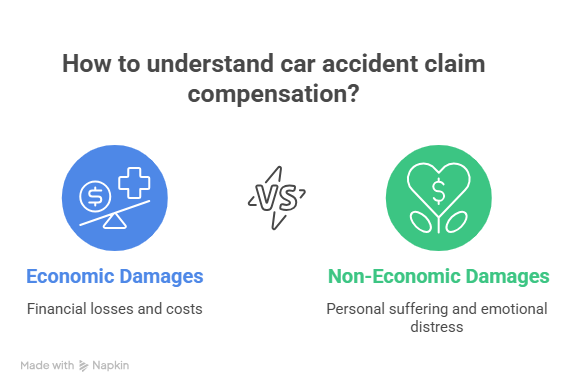
Washington law allows injury victims to pursue two categories of damages.
Economic Damages
Economic damages cover every financial loss you can document with receipts, bills, pay stubs, and medical records.
- Emergency room treatment, hospitalization, and surgery costs
- Follow-up appointments with specialists, neurologists, and orthopedic surgeons
- Physical therapy and occupational rehabilitation
- Prescription medications and medical devices (braces, wheelchairs, crutches)
- In-home nursing or personal care assistance
- Lost wages during your recovery period
- Reduced earning capacity if injuries affect your long-term ability to work
- Vehicle repair or replacement costs
- Out-of-pocket expenses directly related to the accident
Non-Economic Damages
Non-economic damages compensate for losses that do not come with a receipt but are just as real.
- Physical pain and ongoing suffering
- Emotional distress and anxiety
- Post-traumatic stress disorder (PTSD) following the crash
- Depression and sleep disruption
- Loss of enjoyment of life, including activities you can no longer do
- Physical scarring and disfigurement
- Loss of consortium, meaning the impact on your relationship with a spouse or family member
What Washington Law Does Not Allow
Punitive damages are generally not available under Washington state law. Courts here focus on compensating victims rather than punishing defendants. Your recovery is built on documenting actual harm, not seeking punishment payments.
Factors That Affect Your Specific Case Value
- The severity and permanence of your injuries
- Whether your injuries were worsened by any delay in seeking medical care
- The at-fault driver’s insurance coverage limits
- Whether you carry uninsured or underinsured motorist coverage
- Any shared fault assigned to you under Washington’s comparative negligence rules
- The quality of documentation gathered early in the case
An experienced Seattle car accident attorney evaluates all of these factors and builds a demand that reflects the true, complete cost of what happened to you, not just what the adjuster offers in the first call.
How Insurance Companies Try to Minimize Your Claim
Insurance adjusters are not on your side. They are trained professionals whose performance is measured, in part, by how much money they save the company on each claim. Understanding their tactics is the first step in protecting yourself.
The Quick Settlement Offer
Within days of your accident, you may receive a call offering a fast settlement. The offer sounds reasonable because you are in pain, your bills are mounting, and the money feels urgent. But quick offers almost always arrive before the full cost of your injuries is known. Once you accept and sign a release, you cannot go back for more, even if your medical treatment continues for years.
The Recorded Statement Request
Adjusters often call within 24 to 48 hours asking for a recorded statement about what happened. They frame it as routine. It is not routine. It is an opportunity to capture statements they can use to reduce your claim. You are not required to provide a recorded statement to the other driver’s insurer. Do not do it without speaking to an attorney first.
The Fault-Shifting Tactic
Under Washington’s pure comparative negligence law (RCW 4.22.005), your compensation reduces proportionally to any fault assigned to you. A 20% fault assignment on a $300,000 claim costs you $60,000. Adjusters know this. They look for anything in your statement, the police report, or accident photos to argue you share blame. Common targets include: your speed, your following distance, whether you were using your phone, and whether you were wearing a seatbelt.
The Medical Minimization Tactic
Adjusters may dispute that your injuries are as serious as your doctors describe. They may claim your back pain is a pre-existing condition. They may argue that the recommended surgery is not “medically necessary.” They hire independent medical examiners paid to produce opinions that serve the insurance company’s interests.
The Delay Tactic
Some insurance companies drag the claims process out for months. They request additional documentation repeatedly. They assign your claim to multiple adjusters. The goal is to exhaust your patience until you accept a lower offer out of desperation.
How We Protect You
Elsner Law Firm handles all communication with the insurance company from the moment you retain us. No recorded statements. No negotiations without preparation. No settlements until we know the full extent of your injuries and damages. We know every one of these tactics, and we have responses to every one of them.
How We Handle Your Seattle Car Accident Case
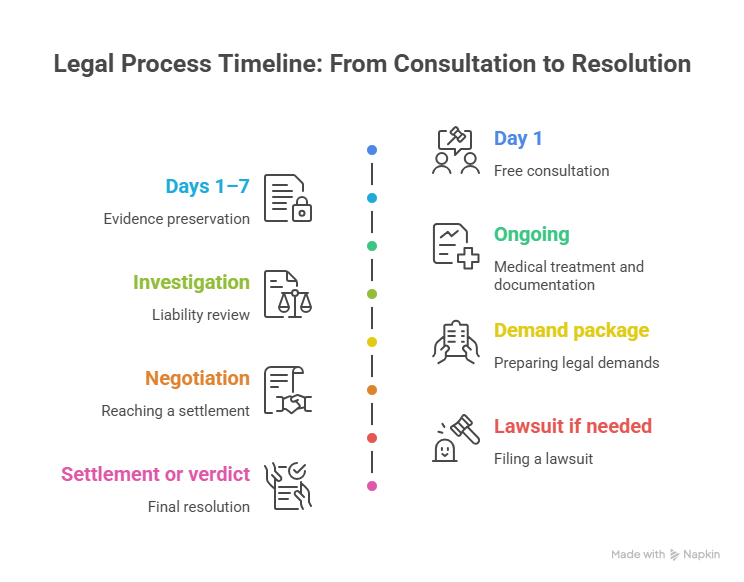
From the moment you call Elsner Law Firm, you have a team working on your case. Here is exactly what that looks like:
Step 1: Free Case Evaluation (Day 1)
Call 206-447-1425. We review the facts of your crash, answer every question you have, and tell you honestly what we believe your case is worth. No cost. No obligation. We take cases on contingency, so we only invest our time when we believe we can win.
Step 2: Evidence Preservation (Days 1 to 7)
We move immediately. Police reports are requested. Surveillance camera footage from businesses along the crash corridor, including gas stations, ATMs, and retail stores on Aurora Avenue, Rainier Avenue, or wherever your crash occurred, is subpoenaed before automatic deletion. Accident scenes are photographed. Black box data from involved vehicles is preserved where applicable.
Step 3: Medical Documentation (Ongoing)
We work alongside your treating physicians to ensure your medical records clearly link your injuries to the crash. We identify all current and anticipated future medical costs, including surgeries, rehabilitation, specialist care, and any required home modifications or assistive equipment.
Step 4: Liability Investigation
We identify every party that may bear responsibility. The at-fault driver. Their employer, if a commercial vehicle was involved. A government entity, if road conditions or signal failures contributed. Product manufacturers, if a vehicle defect played a role. Washington personal injury law allows claims against all responsible parties simultaneously.
Step 5: Demand Package Preparation
We prepare a detailed written demand to the at-fault insurer. This document includes the complete accident narrative, all medical documentation, economic loss calculations, non-economic damage analysis, and supporting legal authority. A strong demand package sets the anchor for negotiations.
Step 6: Negotiation
We counter every lowball offer with evidence. We do not accept settlements that fail to cover future medical costs or that undervalue your pain and suffering. Most Seattle car accident cases resolve at this stage, but resolution only happens on terms that fully compensate you.
Step 7: Litigation if Necessary
If the insurer refuses to offer fair compensation, we file suit in King County Superior Court or the appropriate venue. We have trial experience and do not shy away from the courtroom. Insurance companies know which attorneys will actually go to trial. That knowledge affects how they negotiate.

Types of Car Accidents We Handle
Not every car accident works the same way legally. The type of collision determines how liability is established, which insurance policies apply, and what evidence matters most. Elsner Law Firm handles all major accident types across Seattle and Washington State.
Rear-End Collisions
Rear-end crashes are the most common collision type in Seattle, accounting for nearly 29% of all local accidents. The trailing driver is typically presumed at fault, but insurers still challenge injury severity, especially in low-speed impacts. Whiplash and soft tissue injuries from rear-end crashes are frequently undervalued. We document them fully.
T-Bone and Intersection Accidents
T-bone crashes occur when one vehicle strikes the side of another, most often at intersections. Seattle intersections including Boren Avenue and Pike Street and James Street and 6th Avenue are among the city’s most dangerous. Side-impact collisions produce severe injuries because doors offer far less structural protection than front or rear panels.
Head-On Collisions
Head-on crashes are among the most deadly accident types. They frequently involve impaired or distracted drivers crossing the center line. The combined force of two vehicles traveling toward each other produces catastrophic injuries including spinal damage, traumatic brain injury, and fatal outcomes. These cases often involve criminal charges against the at-fault driver running parallel to your civil claim.
Multi-Vehicle Pileups
Multi-vehicle crashes on I-5, I-90, and SR-99 involve multiple insurers, overlapping liability claims, and complex fault assignments. Each insurer attempts to shift responsibility onto other parties. These cases require immediate legal intervention and careful coordination across multiple insurance carriers simultaneously.
Motorcycle Accidents
Motorcycle riders have no structural protection in a collision. Injuries are almost always severe. Insurers frequently apply bias against riders, arguing they were speeding or lane-splitting regardless of the facts. We counter those assumptions with accident reconstruction evidence and fight for the full value of motorcycle accident claims.
Hit and Run Incidents
If the at-fault driver fled the scene, your own uninsured motorist coverage becomes your primary source of recovery. We also work to identify the responsible driver through traffic camera footage, witness statements, and law enforcement cooperation. Hit and run victims have the same right to full compensation as any other accident victim in Washington.
Common Injuries Caused by Seattle Car Accidents
Car accidents cause a wide spectrum of injuries. Some appear immediately. Others develop over days or weeks. Both types carry legal significance, and both deserve proper documentation.
Traumatic Brain Injuries (TBI)
TBI ranges from mild concussion to severe brain damage. Symptoms include headaches, memory problems, difficulty concentrating, mood changes, and sensitivity to light and sound. Traumatic Brain Injuries often goes undiagnosed in the immediate aftermath of a crash because victims feel “okay.” Symptoms frequently worsen days later. If you hit your head or experienced a violent jolt, seek neurological evaluation immediately.
Spinal Cord and Back Injuries
The spine absorbs tremendous force in a collision. Herniated discs, fractured vertebrae, and spinal cord compression are common results. These injuries can cause radiating nerve pain, numbness in the limbs, or in severe cases, permanent paralysis. Spinal injuries are expensive to treat and frequently require surgery, long-term physical therapy, and lifestyle adjustments.
Whiplash and Soft Tissue Injuries
Whiplash is the most common injury in rear-end collisions. The neck snaps forward and backward violently, straining muscles, tendons, and ligaments. Symptoms often begin 24 to 48 hours after the crash. Soft tissue injuries are frequently undervalued by insurers because they do not appear on X-rays. An experienced attorney documents them through physical therapy records, MRI findings, and physician narratives.
Broken Bones and Fractures
Wrists, ribs, collarbones, legs, and pelvis fractures are common in moderate-to-severe crashes. Dashboard impact commonly fractures knees and lower legs. Airbag deployment can break wrists and facial bones. Fractures often require surgical fixation with rods, screws, or plates, followed by months of rehabilitation.
Knee and Hip Injuries
Dashboard impact and airbag force frequently damage knee ligaments (ACL, MCL) and hip joints. These injuries may require arthroscopic surgery or, in severe cases, full joint replacement. They can permanently alter a person’s mobility, particularly for older adults, workers in physical jobs, and athletes.
Internal Injuries
Blunt trauma from seatbelts, steering wheels, and door impacts can rupture organs including the spleen, liver, and kidneys. Internal bleeding does not always present symptoms immediately. Any crash involving significant abdominal impact warrants emergency evaluation even if you feel stable.
Burn Injuries
Fires, fuel ignition, airbag chemical deployment, and electrical system failures can cause significant burns. Burns require specialized wound care, may cause permanent scarring, and carry high treatment costs.
Scarring and Disfigurement
Lacerations from shattered glass, metal, and dashboard contact can cause visible, permanent scars. Disfigurement affects daily life, professional appearance, and psychological wellbeing. These losses are compensable under Washington personal injury law.
Psychological and Emotional Injuries
PTSD, anxiety, and depression following a serious crash are real, diagnosable, and legally compensable. Many accident victims develop a fear of driving or riding in vehicles. Sleep disorders are common. These conditions require treatment and belong in any complete damages claim.
If you experienced any of these injuries in a Seattle area collision, call 206-447-1425. The sooner you have legal representation, the better your documentation will be.
Common Causes of Car Accidents in Seattle
Seattle’s road network creates conditions that increase collision risk throughout every season of the year. Understanding the specific causes helps establish the negligence that supports your claim.
Distracted Driving
Washington State recorded 135 distracted driving deaths in 2023, a 36% increase from the prior year. Phone use is the most common cause. Texting at 55 mph means traveling the length of a football field without looking at the road. Seattle’s dense pedestrian corridors on Broadway, Pike Street, and Westlake Avenue make distracted driving particularly dangerous. Washington RCW 46.61.672 prohibits handheld phone use while driving and carries fines starting at $235.
Impaired Driving
Alcohol and drug impairment contributed to 400 traffic deaths in Washington in 2023. Cannabis impairment is an increasing factor following legalization. Impaired drivers have reduced reaction times, impaired judgment, and diminished ability to maintain lane position. Aurora Avenue North and Rainier Avenue South see a disproportionate share of impaired-driver crashes in Seattle. Driving under the influence is a criminal offense under RCW 46.61.502.
Excessive Speed
Speeding caused 251 traffic deaths statewide in 2023. High-speed corridors including I-5 through downtown Seattle, SR 99 through SoDo, and I-90 across the floating bridge see frequent speed-related crashes. Higher speeds reduce braking distance, increase crash severity, and reduce a driver’s ability to react to sudden stops or lane changes. When another driver’s speed contributed to your crash, that evidence is critical to your claim.
Failure to Yield and Intersection Errors
Seattle’s most dangerous intersections include James Street and 6th Avenue, Boren Avenue and Pike Street, and the 6-way intersection at 23rd Avenue South and Rainier Avenue. Intersection crashes frequently result from failure to yield on left turns, running red lights, and misjudging the speed of oncoming traffic. These crashes often produce T-bone impacts, which are among the most injury-producing collision types.
Weather and Road Conditions
Seattle averages approximately 38 inches of rain annually. Wet pavement reduces tire traction and increases stopping distances by up to 30%. The first rain after a dry period creates the most dangerous conditions as accumulated oil and rubber residue surface on roadways. Seattle’s steep grades in neighborhoods like Capitol Hill, Queen Anne, and First Hill amplify wet-weather braking risk. Hydroplaning is common on I-405 and SR 520 during heavy rain.
Tailgating and Aggressive Driving
The Mercer Mess and I-5 corridor through Seattle consistently rank among the most congested routes in Washington. Congested commuting conditions encourage tailgating and aggressive lane changes. Rear-end collisions account for approximately 29% of all Seattle crashes, and the rate rises during peak commute hours.
Unsafe Lane Changes
SR 99, I-5, and I-90 require frequent lane changes through short merge zones and narrowing roadways. Drivers who fail to check blind spots, signal, or allow adequate space before merging create multi-vehicle collision scenarios that are legally complex and frequently involve serious injuries.

What to Do After a Car Accident in Seattle
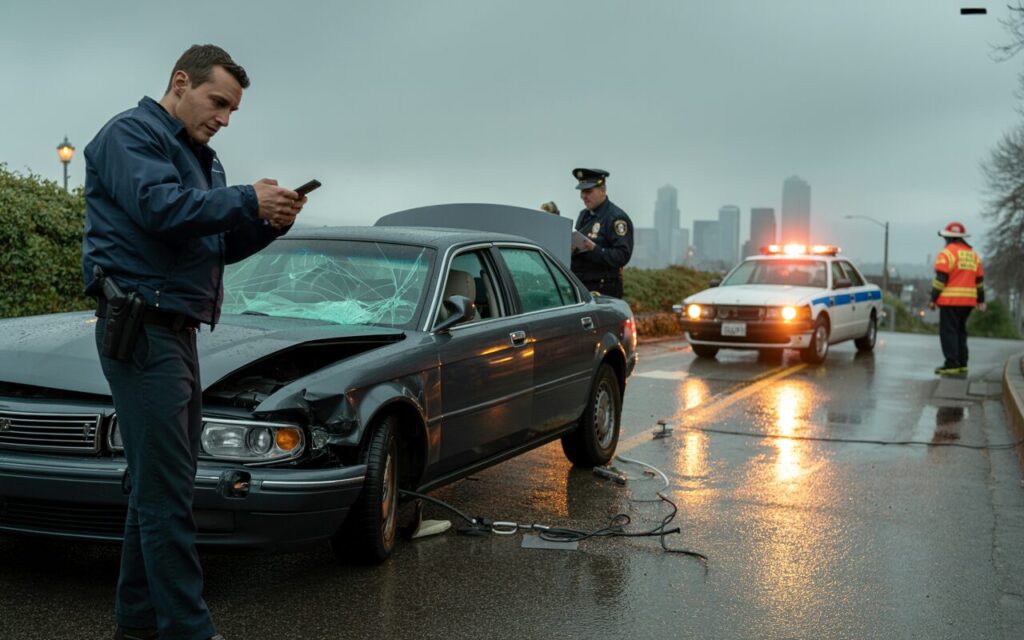
The steps you take in the 72 hours following a crash directly affect both your physical recovery and the strength of your legal claim.
1. Stay at the scene and call 911
Do not leave, even if the crash appears minor. Leaving the scene of an injury accident is a criminal offense in Washington under RCW 46.52.020. Request both police and medical response. The police report becomes a foundational piece of evidence in your claim.
2. Do not apologize or admit fault
Saying “I’m sorry” at the scene can be interpreted as an admission of liability. Under Washington’s comparative fault rules, any admission reduces your recovery. Keep statements factual: exchange information, cooperate with police, and say nothing about whose fault the crash was.
3. Document everything immediately
Take 20 to 30 photographs. Cover: both vehicles from multiple angles, close-up damage, the intersection or road layout, traffic signals or signs, skid marks, weather conditions, and any visible injuries. Video is better. If witnesses are present, get their names and phone numbers before they leave.
4. Seek medical care within 24 hours, even if you feel okay
Adrenaline suppresses pain. Whiplash, TBI, and internal injuries frequently present no symptoms for 24 to 72 hours. Delaying medical care gives insurers an argument that your injuries were not caused by the crash. A same-day medical visit creates a clear, unbroken chain of causation from the accident to your injuries.
5. Do not give a recorded statement to the other driver’s insurer
The other driver’s insurance company will call quickly. They will be friendly. They will say it is routine. Do not record a statement without legal counsel. You have no legal obligation to cooperate with the adverse insurer, and anything you say will be used to minimize your claim.
6. Preserve all physical evidence
Do not repair your vehicle until it has been photographed and evaluated by your legal team. The extent of vehicle damage directly correlates with the severity of injuries in legal proceedings. Keep all damaged clothing, broken items, and medical devices.
7. Track every expense and every symptom
Start a daily injury journal. Record your pain levels, sleep quality, activities you cannot perform, and emotional state. Save every receipt: prescriptions, medical copays, transportation to appointments, household assistance costs. This documentation becomes the foundation of your damages claim.
8. Contact Elsner Law Firm immediately
The sooner we are involved, the more evidence we can preserve, and the more protection you have from insurance company tactics. Call 206-447-1425 for a free same-day consultation.
Seattle Car Accident Statistics (Updated 2025)
Washington State traffic data documents a concerning pattern. Crashes are becoming less frequent but significantly more deadly.
Seattle recorded 8,443 total crashes in 2023, a slight increase from 8,408 in 2022. That number contrasts sharply with the 13,981 crashes recorded in 2014. The 40% reduction in total collisions reflects improvements in vehicle safety technology and traffic management. However, fatal crashes in Seattle increased from 18 in 2014 to 34 in 2023.
Statewide, Washington recorded 810 traffic deaths in 2023, the highest total in 33 years according to the Washington Traffic Safety Commission. The four leading causes, known as the “Fatal Four,” accounted for the overwhelming majority of those deaths:
- Impaired driving: 400 deaths
- Excessive speed: 251 deaths
- Failure to wear a seatbelt: 171 deaths
- Distracted driving: 135 deaths (a 36% increase from 2022)
Seattle-specific crash data from the Washington State Department of Transportation (WSDOT) shows the following 10-year trend:
| Year | Total Crashes | Fatal Crashes | Serious Injury Crashes | Drunk Driver Crashes |
|---|---|---|---|---|
| 2014 | 13,981 | 18 | 194 | 605 |
| 2015 | 14,483 | 22 | 172 | 609 |
| 2016 | 13,660 | 27 | 185 | 657 |
| 2017 | 12,938 | 30 | 198 | 711 |
| 2018 | 12,363 | 19 | 196 | 679 |
| 2019 | 11,110 | 27 | 191 | 629 |
| 2020 | 6,941 | 26 | 158 | 392 |
| 2021 | 8,005 | 44 | 204 | 503 |
| 2022 | 8,408 | 39 | 246 | 599 |
| 2023 | 8,443 | 34 | 288 | 591 |
Source: Washington State Department of Transportation (WSDOT) Crash Data Portal
The serious injury crash count reached 288 in 2023, up from 194 in 2014, even as total crashes declined. This reflects a structural shift: today’s crashes are more severe on average, more likely to require emergency hospitalization, and more likely to result in long-term disability.
For crash victims, these numbers carry a direct legal implication. More severe crashes produce larger damages. Larger damages attract more aggressive insurer resistance. That is exactly when experienced legal representation matters most.
Washington State Laws That Impact Your Car Accident Claim
Washington Is an At-Fault Insurance State
Washington does not use a no-fault insurance system. The driver who causes a collision bears financial responsibility for the resulting harm under Washington’s fault-based framework. Injured victims have three primary options for recovery:
- File a claim with the at-fault driver’s liability insurer
- File a claim with your own insurer under applicable coverage
- File a personal injury lawsuit directly against the at-fault driver in King County Superior Court or the appropriate Washington venue
Pure Comparative Negligence (RCW 4.22.005)
Washington follows the pure comparative fault rule. This means you can recover compensation even if you were partly responsible for the crash. Your total award reduces proportionally to your assigned percentage of fault.
If a jury awards you $200,000 and assigns 25% fault to you, your recovery is $150,000. If you are 50% at fault, you recover 50% of total damages. There is no fault threshold that bars recovery in Washington, unlike in contributory negligence states.
This rule creates a direct financial incentive for insurers to argue you share fault. Every percentage point they can assign to you reduces their liability dollar for dollar. Protecting against fault-shifting arguments is one of the most important functions your attorney performs.
Statute of Limitations (RCW 4.16.080)
Washington allows 3 years from the date of the accident to file a personal injury lawsuit. Missing this deadline permanently eliminates your right to pursue compensation through the courts, regardless of how strong your case is.
Three years sounds like a long time. It is not. Building a strong car accident case requires gathering medical records, securing expert witness testimony, commissioning accident reconstruction analysis, and preparing legal filings. Starting the process immediately protects evidence that will no longer exist in three years.
Do not wait. Call 206-447-1425 today.
Mandatory Insurance Requirements
Washington requires all drivers to carry minimum liability coverage of 25/50/10:
- $25,000 per person for bodily injury
- $50,000 per accident for bodily injury
- $10,000 for property damage
These minimums frequently fall short of covering serious injury claims. A single hospitalization for spinal surgery can exceed $100,000. A TBI requiring long-term care can exceed $1 million in lifetime costs. When the at-fault driver’s policy limits are insufficient, your own uninsured/underinsured motorist coverage becomes a critical source of recovery.
Personal Injury Protection (PIP)
Washington drivers may carry optional PIP coverage, which pays for immediate medical expenses and lost wages regardless of fault. PIP benefits are payable by your own insurer and do not require proving the other driver’s liability. If you have PIP coverage, use it immediately after your crash to begin paying medical bills while your liability claim is being developed.
Why Hire a Lawyer Immediately After a Seattle Car Crash
The 72 hours after your crash are the most legally important period of your entire case.
Evidence is destroyed in real time. Traffic cameras on Aurora Avenue North and Rainier Avenue South overwrite footage every 48 to 72 hours. Skid marks on I-5 are gone after rain. Witnesses leave the scene and become unavailable within days. Once evidence is gone, it cannot be recreated.
Insurance companies mobilize immediately. The at-fault driver’s insurer receives notification of the crash within hours. They assign an adjuster. That adjuster reviews the police report, photographs, and any statements made at the scene. They begin building a file designed to minimize the payout before you have even thought about legal representation.
Delayed medical care harms your claim. A gap between the accident and your first medical visit gives insurers an argument that your injuries are not crash-related. Seeing a physician within 24 hours creates an unbroken chain of causation. It is also simply the right thing to do for your health.
The statute of limitations clock starts immediately. You have 3 years under RCW 4.16.080. But effective legal preparation takes time. Cases filed close to the deadline are weaker cases. Start the process now.
Call Elsner Law Firm at 206-447-1425. Same-day consultations are available. There is no cost and no obligation to call.
Frequently Asked Questions
Should I accept the first settlement offer from the insurance company?
No. Initial offers from insurance companies are almost always significantly below the true value of your claim. They arrive before the full extent of your injuries is known, before you understand your future medical costs, and before you have legal representation. Once you accept a settlement and sign a release, you cannot seek additional compensation, even if your condition worsens. Always consult an attorney before accepting any offer.
What happens during my free consultation with Elsner Law Firm?
The consultation takes approximately 15 to 30 minutes by phone or in person. Justin Elsner reviews the facts of your crash, your current injuries, what the insurance company has communicated, and what documentation you have. He tells you honestly what he believes your case is worth, what evidence will be needed, and how the process will work. There is no cost, no obligation, and no pressure.
Do you charge any upfront fees or retainers?
No. Elsner Law Firm works exclusively on a contingency fee basis. You pay nothing unless we recover compensation for you. Our fee is a percentage of your settlement or verdict, which we explain clearly during your consultation. There are no hidden fees, no hourly billing, and no costs charged to you if the case does not result in a recovery.
How long do I have to file a car accident claim in Washington?
Washington’s statute of limitations for personal injury claims is 3 years from the date of the accident under RCW 4.16.080. Do not wait. Evidence deteriorates, witnesses become unavailable, and surveillance footage is deleted. The earlier you involve an attorney, the stronger your case.
What if I was partly at fault for the accident?
You can still recover compensation. Washington follows the pure comparative fault rule under RCW 4.22.005. Your award reduces by your percentage of fault, but there is no threshold that eliminates your right to recovery. If you were 40% at fault for a crash and your damages total $100,000, you can still recover $60,000. Protecting against inflated fault assignments is one of the most valuable things an attorney does for you.
Can I sue the other driver personally after a car accident in Washington?
Yes. If the at-fault driver’s insurance coverage is insufficient to compensate for your losses, you can file a civil lawsuit directly against the driver for the remaining amount. Whether this is worthwhile depends on the driver’s financial situation and assets. An attorney evaluates this as part of case strategy.
What is Washington’s minimum car insurance requirement?
Washington requires 25/50/10 minimum liability coverage: $25,000 per person for bodily injury, $50,000 per accident for bodily injury, and $10,000 for property damage. Many drivers carry only minimum coverage. In serious injury cases, these limits are frequently exhausted, making your own uninsured and underinsured motorist coverage critical to full recovery.
What if the driver who hit me was uninsured?
If the at-fault driver has no insurance, your own Uninsured Motorist (UM) coverage steps in to compensate you. If they have insurance but the limits are too low, your Underinsured Motorist (UIM) coverage makes up the difference. Washington allows UM/UIM coverage, and Elsner Law Firm handles all aspects of these claims. We also explore whether any other responsible parties, such as a vehicle manufacturer or government entity, may contribute to your recovery.
Do you handle hit-and-run car accident cases in Seattle?
Yes. Hit-and-run crashes are handled through your own uninsured motorist coverage when the at-fault driver cannot be identified. We also work to identify the responsible driver through traffic camera footage, witness accounts, social media investigation, and law enforcement cooperation. Hit-and-run victims have the same right to full compensation as any other accident victim.
What results has Elsner Law Firm achieved for car accident clients?
Elsner Law Firm has been fighting for Washington car accident victims since 2007. In that time, Justin Elsner has recovered compensation for clients across King, Snohomish, Pierce, Whitman, and Kittitas counties, handling rear-end collisions, intersection crashes, highway accidents, drunk driving cases, hit-and-run incidents, and commercial vehicle crashes. For specific case outcomes relevant to your situation, we encourage you to call 206-447-1425 and discuss your case directly.
How long does a Seattle car accident case take to resolve?
Most Seattle car accident cases resolve through settlement within 6 to 18 months. Cases involving disputed liability, serious injuries with ongoing medical treatment, or uncooperative insurers may take 2 to 3 years, including litigation. We do not push you toward a premature settlement. We wait until your medical situation has stabilized and the full value of your claim is established before negotiating final terms.
What should I know about multi-vehicle accidents in Seattle?
Multi-vehicle crashes, common on I-5, I-90, and during heavy-rain conditions on the Eastside corridors, involve multiple insurers, multiple fault assignments, and frequently, policy limit stacking issues. Each insurer’s adjuster will attempt to place as much fault on other parties as possible, including you. These cases require immediate legal intervention, careful liability investigation, and experienced negotiation across multiple insurance carriers simultaneously.
Is Washington a no-fault insurance state?
No. Washington operates under an at-fault system. The driver who caused your crash is legally and financially responsible for your injuries and losses. You pursue compensation through their liability insurer, through a lawsuit against them directly, or through your own coverage when their policy is insufficient.
What is the difference between economic and non-economic damages?
Economic damages are documented financial losses: medical bills, lost wages, property damage, and future treatment costs. Non-economic damages are intangible losses: pain, emotional distress, PTSD, loss of enjoyment of life, and relationship impacts. Washington allows recovery of both. Non-economic damages are often the larger component in serious injury cases and require skilled legal presentation to establish full value.
How do I choose the right car accident attorney in Seattle?
Look for an attorney who focuses on personal injury law, has verifiable experience with Washington State car accident cases, handles cases personally rather than delegating to associates, communicates clearly about fees before you sign anything, and is willing to go to trial if the insurer does not offer fair compensation. Schedule a free consultation with Elsner Law Firm at 206-447-1425 and ask every question on this list.
Your accident happened. The insurance company is already building their file. Do not wait. Call Elsner Law Firm at 206-447-1425 right now for a free consultation. No fees unless we win. Available across Seattle, Brier, Pullman, and Ellensburg.