Call Today!

 CALL US NOW
 TEXT US NOW


A passenger van crash rarely has one simple answer to the question of who is responsible. In Seattle and across Washington State, more than one party can be responsible for a passenger van accident: the van driver, the company or organization that owns or operates the van, a repair shop, the van’s manufacturer, another driver, or even a government agency.
If you were hurt as a passenger in a shuttle, church van, airport van, or 15-passenger van, the real question is not only “who was driving?” It is “who else made this crash possible?” Understanding Seattle passenger van accident liability helps you see why these cases often involve several defendants and several insurance companies, and why the first insurer to call you rarely tells the whole story.
This guide explains who is responsible in a passenger van accident under Washington law, what rules apply to each party, and what to do next if you or someone you love was hurt.
Who Can Be Held Liable? Passenger Van Accident Responsibility in Washington
Washington does not make you pick one at-fault party. Each party is assigned a percentage of fault, and a passenger who is not at fault can collect the defendants’ combined shares from any defendant against whom judgment is entered (RCW 4.22.070(1)(b)). In practice, that means an injured passenger is not stuck if one defendant has little insurance or no money.
Depending on the facts, responsibility for a passenger van accident in Seattle can fall on:
- The van driver, for speeding, distraction, fatigue, or impairment
- The employer or operator, such as a shuttle company, business, or nonprofit
- The carrier, for breaking federal or state safety and insurance rules
- The vehicle manufacturer, for a design or warning defect
- A rental or leasing company, if it was itself negligent
- A repair facility whose work contributed to the crash
- Another driver who caused or contributed to the collision
- A government agency, in some cases
The sections below walk through each one.
The Van Driver: Direct Negligence
The most obvious defendant is the person behind the wheel. A van driver can be negligent by speeding, texting or otherwise getting distracted, driving while drowsy, or driving impaired. A crash involving a full passenger load is especially dangerous because the van is harder to control, and a driver’s mistake affects everyone on board.
Fatigue deserves special attention when a professional driver is involved. For covered interstate passenger carriers, federal hours-of-service rules limit a driver to 10 hours of driving after 8 consecutive hours off duty and bar driving after 15 hours on duty (49 CFR 395.5). If a shuttle or charter driver was pushed past those limits, the driver’s logs and the company’s scheduling practices become key evidence. For how fatigue claims work more broadly, see drowsy driving accident liability in Washington.
Employer Liability in a Passenger Van Accident
When the driver works for a company, a church, a hotel, or another organization, employer liability in a passenger van accident can come in two forms.
Vicarious liability. An employer can be answerable for an employee acting within the scope of employment. Under RCW 4.22.070(1)(a), a principal is responsible for the share of fault assigned to its agent or servant.
Direct negligence. The employer can also be sued for its own mistakes: negligent hiring, negligent retention, or negligent supervision. Think of a company that kept a driver on the road after repeated safety violations, or never checked a driver’s record at all.
The Washington Supreme Court recently confirmed that these two theories can work together. In Earl v. Campbell, No. 104495-0 (Wash. Sept. 3, 2026), the Court held that vicarious liability and negligent retention are separate causes of action that can be pleaded together, even when the employer concedes the employee acted within the scope of employment. That case involved a city and its police officers, not a van crash, but the principle gives injured people a clearer path to hold a company accountable for its own decisions as well as its driver’s conduct.
Shuttle Van Accident Liability in Washington: The Carrier’s Own Duties
Shuttle and charter operators are not just employers. They are regulated carriers with their own legal duties, and breaking those rules can be strong evidence of negligence.
Federal rules. The FMCSA lists for-hire interstate vans designed or used for 9 to 15 passengers as needing a USDOT number, $1,500,000 in liability coverage, hours-of-service compliance, driver qualification files, and inspection and maintenance records.
Washington rules. Within the state, the Utilities and Transportation Commission regulates auto transportation companies (RCW 81.68) and charter and excursion carriers (RCW 81.70). Auto transportation companies must carry at least $100,000 in liability coverage per person and $300,000 per accident for vehicles with a capacity of 16 or fewer (RCW 81.68.060), and charter and excursion carriers must also carry liability and property damage insurance under chapter 81.70 RCW.
When a crash happens, a lawyer can request the driver qualification file, hours-of-service records, and inspection and maintenance history to see whether the carrier followed these rules. Elsner Law Firm’s bus accident practice also covers shuttle and charter crashes.
15-Passenger Van Accident Liability: Manufacturer Responsibility
Sometimes the van itself is part of the problem. Under the Washington Product Liability Act, a manufacturer can face claims for a design defect (judged under a risk-utility test), inadequate warnings, or a manufacturing defect (RCW 7.72.030).
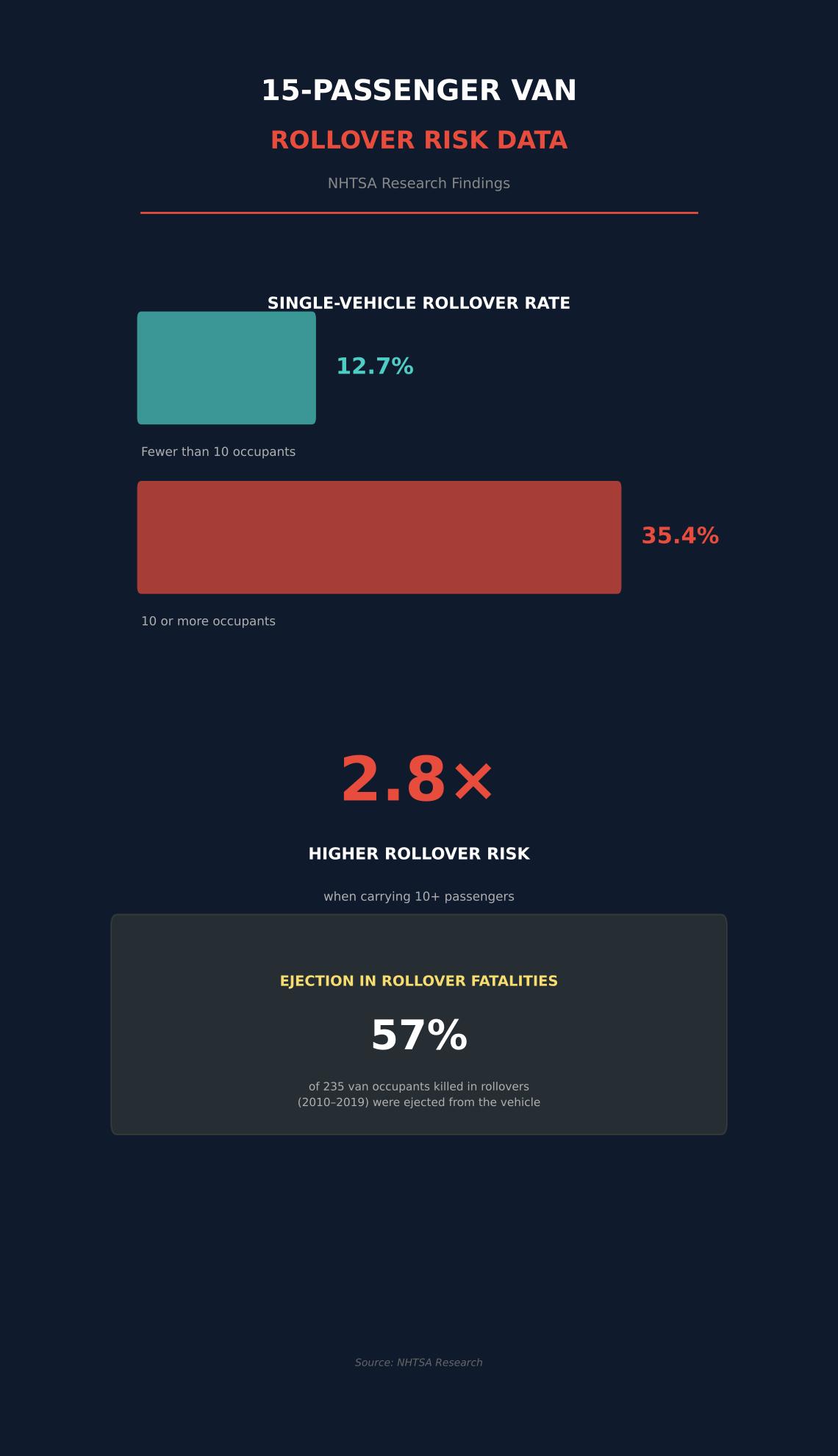
Rollover risk is the best-known concern with 15-passenger vans. NHTSA research published in 2001 found a single-vehicle rollover ratio of 35.4% for 15-passenger vans carrying 10 or more occupants, compared with 12.7% when they carried fewer than 10. Passenger van rollover manufacturer liability claims often turn on whether the design, warnings, and stability features were reasonable for a vehicle that is frequently loaded with people.
Expect the defense to push back. NHTSA has required electronic stability control on new 15-passenger vans and says it may prevent rollovers, so defendants may argue that a newer van was not unreasonably dangerous. NHTSA also notes that these vans stay in service for long periods and that older models may lack the technology. Whether the argument works depends on the specific van, its model year, and how it was loaded and maintained, which is why the vehicle and its records should be preserved early.
Rental and Leasing Companies and the Graves Amendment
If the van was rented or leased, the owner may try to stay out of the case. The federal Graves Amendment (49 U.S.C. 30106) protects an owner in the business of renting or leasing vehicles from liability based only on ownership. That protection does not apply where the owner itself was negligent, for example by renting out a van it knew had a maintenance problem. The facts decide which side of that line a rental or leasing company falls on.
Repair Shops, Churches, Nonprofits, and Other Drivers
Repair facilities. A shop whose work contributed to a crash, such as faulty brake or tire work, can share responsibility.
Churches and other organizations. Many passenger vans belong to churches, schools, and community groups. If a church or nonprofit was negligent in driver training or van maintenance, it can be responsible for what happened.
Other drivers. Sometimes the van driver did little wrong and another motorist caused the crash. In the July 25, 2019 SeaTac shuttle crash, the NTSB reported that a passenger car lost control and collided with a medium-size bus. According to plaintiffs’ counsel (Advocate Magazine, April 2023), a Lyft driver’s lane change led the car’s driver to swerve, and the lawsuit named the car’s driver, the Lyft driver, and Lyft. Lyft then brought in the shuttle’s owner and manufacturer. It is a good example of how one crash can pull in many parties and many insurers, including rideshare accident.
Government-Operated Vans: Special Claim Rules
Local governments are liable for tortious conduct to the same extent as a private party (RCW 4.96.010). The catch is procedure: suing a local government requires the standard claim form and a 60-day wait before filing (RCW 4.96.020). Claims against the State follow RCW 4.92.110.
Vanpools are one place this can matter. King County Metro Vanpool relies on volunteer drivers, which the King County Auditor’s June 2024 audit called a financial and safety risk. The audit counted 943 van groups and more than 5,000 riders as of December 2023, and found the program accounted for $2.3 million in insurance claims payments in 2023, over 2.5% of the county’s total. If a government-run van was involved in your crash, these deadlines and forms should be handled early.
How Washington Comparative Negligence Applies to a Van Accident
Washington follows pure comparative fault. A passenger’s or driver’s own fault reduces damages proportionately but does not bar recovery (RCW 4.22.005). So even if a defendant argues you share some blame, you can still recover for the rest.
The 2015 Ride the Ducks Aurora Bridge crash shows how this works in a Seattle passenger-vehicle case. It involved a commercial passenger vehicle, not a van, but the allocation is instructive. According to Claims Journal (February 2019), the King County jury put about 67% to 70% of fault on Ride the Ducks International, the manufacturer, and 30% to 33% on Ride the Ducks of Seattle, the operator. The jury found the City of Seattle and the State not at fault.
Seat belts. Many people worry that not wearing a belt will wreck their claim. In Washington, failing to wear a seat belt does not constitute negligence and cannot be admitted as evidence of negligence in a civil action (RCW 46.61.688(6)). That said, according to NHTSA, 57% of the 235 15-passenger van occupants killed in rollovers from 2010 to 2019 were ejected, which is a strong reason to buckle up every time.
Deadlines and Insurance in a Washington Passenger Van Accident Claim
Filing deadline. Personal injury claims generally must be filed within three years (RCW 4.16.080(2)). Wrongful death claims are brought by the personal representative of the person who died (RCW 4.20.010). Government claims add the claim-form and 60-day wait rules described above, so waiting is risky. Families can learn more about wrongful death claims in Washington.
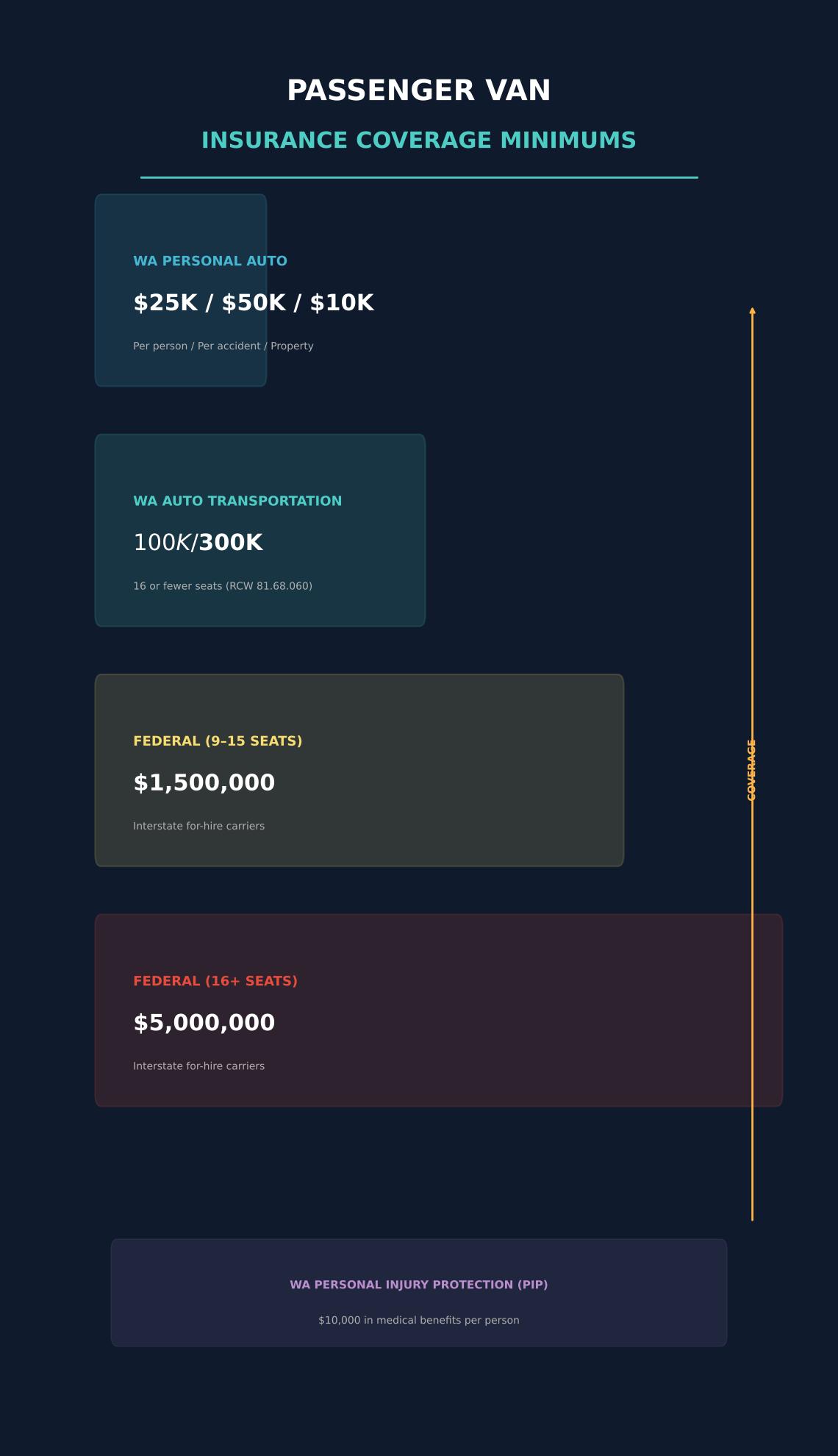
Insurance can vary widely depending on the vehicle. A private van and an interstate for-hire shuttle can carry very different coverage:
| Coverage | Amount | Source |
|---|---|---|
| Washington minimum auto liability | $25,000 per person, $50,000 per accident, $10,000 property damage | RCW 46.29.090 |
| Washington auto transportation companies, vehicles with capacity of 16 or fewer | $100,000 per person, $300,000 per accident | RCW 81.68.060 |
| Federal for-hire interstate passenger carriers, vehicles seating 15 or fewer (including driver) | $1,500,000 | FMCSA |
| Federal for-hire interstate passenger carriers, vehicles seating 16 or more (including driver) | $5,000,000 | FMCSA |
| Personal injury protection (PIP) | $10,000 in medical and hospital benefits; insurers must offer it | RCW 48.22.085, 48.22.095 |
Insurers must also offer underinsured motorist coverage matching the liability limits unless it is rejected in writing (RCW 48.22.030). Some operations are exempt from the federal minimums, including transportation of only school children and teachers to or from school, and a single daily commuter round trip carrying fewer than 16 people.
What to Do After a Passenger Van Accident in Seattle
The days after a van crash matter, because the evidence belongs to other people and can disappear. These steps protect your claim:
- Get medical care and follow up on every symptom, including head, neck, and back pain that shows up later.
- Write down who owns and operates the van: the company name, any USDOT number on the vehicle, the driver’s name, and the plates.
- Photograph the scene, the van, and your injuries if you can, and collect names and contact details for other passengers and witnesses.
- Be careful with insurers. Do not give a recorded statement or accept an early offer before you know who else may be responsible.
- Ask a lawyer to send evidence preservation letters so the van, maintenance records, and driver files are not repaired, sold, or lost.
How a Seattle Passenger Van Accident Lawyer Can Help
Van crash claims are rarely one driver and one insurer. A Seattle passenger van accident lawyer investigates who owns the van, who operated it, who leased it, and every insurance policy that may apply. That work can include reviewing driver qualification and hours-of-service records, inspection and maintenance files, and policy limits, and working with accident reconstruction specialists when the cause of the crash is disputed.
Elsner Law Firm focuses on personal injury law in Washington State and has represented injury victims since 2007. Here is what that means for van crash clients:
- Free consultations. Call or text (206) 447-1425, including after hours, or book online. The firm offers virtual appointments, in-office meetings, and meetings at your home or office.
- No upfront cost. The firm works on contingency, advances all case expenses, and collects a fee only if it wins your case through settlement or trial.
- A network of experts. Medical professionals, accident reconstruction specialists, therapists, and vocational experts help document your injuries and explain how the crash happened.
- Trial-ready preparation. Every case is prepared as if it is going to trial, which gives the firm leverage in negotiations.
- Offices across the state. Seattle (by appointment), Brier, Ellensburg, and Pullman.
- Personal attention. The firm says its clients are real people with a story, not case numbers.
Frequently Asked Questions
Can I sue the company that owns the van?
Often, yes. A company can be responsible for its employee’s conduct and for its own negligent hiring, retention, supervision, or maintenance. A rental or leasing owner is protected by the Graves Amendment only if its liability rests solely on ownership.
What are my passenger rights after a passenger van accident?
If you are not at fault, you can collect the defendants’ combined shares from any defendant against whom judgment is entered (RCW 4.22.070(1)(b)). Even if you share some fault, Washington’s comparative negligence rule reduces your damages instead of barring them.
Does not wearing a seat belt ruin my case?
Not in the way many people fear. Under RCW 46.61.688(6), belt non-use cannot be admitted as evidence of negligence in a civil action.
How long do I have to file?
Three years for personal injury (RCW 4.16.080(2)). If a government agency is involved, you must also file a claim form and wait 60 days before suing (RCW 4.96.020).
Talk to a Seattle Car Accident Attorney About Your Van Crash
Understanding Washington passenger van accident laws is the first step. Finding every responsible party and every available insurance policy is the harder part, and it is where an experienced lawyer makes a difference.
If you were hurt in a van, shuttle, or 15-passenger van crash, Elsner Law Firm offers a free consultation. Call or text (206) 447-1425, including after hours, or book an online consultation. The Seattle office, at 2130 Westlake Ave N, #3, Seattle, WA 98109, is by appointment only. You pay nothing unless the firm wins your case.
This article is general information, not legal advice. Every case depends on its own facts, and deadlines can be shorter than they appear.