CALL US NOW
 TEXT US NOW
You did not ask for this. One moment you were at work, in your car, or going about your day. The next, something hit your eye and your world changed. Maybe you can still see partially. Maybe you cannot see at all. Either way, the pain is real, the fear is real, and the financial pressure is building fast. An Eye injury lawyer can help you understand exactly what your claim is worth before you say a single word to the insurance company.
Insurance companies will call you quickly. They will use words like “fair” and “reasonable” while offering you a number that does not come close to covering what your eye injury will actually cost you over your lifetime. This guide is here to make sure you know the difference.
Here is what this guide covers:
- Real settlement ranges for minor, moderate, and severe eye injuries in Seattle
- Research-backed national data from OSHA, BLS, and the National Safety Council
- What Washington State law means for your pain and suffering claim
- The difference between workers’ compensation and a personal injury lawsuit
- How to protect your claim from the moment of injury forward
What Are the Average Eye Injury Settlement Amounts in Seattle, Washington?
Eye injury settlements in Seattle range from $5,000 for minor corneal injuries to over $500,000 for permanent vision loss or total blindness. The exact figure depends on injury severity, your total medical costs, lost income, and how well your damages are documented and presented.
Here is how settlements break down nationally, based on data from the National Safety Council and published case outcomes:
| Injury Type | Typical Settlement Range |
| Minor (corneal abrasion, temporary irritation) | $5,000 to $25,000 |
| Moderate (permanent vision reduction, traumatic iritis) | $25,000 to $75,000 |
| Serious (partial vision loss, detached retina, hyphema) | $75,000 to $250,000 |
| Severe (blindness in one or both eyes) | $250,000 to $1,000,000+ |
The National Safety Council reports the average workers’ compensation cost for an eye injury claim is approximately $26,500 nationally, covering medical expenses and partial lost wages. For face and eye injuries specifically, 2023 NSC data shows an average of $33,635, which includes $15,200 in indemnity payments and $18,435 in medical costs.
These figures represent the floor, not the ceiling. A personal injury lawsuit against a negligent third party unlocks pain and suffering, full lost wages, and future medical care, which can push total compensation several times higher than workers’ comp alone.
What Types of Eye Injuries Lead to the Highest Payouts?
Permanent, vision-altering injuries consistently produce the largest settlements in Washington State. Temporary injuries with full recovery settle at the low end. Injuries that change how you see the world for the rest of your life settle at the high end.
The injuries most likely to generate serious compensation include:
Optic nerve damage from blunt force trauma or orbital fracture affects the pathway carrying visual signals to the brain. Permanent visual field loss from optic nerve damage routinely produces settlements above $150,000 in Washington State personal injury cases. This type of trauma is common in head-on collisions where airbag deployment or direct facial impact occurs.
Detached retina from a car accident impact or workplace blow is a surgical emergency. If repair is delayed or incomplete, permanent vision loss follows. Cases with lasting retinal damage typically settle between $100,000 and $400,000 depending on the degree of vision lost.
Chemical eye burns from exposure to acids, caustic liquids, or industrial solvents cause corneal scarring and permanent vision damage. OSHA standard 29 CFR 1910.133 requires employers to provide proper eye protection in settings with chemical hazard exposure. When employers skip that protection, it creates direct liability.
Orbital fracture from a car accident or physical impact damages the bone structure around the eye. Surgery and long-term rehabilitation are typically required, driving settlement values well into the six-figure range, similar to what’s seen in serious spinal injury claims requiring extensive surgical care.
Hyphema and traumatic iritis are internal injuries from blunt force. Recurring or severe cases lead to lasting vision impairment and sometimes require surgical correction, both of which support larger non-economic damage awards.
If your eye injury happened in a rear-end collision or other car accident in Seattle, understanding how vehicle accident claims work in Washington is one of the most important early steps before you speak to any insurance adjuster.
How Does Washington State Law Affect What You Can Recover?
Washington’s pure comparative negligence law means you can recover compensation even if you were partially at fault, with your award reduced only by your share of responsibility. You are not blocked from recovery unless you are 100% at fault.
Under RCW 4.22.005, if a court finds you 20% responsible for the accident that caused your eye injury, a $200,000 award becomes $160,000. In workplace cases, employers sometimes argue that a worker contributed to their own injury by not wearing protective gear. This is a negotiating tactic, not an automatic bar to compensation, and an experienced attorney can counter it effectively with OSHA compliance records and expert testimony.
Washington’s statute of limitations for personal injury is three years from the date of injury. Miss that deadline and your right to sue is gone permanently, regardless of how serious your injuries are or how clear the other party’s negligence was.
There is no cap on non-economic damages in Washington personal injury cases. This matters significantly in eye injury claims because the emotional and psychological impact of vision loss, losing the ability to drive, read, recognize faces, or work at a screen, can dwarf the medical bills themselves. Washington law allows juries and settlement negotiations to account for that full human cost.
If your insurer denied your claim or is offering far less than your injury warrants, reviewing how insurance claim denials work in Washington can clarify your legal options before you respond.
Workers’ Compensation vs. a Personal Injury Lawsuit: Which Pays More?
A personal injury lawsuit against a third party almost always recovers more than workers’ compensation alone because it includes pain and suffering, full lost wages, and future medical care. Workers’ comp pays only a portion of those losses.
Workers’ compensation is a no-fault system. It covers your medical bills and roughly two-thirds of your regular wages while you are temporarily disabled. It does not compensate you for pain, emotional distress, loss of enjoyment of life, or the full cost of your long-term vision care.
A third-party personal injury lawsuit is available when someone other than your direct employer caused or contributed to your injury. Common Seattle examples include a defective piece of machinery from another manufacturer, a negligent subcontractor on the same job site, or a driver who hit your vehicle while you were working. These lawsuits allow you to recover all economic and non-economic damages.
In many workplace eye injury cases in Seattle, both paths are pursued at the same time. The workers’ comp insurer may assert a lien on your personal injury settlement, but an experienced attorney negotiates that lien to maximize your actual take-home recovery.
The difference in outcomes is substantial. Workers’ comp for a serious eye injury might pay $30,000 to $50,000. The same injury pursued through a third-party lawsuit with documented pain and suffering, lost earning capacity, and expert testimony can produce $300,000 or more.
For workers injured in distracted driving accidents while on the job in Seattle, the whiplash and rear-end collision claim process in Washington involves its own set of liability rules that run alongside any workers’ comp claim you file.
What Research Data Says About the Scale of Eye Injuries in Washington
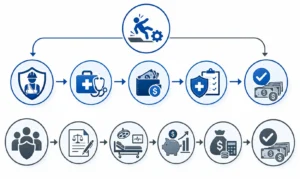
Eye injuries are far more common and costly than most people realize, and the industries most concentrated in the Seattle region carry some of the highest risk. The data makes clear why these cases carry significant compensation when properly pursued.
According to OSHA, workplace eye injuries cost an estimated $300 million per year nationally in workers’ compensation, medical treatment, and lost productivity. The Bureau of Labor Statistics reports approximately 20,000 workplace eye injuries occur each year in the United States, with workers in construction, manufacturing, and craft trades accounting for the majority.
BLS data shows that nearly three out of five injured workers were not wearing eye protection at the time of their accident. Approximately 70% of all workplace eye injuries result from flying or falling objects and sparks striking the eye directly.
In Seattle and King County, the industries with the highest eye injury exposure include construction sites, welding operations, warehouse facilities, manufacturing plants, and mining operations in eastern Washington. OSHA’s standard 29 CFR 1910.133 requires employers to supply compliant protective equipment in all of these environments. When that requirement is ignored and a worker loses vision, the employer’s violation becomes a central piece of the liability case.
A 2024 Idaho settlement of $175,000 involved a driver who failed to yield, causing an eye injury. A Maryland median for vision loss in one eye sits at $231,000. These are not outlier numbers in severe cases. They reflect what courts and settlement negotiations produce when injuries are permanent and liability is clear.
If you suffered an eye injury anywhere in Washington State, Elsner Law Firm is available 24 hours a day for a free case evaluation. No fees unless you win. Call or text 206-447-1425 anytime.
Why Elsner Law Firm Is the Right Choice for Your Eye Injury Claim in Seattle
Choosing the right attorney for a serious eye injury claim in Seattle is one of the most consequential decisions you will make after your injury. Elsner Law Firm has spent over 17 years doing exactly this work in Washington State, and the difference in outcomes for clients who are represented versus those who are not is documented and significant.
17+ Years of Exclusive Washington Personal Injury Focus
Elsner Law Firm handles only personal injury cases in Washington. No criminal defense, no family law. Every process, every expert relationship, and every legal strategy is built around injury victims in this state. That means deep knowledge of how King County courts evaluate eye injury claims, how local insurers behave under pressure, and what Washington juries respond to when permanent vision loss is at issue.
Clients Recover 3.5x to 6x More Than Initial Insurance Offers
National data shows that represented injury victims recover an average of 3.5 times more than those who handle claims alone. Elsner Law Firm clients have received settlements as high as six times the insurer’s opening offer. On a $40,000 initial offer for a serious eye injury, that gap could mean $240,000 in your pocket instead of $40,000 in theirs.
Zero Upfront Costs, No Fees Unless You Win
There is no consultation fee. No retainer. No case costs paid out of your pocket. Elsner Law Firm advances everything and collects only when your case is won. If the firm does not recover for you, you owe nothing. Your financial situation right now does not determine whether you get proper representation.
Expert Network Built for Complex Eye Injury Cases
Serious vision loss claims require ophthalmology experts, accident reconstruction specialists, and vocational experts to calculate future earning capacity loss. Elsner Law Firm has these relationships established and deploys them strategically to document every layer of your damages. This network is what transforms a workers’ comp-only outcome into a full personal injury recovery.
Every Case Is Built for Trial
Insurers offer more when they know your attorney is genuinely prepared to litigate. Elsner Law Firm prepares every file as if a King County jury will hear it. That preparation changes the negotiating dynamic and consistently produces stronger outcomes at the settlement table.
24/7 Access, Including Home and Virtual Visits
Eye injuries often make travel difficult during recovery. Elsner Law Firm is reachable any time by call, text, or online scheduling. In-person, virtual, and home visit options are available. Offices are located in Seattle, Brier, Ellensburg, and Pullman.
Multilingual Support Including Spanish-Speaking Staff
Elsner Law Firm provides culturally sensitive representation for Seattle’s diverse communities, with dedicated Spanish-language support throughout every stage of the case.
Frequently Asked Questions
How much is a typical eye injury settlement in Washington State?
Minor injuries settle between $5,000 and $25,000. Moderate cases with permanent vision reduction range from $25,000 to $75,000. Serious injuries involving partial vision loss or retinal damage typically settle from $75,000 to $250,000. Total blindness cases regularly exceed $250,000, with complex cases reaching $1 million or more.
Can I file a personal injury lawsuit if my eye injury happened at work?
Yes, if someone other than your direct employer caused or contributed to the injury. Defective equipment manufacturers, negligent contractors, and at-fault drivers all qualify as third parties. A third-party lawsuit lets you recover pain and suffering that workers’ comp never pays.
How long do I have to file an eye injury claim in Washington?
Three years from the injury date under Washington’s statute of limitations (RCW 4.16.080). Missing this deadline ends your right to sue, permanently. Report your injury immediately and speak to an attorney as soon as possible.
Does Washington cap pain and suffering for eye injuries?
No. Washington State does not cap non-economic damages in personal injury cases. Severe, life-altering vision loss can produce very large pain and suffering awards when properly documented and presented.
What if I was not wearing eye protection when I was injured at work?
You can still recover under Washington’s pure comparative negligence law. Your award is reduced by your share of fault, but you are not barred. An attorney can also challenge the employer’s liability for failing to enforce OSHA safety requirements, which often reduces or eliminates any fault assigned to the worker.
Conclusion
Vision loss is one of the most life-altering outcomes any personal injury can produce. It changes how you work, how you move through the world, and how you connect with the people around you. Washington State law recognizes the full weight of that loss, and it gives you the legal tools to hold negligent parties accountable for all of it.
Whether your eye injury claim in Washington State comes from a construction site accident, a car crash on I-5, defective safety equipment, or a chemical exposure, the path forward is the same: get medical documentation in order, understand your full damages, and do not let an insurance company settle your future for a fraction of what it is worth.
Elsner Law Firm in Seattle is ready to fight for you. Over 17 years. Washington State only. No fees unless you win. Free consultations 24 hours a day, seven days a week by call, text, or online. Call or text 206-447-1425 or visit elsnerlawfirm.com to start your free case evaluation today.