CALL US NOW
 TEXT US NOW
Why Seattle motorcycle crash victims call Elsner Law Firm
Rider-bias pushback when adjusters assume the motorcyclist was speeding, reckless, or partly at fault.
Serious-injury claim guidance for medical bills, lost income, future treatment, and pain and suffering after a motorcycle crash.
Evidence preservation for crash reports, witness statements, roadway conditions, photos, and vehicle damage before details disappear.
Washington personal injury focus for riders hurt in Seattle and statewide motorcycle crashes.
Free case review by phone at 206-447-1425.
One moment changes everything. A driver turns left without looking. A car door swings open. Gravel on Aurora Avenue sends your bike sliding. Now you are dealing with broken bones, mounting medical bills, and an insurance company that assumes every motorcyclist is reckless.
Elsner Law Firm fights for injured riders across Seattle, King County, and all of Washington State. We know that most motorcycle crashes are caused by negligent drivers, not careless riders. We know insurance adjusters carry anti-motorcycle bias into every claim. And we know how to overcome both.
You pay nothing unless we win. Call 206-447-1425 today for a free case review with a Seattle motorcycle accident attorney who will tell you exactly where you stand.
How a Seattle Motorcycle Accident Lawyer Helps Your Case
After a motorcycle crash, the legal process can feel as overwhelming as the injuries. A motorcycle accident attorney handles the burden so you can focus on healing.
At Elsner Law Firm, our team investigates the crash, collects police reports and witness statements, and works with accident reconstruction experts to prove exactly what happened. We handle all insurance correspondence. We build a demand package that documents every dollar of damage. We negotiate aggressively against lowball offers.
If the insurance company refuses a fair settlement, we file a personal injury lawsuit and take the case to trial. Most firms settle early. We prepare every case as if it is going to a jury, and insurance companies know that.
Our motorcycle accident lawyers gather and organize the evidence that matters most: photographs of the scene, traffic camera footage, surveillance video from nearby businesses, medical records, damaged gear, and expense receipts. We retain expert witnesses for deposition and testimony when the case demands it.
From the initial consultation through mediation, negotiation, or trial, Elsner Law Firm stands beside injured riders at every stage.
Why Riders Across Seattle Trust Elsner Law Firm
Motorcycle accident cases require more than general personal injury knowledge. They require attorneys who understand motorcycle physics, braking distances, visibility issues, and the bias riders face from adjusters and juries.
We counter anti-motorcycle bias. Insurance companies assume you were speeding, weaving, or showing off. We challenge those stereotypes with physical evidence, expert testimony, and aggressive advocacy.
We know Seattle roads. Our attorneys handle motorcycle crash claims from downtown Seattle to Interstate 5, Aurora Avenue to Lake City Way. We understand the specific hazards riders face on Puget Sound area roads.
We fight for maximum compensation. Under Washington’s pure comparative negligence law (RCW 4.22.005), even riders who share partial fault can recover damages. We work to minimize fault assigned to you and maximize your recovery.
We communicate clearly. You will always know the status of your case. We return calls the same day. We explain the legal process in plain language.
You pay nothing upfront. We work on contingency. Our fee comes from the compensation we recover for you. If we do not win, you owe us nothing.
Washington Motorcycle Accident Statistics
Motorcycle riding on Seattle’s roads carries real risk. Understanding the data helps riders appreciate why legal preparation matters.
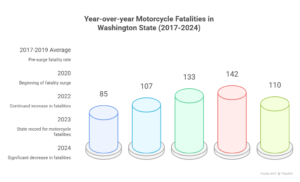
Washington recorded 142 motorcyclist fatalities in 2023, the highest in state history. That number dropped to 110 in 2024, a 23 percent decrease, according to the Washington State Department of Transportation. Still, motorcyclists account for approximately 16 percent of all traffic fatalities in the state while representing a small fraction of registered vehicles.
The National Highway Traffic Safety Administration reports that motorcyclists are roughly 28 times more likely than passenger vehicle occupants to die in a crash per mile traveled. The Washington Traffic Safety Commission confirms that fatality numbers remain above pre-pandemic levels, when the average was 85 per year from 2017 to 2019.
Alcohol impairment remains a major factor. Nationally, 42 percent of motorcyclists killed in single-vehicle crashes in 2022 were alcohol-impaired. Distracted driving contributed to 8 percent of fatal motorcycle crashes in Washington that same year.
These numbers represent real people. Daily commuters. Weekend riders. Families who ride together. Experienced cyclists and new riders alike. Every one of them deserved to come home safe.

Common Causes of Motorcycle Accidents in Seattle
Most motorcycle collisions are caused by driver negligence, not rider error. Despite what insurance companies want you to believe, the data supports what riders already know: other drivers are the problem.
Left-Turn Accidents
The most deadly scenario. A vehicle turns left across your path at an intersection. The driver either did not see you or misjudged your speed. You have nowhere to go. Left-turn collisions account for a disproportionate share of serious motorcycle crashes in King County and across Washington State.
Lane Change Collisions
Drivers change lanes without checking blind spots. They see the gap but not the motorcycle occupying it. No signal. No mirror check. Sudden impact.
Distracted Driving
Texting, GPS navigation, eating, and phone calls all reduce driver awareness. A distracted driver may not see a motorcycle even in broad daylight. In 2022, distracted driving was involved in 8 percent of fatal motorcycle crashes in Washington.
Impaired Driving
Drunk and drugged drivers have slower reaction times and poor judgment. Evening and weekend rides mean sharing roads with impaired drivers leaving restaurants and bars. Alcohol involvement in motorcycle fatalities remains disproportionately high.
Door Strikes
A driver or passenger in a parked car opens a door directly into a rider’s path. At speed, there is no time to react. Door strikes cause devastating injuries including road rash, broken bones, and traumatic brain injuries.
Road Hazards
Potholes, gravel, wet leaves, oil slicks, metal plates, and streetcar tracks pose minor inconvenience for cars but can throw a motorcycle. When the City of Seattle, King County, or the Washington State Department of Transportation fails to maintain safe road conditions, riders pay the price.
Rear-End Crashes
Motorcycles stop faster than cars in many situations. Drivers following too closely do not expect the motorcycle ahead to stop quickly. The result is a rear-end collision that launches the rider from the bike.
Failure to Yield
Drivers pulling out of side streets, driveways, and parking lots without yielding the right of way to approaching motorcycles cause preventable crashes. Visibility issues compound the problem, particularly on busy arterials.
Speeding
Excessive speed reduces reaction time for both riders and drivers. At higher speeds, the force of impact increases exponentially. Speeding-involved motorcyclist fatalities dropped nearly 21 percent in Washington in 2024, but the number remains concerning.
Where Motorcycle Accidents Happen Most in Seattle
Certain Seattle roads and corridors see higher concentrations of motorcycle crashes. If you ride these routes, heightened awareness is essential.
Interstate 5 through downtown Seattle. Heavy traffic, frequent lane changes, construction zones, and aggressive drivers create a gauntlet. The express lane transitions add complexity that puts riders at risk.
Aurora Avenue (SR-99). This arterial has a well-documented history of serious crashes. The mix of high speeds, frequent intersections, and drivers making sudden turns creates constant danger for motorcyclists.
Downtown streets with streetcar tracks. First Avenue, Broadway, and Jackson Street feature rails that become slippery when wet. The gaps can catch motorcycle tires and cause riders to lose control, particularly when crossing at shallow angles.
West Seattle Bridge approaches. Merge patterns and heavy traffic crowd motorcycles into tight spaces. Limited escape routes make accidents on this corridor particularly dangerous.
Lake City Way. Constant traffic, numerous side streets, and driveways create frequent conflict points. Drivers pulling out without looking cause too many preventable collisions.
Highway 520 and I-90 bridges. High winds on the floating bridges push motorcycles laterally. Add rain and heavy traffic and conditions become treacherous for two-wheeled vehicles.
If you have been injured on any of these Seattle roads, call Elsner Law Firm at 206-447-1425. We handle motorcycle crash claims across the entire Puget Sound region.
Motorcycle Accident Injuries We Handle
Motorcycle crashes produce severe injuries because riders lack the structural protection car occupants take for granted. No steel cage. No airbags. No crumple zones.
Traumatic Brain Injury
Even with a DOT-certified helmet, the forces in a motorcycle crash can cause concussions and traumatic brain injuries. TBIs may result in long-term cognitive impairment, memory loss, personality changes, and chronic headaches. Some brain injuries do not become apparent for hours or days after the crash.
Spinal Cord Injury and Paralysis
Impact with the road surface or another vehicle can damage the spinal cord. Depending on the location and severity, spinal cord injuries cause partial or complete paralysis. Victims may require lifelong medical care, adaptive equipment, and home modifications.
Road Rash
Sliding across pavement at speed strips skin through multiple layers. Severe road rash requires extensive medical treatment, including debridement, skin grafts, and multiple surgeries. Scarring and disfigurement are common long-term consequences.
Broken Bones and Fractures
Legs, arms, ribs, pelvis, collarbone, and wrists are all vulnerable in motorcycle crashes. Compound fractures may require surgical repair with plates and screws. Recovery timelines often stretch months.
Internal Organ Damage
Blunt force trauma can cause internal bleeding, organ laceration, and other injuries that are not immediately visible. Internal injuries are life-threatening and require emergency diagnosis and surgery.
Amputation
Crushing forces in high-speed collisions can destroy limbs beyond surgical repair. Traumatic amputation fundamentally changes a victim’s life and requires years of rehabilitation, prosthetics, and psychological support.
Soft Tissue Injuries
Sprains, strains, and ligament tears occur when riders are ejected or brace for impact. Soft tissue injuries may not appear on standard imaging but cause chronic pain and limited mobility.
Psychological Trauma
PTSD, anxiety, depression, and emotional distress are common after serious motorcycle accidents. Fear of riding. Flashbacks to the crash. Sleep disruption. These psychological injuries deserve compensation alongside physical ones.
Wrongful Death
When a motorcycle accident kills a rider, surviving family members may file a wrongful death claim. In 2023, 142 families in Washington lost someone to a fatal motorcycle crash. A wrongful death lawsuit can recover funeral expenses, lost future income, loss of companionship, and other damages.
If your loved one was killed in a motorcycle accident in Seattle or King County, Elsner Law Firm can help your family pursue justice.

Washington Motorcycle Laws That Affect Your Accident Claim
Washington State has specific motorcycle statutes that directly impact your rights after a crash. Understanding these laws is essential to protecting your claim.
Motorcycle Endorsement Requirement (RCW 46.20.500)
Washington law requires all motorcycle operators to hold a valid driver’s license with a motorcycle endorsement. You can obtain the endorsement by passing the Department of Licensing knowledge and riding skills tests or by completing an approved motorcycle safety course. Riding without an endorsement is a traffic infraction and may be used by the defense to allege contributory negligence. However, lacking an endorsement does not automatically bar you from recovering compensation.
Helmet Law (RCW 46.37.530)
All motorcycle riders and passengers in Washington must wear a DOT-certified helmet on all public roads. The helmet must have a neck or chin strap fastened during operation. Children under five may not ride on motorcycles at all.
Importantly, Washington law does not allow the at-fault driver to reduce your damages because you were not wearing a helmet. Your choice of protective gear does not excuse another driver’s negligence. This is a critical distinction that insurance adjusters often misrepresent.
Lane Splitting Prohibition (RCW 46.61.608)
Lane splitting, riding between lanes of traffic, is illegal in Washington. Motorcyclists are entitled to full use of a traffic lane, and no motor vehicle may be driven in a manner that deprives a motorcycle of full lane use. If you were lane-splitting at the time of an accident, the opposing party will likely argue comparative fault.
Pure Comparative Negligence (RCW 4.22.005)
Washington follows a pure comparative negligence standard. You can recover damages even if you were partially at fault. Your compensation is reduced by your percentage of responsibility.
Example: If your total damages are $500,000 and you are found 20 percent at fault, you recover $400,000. There is no fault threshold that bars recovery entirely. Even a rider found 90 percent at fault can recover 10 percent of damages from the other party.
Insurance companies aggressively use comparative fault to reduce motorcycle claims. They argue you were speeding without evidence. They claim you were in a blind spot. They say your lane position was improper. Our attorneys counter these tactics with accident reconstruction, expert analysis, and physical evidence.
Statute of Limitations (RCW 4.16.080)
You have three years from the date of a motorcycle accident to file a personal injury lawsuit in Washington. Miss this deadline and you lose the right to pursue compensation entirely. Wrongful death claims also carry a three-year filing period.
Certain situations can shorten this timeframe. Claims against government entities for road defects or maintenance failures typically require a tort claim notice within 60 days. Do not wait. Contact an attorney as soon as possible after your crash.
No Cap on Non-Economic Damages
Washington does not impose a statutory cap on non-economic damages such as pain and suffering, emotional distress, or loss of enjoyment of life. This is significant. In states with damage caps, severely injured riders have their compensation artificially limited. In Washington, a jury can award non-economic damages that reflect the true impact of your injuries.
Compensation Available After a Seattle Motorcycle Accident
Can you recover compensation after a motorcycle crash? Yes. Washington law allows injured riders to pursue both economic and non-economic damages from the at-fault party.
Economic Damages
These are your measurable financial losses:
Medical expenses, including emergency care, surgery, hospitalization, rehabilitation, prescription medications, and anticipated future medical needs. Lost wages from time you could not work during recovery. Reduced earning capacity if your injuries prevent you from returning to your previous occupation or working at the same level. Property damage to your motorcycle, helmet, protective gear, and personal belongings. Rehabilitation costs, including physical therapy, occupational therapy, and adaptive equipment.
Non-Economic Damages
These compensate for the human toll of your injuries:
Pain and suffering from acute and chronic physical discomfort. Emotional distress, including anxiety, depression, and PTSD. Loss of enjoyment of life when injuries prevent activities you once loved. Scarring and disfigurement, which are particularly common in motorcycle accidents involving road rash. Loss of consortium for spouses whose relationship has been affected by the injuries. Permanent disability that changes the trajectory of your life.
What Is My Motorcycle Accident Case Worth?
Every case is different. The value of your claim depends on the severity of your injuries, the total amount of medical bills, whether you can return to work, the extent of permanent limitations, available insurance coverage, and your percentage of fault.
Motorcycle accident cases often involve catastrophic injuries that generate substantial claims. Because Washington has no cap on non-economic damages, severely injured riders can pursue compensation that reflects the full scope of their suffering.
The best way to understand what your case is worth is to talk with an experienced motorcycle accident lawyer. Call Elsner Law Firm at 206-447-1425 for a free case evaluation.

What to Do After a Motorcycle Accident in Seattle
The actions you take immediately after a motorcycle crash directly impact your health, your legal rights, and the strength of your claim. Follow these steps.
At the Scene
Move to safety if you can. Get out of traffic. Do not leave the scene. If you suspect a neck or spinal injury, stay still and wait for emergency responders.
Call 911. Even for seemingly minor crashes. You need a police report. Request medical assistance. Adrenaline masks pain, and some injuries do not produce immediate symptoms.
Document everything. Photograph your motorcycle, the other vehicle, road conditions, skid marks, debris, traffic signals, and your visible injuries. Take photos from multiple angles. Record the time and location.
Collect information. Get names, phone numbers, insurance details, and license plate numbers from all involved parties. Obtain contact information from witnesses. Witnesses are critical in motorcycle cases because drivers frequently misrepresent what happened.
Do not admit fault. Do not apologize. Do not speculate about what happened. Even casual comments can be used against you by insurance companies. Let the police report and investigation determine fault.
Note the other driver’s statements. If the driver says anything like “I did not see you” or “I was not paying attention,” write it down immediately or ask a witness to confirm what was said. These admissions often disappear once insurance companies get involved.
In the Days After the Crash
See a doctor within 24 hours. Internal bleeding, concussions, and soft tissue injuries may not produce immediate symptoms. Prompt medical evaluation creates documentation that links your injuries to the accident. Delays in treatment give insurance companies ammunition to argue you were not seriously hurt.
Follow all medical advice. Attend every appointment. Complete prescribed physical therapy. Take medications as directed. Gaps in treatment let adjusters claim you have recovered or that your injuries are not as severe as stated.
Keep a pain journal. Record daily pain levels, physical limitations, and how your injuries affect normal activities. This documentation supports non-economic damage claims for pain and suffering.
Preserve your motorcycle and gear. Do not repair or dispose of your motorcycle until it has been inspected and photographed. Damaged gear, including helmets, jackets, and boots, is evidence of impact forces.
Stay off social media. Insurance companies monitor Facebook, Instagram, and other platforms for any content they can use against you. A photo of you standing at a family event becomes “proof” you are not really injured. Make all profiles private.
Do not give recorded statements to the other driver’s insurance company. You are not required to provide one. Adjusters use recorded statements to find contradictions and build arguments against your claim.
Contact a motorcycle accident attorney. Evidence disappears. Witnesses relocate. Memories fade. Traffic camera footage gets overwritten. The sooner Elsner Law Firm begins investigating your crash, the stronger your case becomes.
How Insurance Companies Work Against Motorcycle Riders
Insurance adjusters do not approach motorcycle accident claims objectively. They carry anti-motorcycle bias into every evaluation. Understanding their tactics protects your claim.
Automatic Fault Assumptions
The moment an adjuster sees “motorcycle” on the claim, assumptions begin. You were speeding. You were weaving through traffic. You appeared out of nowhere. These are not based on evidence. They are based on stereotypes about riders. We challenge every unsupported fault allegation with physical evidence and expert testimony.
Lowball Settlement Offers
Insurance companies know you are facing medical bills, lost wages, and financial pressure. They offer quick settlements far below what your claim is worth, hoping desperation forces you to accept. Never accept an initial settlement offer without consulting an attorney. Once you sign, you cannot go back for more.
Recorded Statement Traps
An adjuster will call within days of your accident asking for your “version of events.” They sound friendly. They are building a case against you. A statement like “I did not see him until the last second” becomes “you admitted you were not paying attention.” Let your attorney handle all communications.
Social Media Surveillance
Investigators monitor your social media accounts looking for anything to use against you. A check-in at a restaurant becomes evidence you can work. A smile in a family photo becomes proof your injuries are exaggerated. Go dark on social media until your case resolves.
Disputing Medical Treatment
Adjusters argue your injuries are pre-existing, your treatment is excessive, or you have already recovered. They send you to insurance-hired doctors who consistently minimize findings. Your treating physicians’ opinions matter most, and we ensure those opinions are properly documented and presented.
Gear Scrutiny
Were you wearing full protective equipment? They will argue any injury you sustained proves you were irresponsible. Were you wearing a helmet? They may claim the helmet proves you could not have been seriously hurt. We shut down these bad-faith arguments with medical evidence and legal authority.
Elsner Law Firm takes control of all insurance communications the moment you hire us. Adjusters must deal with us, not you. We know their playbook. We counter every tactic. Call 206-447-1425 for a free case review.
What Does a Seattle Motorcycle Accident Lawyer Cost?
Hiring Elsner Law Firm costs you nothing upfront. We handle motorcycle accident cases on a contingency fee basis. Our fee is a percentage of the compensation we recover for you. If we do not win your case, you owe us nothing.
Contingency fees for personal injury cases typically range from 30 to 40 percent of the total recovery, depending on case complexity and whether the case settles or goes to trial. Under Washington court rules, all contingency fee agreements must be in writing and signed by the client.
This arrangement means every injured rider can access quality legal representation regardless of financial situation. You do not need money to hire us. You need a phone.
Call 206-447-1425 for a free consultation. We will evaluate your case and explain exactly how the fee structure works before you make any decisions.
The Legal Process for a Motorcycle Accident Claim
Understanding the legal process reduces anxiety and helps you make informed decisions at each stage.
Free Consultation. We review the details of your crash, discuss your injuries, evaluate liability and insurance coverage, and explain your legal options. We offer flexible consultation settings, including virtual appointments, in-office meetings, and visits to your home, office, or a location convenient for you. There is no cost and no obligation.
Investigation and Evidence Collection. We gather police reports, medical records, witness statements, photographs of the scene, traffic camera footage, and any other evidence that establishes fault and damages. If needed, we retain accident reconstruction specialists who understand motorcycle physics, braking distances, and crash dynamics.
Medical Treatment and Documentation. We coordinate with your medical providers to ensure your injuries are fully documented. We track your progress toward maximum medical improvement, the point at which your condition has stabilized and future medical needs can be assessed.
Demand Package. Once we understand the full scope of your damages, we prepare a comprehensive demand package for the at-fault party’s insurance company. This package includes all medical documentation, lost wage verification, expert opinions, and a detailed calculation of economic and non-economic damages.
Settlement Negotiation. Most motorcycle accident claims resolve through negotiation. Our attorneys negotiate aggressively and do not accept lowball offers. We counter every argument insurance companies make to undervalue your claim.
Mediation. If direct negotiation does not produce a fair result, we may engage in mediation, a structured negotiation process with a neutral mediator. Mediation often resolves disputes that direct negotiation cannot.
Filing a Lawsuit and Trial. If the insurance company refuses to pay what your case is worth, we file a personal injury lawsuit and prepare for trial. Our willingness to go to court gives us leverage in every negotiation. Insurance companies know which firms settle cheap and which firms fight. We fight.
Filing a Claim Against a Government Entity
If your motorcycle accident was caused by a road defect, missing signage, inadequate lighting, or failure to maintain safe road conditions, a government entity such as the City of Seattle, King County, or the Washington State Department of Transportation may be liable.
Claims against government entities follow different rules. In many jurisdictions, you must file a formal tort claim notice within 60 days of the incident. Missing this deadline can permanently bar your claim, even if the three-year statute of limitations has not expired.
Government liability cases require proof that the entity knew or should have known about the dangerous condition and failed to fix it. Our attorneys investigate road maintenance records, prior complaints, and inspection logs to build these claims.
If a pothole, oil slick, gravel, missing guardrail, or other road defect caused your motorcycle accident, contact Elsner Law Firm immediately. The filing deadlines are short and unforgiving.
Uninsured and Underinsured Motorist Claims
Washington does not require motorcyclists to carry automobile insurance, unlike car drivers. This means some riders lack uninsured/underinsured motorist (UIM) coverage that would protect them if the at-fault driver has no insurance or insufficient coverage.
If the driver who hit you has no insurance, your options depend on your own policy. If you carry UIM coverage, your own insurance company pays for damages up to your policy limits. If you do not carry UIM coverage, recovering full compensation may be more difficult.
Washington law requires insurance companies to offer UIM coverage to all policyholders, but riders can decline it. If you have UIM coverage and the at-fault driver is uninsured, we file a claim against your own carrier and fight for maximum recovery.
Understanding your insurance coverage before an accident is ideal. After an accident, let Elsner Law Firm review all available policies to identify every source of potential compensation.
Frequently Asked Questions
What should I do immediately after a motorcycle accident?
Call 911 for medical assistance and police documentation. Photograph the scene and collect contact information from all parties and witnesses. Do not admit fault. Do not post about the crash on social media. Contact a Seattle motorcycle accident attorney as soon as possible for a free case review.
What is the average settlement for a motorcycle accident in Washington?
Settlement values vary widely based on injury severity, medical expenses, lost wages, permanent impairment, and available insurance coverage. Cases involving traumatic brain injuries, spinal cord damage, or amputation typically produce substantially higher settlements than soft tissue injury claims. The best way to estimate your case value is to speak with an experienced attorney.
Can I recover compensation if I was partially at fault?
Yes. Washington’s pure comparative negligence law (RCW 4.22.005) allows you to recover damages even if you share fault. Your recovery is reduced by your percentage of responsibility. For example, if you are 25 percent at fault and your damages total $400,000, you recover $300,000.
Does not wearing a helmet affect my claim in Washington?
Washington law requires helmet use (RCW 46.37.530), and riding without one is a traffic infraction. However, Washington does not allow the at-fault driver to reduce your damages based on your helmet choice. The other driver’s negligence caused the crash, not your equipment decisions.
How long do I have to file a motorcycle accident lawsuit in Washington?
Three years from the date of the accident under RCW 4.16.080. However, claims against government entities may require a tort claim notice within 60 days. Do not wait. Contact an attorney promptly to preserve your rights.
How much does it cost to hire a motorcycle accident lawyer?
Elsner Law Firm works on contingency. You pay nothing upfront and owe nothing unless we win compensation for you. Our fee is a percentage of the recovery, and all fee terms are explained in writing before you commit.
Can I file a claim if I did not have a motorcycle endorsement?
Riding without a valid motorcycle endorsement (RCW 46.20.500) is a traffic infraction. The opposing party may argue contributory negligence. However, lacking an endorsement does not automatically prevent you from recovering compensation. The at-fault driver still bears responsibility for their negligence.
What if the driver who hit me was uninsured?
If you carry uninsured/underinsured motorist coverage, your own insurance policy may cover your damages. Elsner Law Firm reviews all available insurance policies to identify every potential source of recovery.
What types of compensation can I receive?
You may recover economic damages (medical bills, lost wages, property damage, rehabilitation costs, future medical needs) and non-economic damages (pain and suffering, emotional distress, loss of enjoyment of life, scarring, disfigurement, loss of consortium). Washington has no statutory cap on non-economic damages.
Contact Elsner Law Firm Today
If you have been injured in a motorcycle accident in Seattle, King County, or anywhere in Washington State, do not face the insurance companies alone. Evidence disappears. Witnesses forget. Filing deadlines pass. Protect your rights today.
At Elsner Law Firm, our Seattle motorcycle accident lawyers combine legal skill with genuine compassion for injured riders. Whether you are a daily commuter, a weekend rider, or an experienced cyclist who has logged thousands of miles, you deserve an attorney who fights as hard as you ride.
Call 206-447-1425 now for your free consultation. We will review your case, explain your options, and tell you exactly what we can do for you. No pressure. No obligation. No fee unless we win.
Elsner Law Firm. Seattle motorcycle accident attorneys who fight for riders.
Areas We Serve in Washington State