CALL US NOW
 TEXT US NOW
Understanding Winter Slip and Fall Liability in Washington
Yes. If a property owner in Washington failed to clear ice or snow and you were hurt, they can be held legally liable.
Washington law is clear on this. Property owners cannot point to the weather and walk away from responsibility. If you slipped on an icy walkway, a parking lot, or an untreated stairwell, the person or business responsible for maintaining that space may owe you full compensation.
We have spent over 17 years helping injured people across Washington navigate exactly this situation. We know how insurance companies respond to these claims, how Washington courts evaluate them, and what it takes to build a strong slip and fall case. That experience is what we bring to every client from day one.
The National Floor Safety Institute reports that slip and fall accidents cause over 1 million emergency room visits in the United States every year. The CDC confirms that falls are the leading cause of injury-related ER visits for adults over 55. Washington winters make those numbers significantly worse.
By the end of this article, you will know:
- Why Washington property owners cannot use weather as a legal excuse
- The three elements you must prove to win a slip and fall claim
- Who is liable depending on where you fell
- What to do immediately after a winter fall to protect your evidence
- How Washington’s fault rules still let you recover even if you share some blame
Washington Is Different: Why Property Owners Cannot Blame the Weather
In many states, a property owner can escape liability by pointing to naturally accumulating snow or ice. Washington does not follow that rule.
Washington courts have confirmed that businesses owe customers a duty to address ice and snow on areas they control. This was established in Leonard v. Pay’n Save Drug Stores, Inc. (1994). Saying “it snowed” is not a legal defense here. For guidance on property owner responsibilities in Seattle, see the City of Seattle Snow and Ice Removal Guidelines.
Seattle’s Snow Removal Rules
Seattle requires property owners to clear sidewalks within 24 hours of snowfall ending and maintain a 36-inch-wide clear pathway. Other cities like Yakima require clearing by 9 a.m. the morning after a storm.
| Seattle Rule | Requirement |
|---|---|
| Clearance deadline | Within 24 hours after snowfall ends |
| Pathway width | At least 36 inches wide |
| Ice treatment | Salt or sand must be applied |
| Warning requirement | Post visible warning if hazard cannot be removed immediately |
Failing to follow these rules does not automatically prove liability. But it is strong evidence that the owner did not take reasonable care.
What You Must Prove to Win a Winter Slip and Fall Claim
To win a slip and fall claim in Washington, you must prove three things.
| Element | What It Means | Key Evidence |
|---|---|---|
| Owner knew or should have known | Hazard existed long enough to be found and fixed | Weather records, inspection logs, security footage |
| Danger was not obvious to you | You could not reasonably have seen or avoided it | Photos, lighting conditions, expert testimony |
| Owner failed to act | No reasonable steps taken to clear, salt, or warn | No maintenance records, no salt logs, no warning signs |
Notice: Actual vs. Constructive
Actual notice means the owner was directly told about the ice. Constructive notice means the hazard existed long enough that they should have found it on their own. A two-day freeze with no salting is strong constructive notice.
The Reasonable Care Standard
Washington Jury Instruction WPI 120.07 tells juries to evaluate whether the owner acted as a reasonably careful person would. No salt, no sand, no inspection, no warning sign. Each gap is evidence of failure to meet that standard.
In Mucsi v. Graoch Associates (2001), the Washington Supreme Court confirmed that landlords can be held liable for icy common areas when they had time and opportunity to act.
Who Is Liable? Liability by Property Type
| Property Type | Liability Standard |
|---|---|
| Residential homeowner | Must clear driveways, walks, and entry steps for guests. Liability depends on notice and time to act. |
| Commercial business | Higher standard. Must inspect and clear parking lots, entrances, and walkways. Known storm with no action is strong negligence evidence. |
| Landlord or rental property | Responsible for common areas such as parking lots and stairwells. Tenants may be responsible for private entry areas. Lease terms are reviewed. |
| City or municipality | Can be sued but harder. City must have had notice and reasonable time to respond. Government immunity rules apply to some decisions. |
If you slipped on a public Seattle sidewalk and want to know whether the city could be responsible, our slip and fall attorneys can walk you through how government liability works in Washington.

Common Winter Slip and Fall Injury Sites in Washington
Certain locations carry a higher risk during winter. Knowing where falls happen most often helps identify whether the property owner had a stronger duty to act.
- Parking lots — High foot traffic, often poorly lit, slow to be treated after storms
- Store entrances and exits — Melted snow creates invisible wet floors near doorways
- Apartment stairwells — Shaded areas trap ice long after other surfaces have cleared
- Public sidewalks — Adjacent owners are responsible in Seattle for abutting sidewalks
- Ramps and loading docks — Sloped surfaces refreeze quickly and are rarely prioritized
- Shaded walkways — Stay icy for days after visible ice elsewhere has melted
What If You Were Partly at Fault? Washington’s Comparative Fault Rule
If you think you may have contributed to your fall, this part matters more than most people realize.
Washington follows a pure comparative negligence rule. You can still recover compensation even if you were partly at fault. Your damages are simply reduced by your share of responsibility.
The mall is found 75% at fault for failing to salt the walkway. You are found 25% at fault for footwear. Your total damages are $100,000. You recover $75,000.
Insurance companies use shared-fault arguments aggressively in ice and snow cases. An attorney can challenge these arguments and work to minimize the fault assigned to you.
Injuries and Compensation: What You May Be Entitled to Recover
Winter falls are serious. Ice gives no warning. The impact is sudden and hard.
Common injuries include:
- Wrist and arm fractures from catching yourself
- Hip fractures, especially serious for adults over 65
- Knee ligament and cartilage damage
- Head injuries and traumatic brain injuries
- Spinal cord and disc injuries
If you suffered a bone fracture, our broken bones legal guide explains how injury documentation affects case value.
| Economic Damages | Non-Economic Damages |
|---|---|
| Current and future medical bills | Physical pain and suffering |
| Lost wages during recovery | Emotional distress |
| Lost earning capacity | Loss of enjoyment of daily life |
| Rehabilitation costs | Permanent disability or disfigurement |

What to Do Immediately After a Winter Slip and Fall
The steps you take in the first few hours shape the strength of your claim. Evidence disappears fast. Surveillance footage is often deleted within 24 to 72 hours.
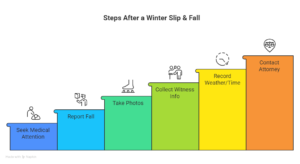
- Get medical attention the same day. Documented injuries from day one are far harder to dispute.
- Report the fall to the property owner before you leave. Ask for a written incident report.
- Photograph everything immediately. Capture the ice, the absence of salt, missing warning signs, and lighting conditions.
- Collect witness contact information. Anyone who saw the fall or noticed the hazard beforehand is valuable.
- Record the time, date, and weather. Screenshot your weather app showing temperature and recent precipitation.
- Do not give a recorded statement to any insurance company without legal advice.
- Contact a Washington slip and fall attorney as soon as possible. The earlier we get involved, the better we can preserve your evidence.
Washington’s 3-Year Deadline
Washington gives most injury victims three years from the date of injury to file a lawsuit under RCW 4.16.080. Miss that deadline and your claim is permanently gone.
For claims against a city or government agency, additional notice requirements may apply within a much shorter window. Review our accident timeline resource for a full breakdown.
Why Choose Elsner Law Firm for Your Slip and Fall Case
Not every firm is the right fit for a Washington winter slip and fall case. These claims require local legal knowledge, fast evidence work, and a team that knows exactly how insurance companies fight back.
- 17 Years of Washington-Only Experience We practice exclusively in Washington State. We know the courts, the local insurers, and the exact legal standards that apply to premises liability claims here.
- No Fees Unless We Win You pay nothing upfront. We advance all case costs. We only get paid when we recover money for you.
- 24/7 Availability Call, text, or schedule online any time. Someone from our team will respond right away.
- Trial-Ready Preparation Every case is built as if it is going to trial. One client received an initial offer of $60,000. We settled for $400,000 after taking the case to litigation.
- Expert Witness Network We work with medical professionals, accident reconstruction specialists, and vocational experts who document the full scope of your damages.
Call or text Elsner Law Firm at (206) 447-1425. Free case review. No obligation. Available 24/7.
FREQUENTLY ASKED QUESTIONS
Can I sue a property owner for a slip and fall on ice in Washington?
Yes. Washington does not protect property owners simply because ice formed naturally. If the owner knew about the hazard and failed to act, you have grounds for a claim.
Is a business liable if I slipped in their parking lot?
Yes, if they had notice and did not treat it within a reasonable time. Businesses face a higher standard of care than homeowners.
Can I sue the city for a slip on a public sidewalk?
You can pursue a claim, but the rules are more complex. The city must have had notice and reasonable time to respond. Talk to an attorney before taking any action.
What if I was partly at fault?
You can still recover. Washington reduces your damages by your percentage of fault but does not bar your claim entirely.
How long do I have to file?
Three years from the date of injury under RCW 4.16.080. For government claims, shorter deadlines may apply.
CONCLUSION
Washington holds property owners to a real standard when it comes to winter conditions. When they ignore that standard and someone is hurt, the law provides a clear path to recovery.
Remember:
- Washington rejects the natural accumulation defense for most property types
- You must prove notice, non-obvious hazard, and failure to act
- Comparative fault still allows recovery even with shared responsibility
- You have three years to file but evidence disappears much faster
- The right legal representation makes a measurable difference in what you recover
If you or a loved one was injured in a winter slip and fall anywhere in Washington, call or text Elsner Law Firm now at (206) 447-1425. No fees unless we win. Available 24/7. Offices in Seattle, Brier, Ellensburg, and Pullman.