CALL US NOW
 TEXT US NOW
Crosswalk accidents are a growing concern in Washington State, where pedestrians face serious risks at busy intersections and crosswalks. Whether you’re walking, cycling, or driving, understanding the rules surrounding pedestrian right-of-way can prevent accidents and save lives. In 2026, pedestrian safety remains a top priority, with laws designed to protect those on foot, especially in worst city for pedestrians rankings like Seattle.
In Washington, pedestrians generally have the right-of-way in marked crosswalks, but the law is not always clear when it comes to unmarked crosswalks or intersections without signals. As a result, both pedestrians and drivers need to be informed and vigilant. Drivers must yield to pedestrians at crosswalks, while pedestrians must exercise caution when crossing streets. Failing to respect these laws can lead to a pedestrian getting hit car incident, injuries, and long-term consequences.
This guide aims to provide a comprehensive understanding of pedestrian right-of-way laws, the factors that contribute to crosswalk accidents, and the steps both drivers and pedestrians can take to reduce risk and promote safety on the roads. Whether you’re recovering from an accident or simply seeking to learn more about when to call Elsner Law for guidance, this resource will empower you with the knowledge you need to navigate Washington’s crosswalks safely.
Introduction: Navigating Washington’s Crosswalks Safely
Crosswalks are essential for pedestrian safety, offering designated spaces for those on foot to cross busy roads. However, despite their importance, crosswalk accidents remain a prevalent issue in Washington. From busy urban intersections in Seattle to quieter suburban roads, pedestrians are at risk of injury or worse when right-of-way rules aren’t followed or when crosswalks are poorly designed. Understanding the laws governing crosswalks and pedestrian rights is crucial for everyone pedestrians, drivers, and even cyclists, who share the road.
As we move into 2026, the need for better education, safer infrastructure, and stronger enforcement of pedestrian right-of-way laws is more urgent than ever. This section explores the role of crosswalks in pedestrian safety, highlights the growing concern around pedestrian accidents, and sets the stage for a deeper understanding of pedestrian right-of-way laws in Washington.
The Critical Role of Crosswalks in Pedestrian Safety
Crosswalks provide a vital service by guiding pedestrians safely across busy roads. They are marked with clear signage and often controlled by signals to give pedestrians the right to cross. These designated areas help reduce the risk of accidents by clearly communicating where pedestrians should walk and where drivers should yield. However, the effectiveness of crosswalks in preventing accidents is heavily dependent on both pedestrian and driver compliance with the rules.
Despite being a critical safety feature, crosswalks are not always respected by drivers, who sometimes fail to yield the right-of-way or speed through intersections without paying attention to pedestrians. Properly marked and maintained crosswalks are essential, but pedestrians must also exercise caution and follow safety rules to avoid dangerous situations.
The Growing Concern of Pedestrian Accidents in Washington
Washington has seen an increase in pedestrian accidents over the past few years, with more incidents happening at crosswalks and intersections. According to recent data, pedestrian injuries and fatalities have risen, particularly in urban areas like Seattle, where heavy traffic and complex roadways create high-risk environments for pedestrians. The rise in accidents can be attributed to a variety of factors, including distracted driving, speeding, and pedestrians crossing without paying attention.
As more people walk and bike in Washington’s cities, especially with the growth of eco-friendly commuting options, addressing pedestrian safety is becoming more urgent. Public awareness campaigns, improved infrastructure, and stricter law enforcement are key to addressing these concerns and preventing future accidents.
Setting the Stage: Understanding Pedestrian Right-of-Way as a Cornerstone of Safety
Pedestrian right-of-way laws are central to ensuring pedestrian safety at crosswalks. In Washington, pedestrians generally have the right-of-way when crossing marked crosswalks, requiring drivers to yield to them. These laws aim to protect vulnerable road users, such as children, seniors, and individuals with disabilities. However, understanding these laws fully is not always straightforward, especially at unmarked crosswalks or at intersections with no traffic signals.
By recognizing and adhering to pedestrian right-of-way laws, both drivers and pedestrians can play their part in reducing crosswalk accidents and creating a safer road environment for everyone. This section lays the foundation for a deeper dive into the specific pedestrian right-of-way laws in Washington and how they impact accident liability and compensation.
The Foundation: Defining Pedestrian Right-of-Way in Washington State
In Washington State, pedestrian right-of-way laws are designed to protect those who are most vulnerable on the road pedestrians. These laws clearly define when and where pedestrians are entitled to cross the street and when drivers must yield to them. Understanding these laws is essential to maintaining safety on the roadways and ensuring fair treatment for pedestrians involved in accidents. Whether you’re a pedestrian, a driver, or both, knowing the rules around right-of-way is crucial to preventing accidents and avoiding liability.
What “Right-of-Way” Truly Means for Pedestrians and Drivers
Pedestrian right-of-way refers to the legal right of pedestrians to cross streets at designated crosswalks without being impeded by vehicles. In Washington, when a pedestrian enters a marked or unmarked crosswalk, drivers are legally required to stop and yield. This law is based on the principle that pedestrians, particularly in urban settings, are more vulnerable to injury and death when involved in a collision with a vehicle.
For drivers, understanding when to yield is equally important. In Washington, drivers must yield to pedestrians at marked crosswalks, but they must also be aware that pedestrians can also cross at unmarked crosswalks at intersections. The key takeaway for both parties is that yielding to pedestrians is not optional, it’s the law designed to prevent accidents and save lives.
The Guiding Principle: Protecting Vulnerable Road Users
Pedestrian right-of-way laws are grounded in the principle of protecting vulnerable road users. Pedestrians, unlike drivers, have no physical protection and are at risk of severe injury or death when involved in accidents. This makes it imperative for both pedestrians and drivers to follow safety protocols at crosswalks and other pedestrian areas.
In Washington, these laws are particularly important because the state has a high population of pedestrians, especially in urban areas where chances getting hit pedestrian demographics can vary by neighborhood. Vulnerable road users, such as children, the elderly, and people with disabilities, are disproportionately affected by crosswalk accidents. As such, these laws ensure that pedestrians are given priority to reduce the risk of harm and make the roads safer for everyone.
Washington State Pedestrian Right-of-Way Laws: A Deep Dive into RCWs
Washington State has specific statutes that outline the rules for pedestrian right-of-way. These laws are codified in the Revised Code of Washington (RCWs) and serve as the legal framework for determining when pedestrians have the right to cross the street and when drivers are obligated to yield. Understanding these laws is essential for both pedestrians and drivers, as they help clarify roles, responsibilities, and prevent confusion on the roads.
In this section, we will break down the most relevant RCWs that address pedestrian right-of-way laws, focusing on marked and unmarked crosswalks, as well as controlled and uncontrolled intersections.
Marked Crosswalks: When Pedestrians Always Have the Right-of-Way
Under RCW 46.61.235, when pedestrians are in a marked crosswalk, they always have the right-of-way. Drivers must stop and yield to pedestrians crossing at these designated areas, regardless of whether the pedestrian is currently walking or preparing to cross. This law applies to all marked crosswalks, whether at intersections controlled by traffic signals or not.
Marked crosswalks are clearly visible, often with painted lines or signs, indicating the designated space for pedestrians to cross. These areas are designed to protect pedestrians by providing a clear and safe path. If an accident occurs when a pedestrian is in a marked crosswalk, the driver is typically considered at fault for failing to yield, unless other contributing factors are present.
Unmarked Crosswalks: Understanding the Often Misunderstood Law
While marked crosswalks are straightforward, unmarked crosswalks are often misunderstood. RCW 46.61.240 establishes that pedestrians have the right-of-way at unmarked crosswalks, which exist at any intersection where no painted lines or signs designate a crosswalk. Even though these crosswalks are not as visibly obvious, they are still legally recognized as crossing areas for pedestrians.
At unmarked crosswalks, drivers are required to yield to pedestrians who are crossing within the boundaries of the intersection. However, pedestrians must also be aware of their surroundings and exercise caution, as unmarked crosswalks may not be as easily noticed by drivers, especially in high-traffic areas. Understanding this law is key to avoiding accidents at intersections without clearly defined crosswalks.
Controlled Intersections: Navigating Traffic Signals and Control Devices
At controlled intersections, where traffic signals and control devices (such as stop signs or traffic lights) are present, the rules governing pedestrian right-of-way are more specific. RCW 46.61.050 stipulates that pedestrians must obey traffic control signals. This means that pedestrians should only cross when the signal indicates it is safe to do so, such as when the light is green or the “walk” signal is displayed.
However, drivers are still required to yield to pedestrians who are already in the crosswalk, regardless of the signal, as long as they are safely within the crosswalk’s boundaries. This rule helps reduce conflicts between pedestrians and vehicles at busy intersections, ensuring pedestrians can cross safely when the signal permits.
Common Causes of Crosswalk Accidents in Washington
Crosswalk accidents can occur for a variety of reasons, but two primary factors, driver negligence and pedestrian error often play the most significant roles. Understanding these common causes can help both pedestrians and drivers avoid dangerous situations and reduce the risk of accidents. Whether it’s a driver failing to yield the right-of-way or a pedestrian failing to follow safety guidelines, awareness is key to preventing injury.
Driver Negligence and Failure to Yield
One of the most common causes of crosswalk accidents in Washington is driver negligence, particularly the failure to yield the right-of-way to pedestrians. Despite pedestrian right-of-way laws, many drivers still fail to stop at marked and unmarked crosswalks when pedestrians are present. This often happens due to distractions, speeding, or a lack of awareness of pedestrian traffic.
In some cases, drivers may be too focused on making turns, running red lights, or dealing with traffic signals, which leads them to overlook pedestrians. Failing to yield not only violates traffic laws but also puts vulnerable road users at significant risk. When drivers don’t give pedestrians the proper right-of-way, they can be held liable for any resulting injuries or fatalities.
Pedestrian Error and Contribution to Accidents
While drivers are often at fault, pedestrians can also contribute to crosswalk accidents through error or negligence. Common pedestrian mistakes include:
- Jaywalking: Crossing the street outside of designated crosswalks or against traffic signals can increase the risk of accidents.
- Not making eye contact with drivers: Failing to make eye contact with a driver can lead to miscommunication, where a driver might not see the pedestrian or anticipate their crossing.
- Distracted walking: Just like drivers, pedestrians who use their phones or listen to music while walking may not be fully aware of their surroundings, leading them to step into traffic without noticing an approaching vehicle.
Although pedestrians have the right-of-way in most cases, they must still exercise caution and follow traffic rules to avoid accidents. Contributing to an accident, even unintentionally, can affect the outcome of an injury claim under Washington’s comparative negligence laws.
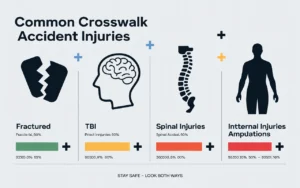
The Devastating Impact: Common Injuries and Damages in Crosswalk Accidents
Crosswalk accidents can result in severe and life-altering injuries for pedestrians, given their vulnerability when struck by vehicles. Even at relatively low speeds, the human body is not equipped to withstand the impact of a car or truck, leading to various types of injuries, some of which may require long-term care or result in permanent disability. These injuries can also lead to significant emotional, financial, and psychological consequences, further complicating the recovery process for victims.
Severe Physical Injuries Sustained by Pedestrians
Pedestrians involved in crosswalk accidents are at risk of serious injuries due to the lack of physical protection when struck by a vehicle. Common severe injuries include:
- Fractures and Broken Bones: The force of impact can lead to broken bones in the legs, arms, pelvis, or even the spine, which may require surgery, extended hospital stays, and rehabilitation.
- Traumatic Brain Injuries (TBI): Head injuries, including concussions and more severe brain injuries, are common in crosswalk accidents, especially if the pedestrian is thrown or knocked to the ground. TBIs can lead to long-term cognitive impairments, memory loss, and changes in personality.
- Spinal Cord Injuries: Damage to the spinal cord can result in partial or complete paralysis, depending on the location and severity of the injury. Spinal cord injuries can have life-changing effects, requiring long-term medical care and adaptive equipment.
- Internal Injuries: The impact of a vehicle may cause internal bleeding, organ damage, or ruptured organs, which can be life-threatening and require immediate medical intervention.
- Amputations: In severe cases, the force of the accident may result in amputations of limbs, especially if the pedestrian is pinned under a vehicle or experiences severe crushing injuries.
The severity of these injuries can lead to substantial medical bills, loss of income, and long-term physical and emotional suffering. Pedestrians involved in these types of accidents often face a difficult and lengthy recovery process, both physically and financially.
Navigating the Aftermath: Establishing Liability and Seeking Compensation
After a crosswalk accident, establishing liability and seeking compensation can be a complex process. Pedestrians often face challenges when it comes to proving fault, especially when multiple parties may be involved or when both the driver and pedestrian share some degree of responsibility. However, understanding the steps involved in the aftermath of an accident, from taking immediate action to filing a personal injury claim, is essential for securing fair compensation for injuries and damages.
Immediate Steps After a Crosswalk Accident
In the aftermath of a crosswalk accident, the first few steps you take can significantly impact your ability to secure compensation. Here are the immediate actions you should take if you’ve been involved in a crosswalk accident:
- Seek Medical Attention: Even if you don’t feel injured, it’s critical to get checked by a medical professional. Some injuries, such as internal bleeding or head trauma, may not show symptoms immediately but can be life-threatening.
- Call 911: Contact law enforcement to report the accident and have a police officer document the scene. A police report can be crucial in establishing fault and providing a clear account of the accident.
- Document the Scene: If possible, take pictures of the accident scene, your injuries, and any damages to your bicycle or other property. This evidence will be vital for your claim.
- Gather Information: Collect contact details from the driver, witnesses, and anyone else involved. This includes insurance information, license numbers, and phone numbers.
- Avoid Admitting Fault: Never admit fault or apologize for the accident, even if you feel partially responsible. Fault determination should be left to the authorities and legal experts.
Determining Liability and Fault in Washington
In Washington, fault for a crosswalk accident can be determined by evaluating the actions of both the pedestrian and the driver. Washington follows a pure comparative negligence system, which means that even if you, as a pedestrian, are partially at fault, you can still recover compensation for your injuries, but your award may be reduced based on your percentage of fault.
- Driver’s Liability: In most cases, drivers are held liable if they fail to yield the right-of-way to pedestrians in marked crosswalks. However, drivers may also be found at fault in unmarked crosswalks if they don’t exercise caution and yield to pedestrians at intersections.
- Pedestrian’s Contribution: If a pedestrian is jaywalking or crossing outside of a crosswalk, they may share some of the fault in the accident. However, Washington law still allows for compensation, even if the pedestrian is partially at fault, based on the percentage of responsibility.
Determining fault often requires a thorough investigation, including witness testimony, traffic camera footage, and expert analysis.
The Personal Injury Claims Process
Once fault is established, the personal injury claims process begins. This process involves several key steps:
- Medical Treatment and Documentation: Continuously seeking medical treatment and maintaining thorough records of your injuries, treatments, and recovery progress is crucial. These documents serve as evidence of your pain and suffering and are used to calculate your compensation.
- Negotiating with Insurance Companies: The insurance company representing the at-fault driver will likely try to minimize the amount they pay out. A personal injury lawyer can negotiate on your behalf, ensuring that the settlement offer is fair and that all your damages, including medical bills and lost wages, are accounted for.
- Filing a Lawsuit: If the insurance company does not offer a satisfactory settlement, your lawyer may recommend filing a lawsuit. The court process involves presenting evidence and arguing your case in front of a judge or jury.
- Settlement or Trial: Many personal injury claims are settled before reaching trial, but if necessary, your lawyer will prepare your case for court. A trial may result in higher compensation, especially if the jury finds the defendant at fault.
Throughout this process, having an experienced personal injury lawyer can significantly improve your chances of a successful outcome, ensuring that you are fairly compensated for the injuries and losses you’ve sustained.
The Critical Role of a Pedestrian Accident Attorney
After a crosswalk accident, having a skilled Seattle Pedestrian Accident Lawyer on your side is essential. A lawyer who specializes in pedestrian accidents can provide the expertise needed to navigate the complex legal and insurance processes, ensuring that your rights are protected and you receive the compensation you deserve. With the often confusing nature of liability and damages, having a legal professional who knows Washington’s laws inside and out can make a significant difference in the outcome of your case.
Why Legal Advocacy is Essential for Injury Victims
Legal advocacy is crucial for injury victims, particularly in cases involving crosswalk accidents, where the complexity of liability and insurance claims can be overwhelming. Here’s why hiring an attorney is essential:
- Expertise in Pedestrian Laws: Pedestrian accident lawyers are well-versed in the specific laws that govern pedestrian right-of-way, crosswalk regulations, and comparative negligence in Washington. They will know how to gather the right evidence, navigate the complexities of the law, and present your case in the most effective way.
- Negotiation with Insurance Companies: Insurance companies often attempt to settle claims quickly and for less than what the victim truly deserves. A lawyer with experience in pedestrian accidents will advocate on your behalf, ensuring the insurance company doesn’t pressure you into accepting an unfair settlement.
- Maximizing Compensation: Attorneys understand the full scope of damages you can claim, from medical bills and lost wages to pain and suffering. They will ensure that all your losses are accounted for and that you receive compensation for both economic and non-economic damages.
- Reducing Stress and Time Investment: The aftermath of an accident can be stressful, especially when dealing with medical treatments and insurance claims. A personal injury lawyer will handle the legal aspects, allowing you to focus on your recovery while they manage the case.
- Fighting for Justice: When you’ve been injured, you deserve fair compensation for your suffering. A pedestrian accident lawyer will fight for your rights in court, ensuring that the responsible party is held accountable for their actions.
Hiring a personal injury lawyer after a crosswalk accident can make a significant difference in both the outcome of your case and your peace of mind during the recovery process.
Proactive Measures: Enhancing Crosswalk Safety in Washington for 2026 and Beyond
Improving crosswalk safety is essential to reducing accidents and protecting pedestrians. As Washington State continues to grow, enhancing safety measures at crosswalks will require collaboration between local governments, pedestrians, and drivers. For 2026 and beyond, Washington has committed to improving infrastructure, public education, and law enforcement to prevent crosswalk accidents. Both pedestrians and drivers must play an active role in maintaining safety on the roads. Here are some proactive steps everyone can take to improve safety at crosswalks.
Safety Tips for Pedestrians at Crosswalks
Pedestrians must take personal responsibility for their safety when crossing streets. While right-of-way laws provide protection, following best practices can further reduce the risk of accidents. Here are some safety tips for pedestrians:
- Always Use Marked Crosswalks: Whenever possible, cross streets at marked crosswalks. These areas are designed to provide safer crossings and are where drivers expect pedestrians to be. If you’re at an intersection with no marked crosswalk, be cautious and ensure it’s safe to cross.
- Look Both Ways Before Crossing: Even if you have the right-of-way, always look both ways to ensure that drivers are yielding to you. Don’t assume a vehicle will stop, be aware of oncoming traffic.
- Be Visible: Wear bright clothing or reflective gear, especially at night, to make yourself more visible to drivers. Carrying a flashlight or using reflective accessories can increase your visibility in low-light conditions.
- Don’t Distract Yourself: Avoid using your phone or wearing headphones while crossing. Stay alert to your surroundings so you can react quickly if a driver fails to yield or if there are unexpected hazards.
- Make Eye Contact with Drivers: Try to make eye contact with drivers before crossing the street. This ensures that the driver sees you and is aware of your intentions to cross.
By following these basic safety tips, pedestrians can reduce the risk of crosswalk accidents and stay safe while navigating Washington’s roadways.
Safety Tips for Drivers Approaching Crosswalks
Drivers also have a critical role in crosswalk safety. Understanding the laws and taking proactive steps to yield to pedestrians can prevent accidents and save lives. Here are some safety tips for drivers approaching crosswalks:
- Yield to Pedestrians in Marked Crosswalks: Always stop and yield the right-of-way to pedestrians in marked crosswalks. If a pedestrian is waiting at the edge of the crosswalk, be prepared to stop and allow them to cross.
- Slow Down Near Crosswalks: Reduce your speed when approaching crosswalks, especially in busy urban areas or near schools and parks. Slower speeds give you more time to react if a pedestrian enters the crosswalk unexpectedly.
- Stop for Pedestrians at Unmarked Crosswalks: In Washington, pedestrians have the right-of-way at unmarked crosswalks at intersections. If a pedestrian is crossing at an unmarked crosswalk, stop and allow them to cross safely.
- Be Cautious at Intersections: Watch for pedestrians in the crosswalk, especially when turning at intersections. Use your signals early and always look for pedestrians before making a turn.
- Avoid Distractions: Distracted driving is a leading cause of crosswalk accidents. Avoid using your phone or engaging in other distractions while driving. Stay focused on the road and be aware of pedestrians.
By following these safety tips, drivers can help reduce the number of crosswalk accidents and make Washington’s roads safer for everyone.
Frequently Asked Questions
Q1: What are pedestrian right-of-way laws in Washington State?
A1: In Washington State, pedestrians have the right-of-way at marked and unmarked crosswalks at intersections. Drivers must yield to pedestrians who are crossing the street at these locations. Pedestrians must also follow traffic signals and cross safely at designated areas to reduce the risk of accidents.
Q2: Do pedestrians always have the right-of-way in crosswalks?
A2: Yes, pedestrians have the right-of-way in marked crosswalks. Drivers must yield when pedestrians are crossing. However, pedestrians must also be cautious and follow traffic signals, especially in unmarked crosswalks or at intersections without traffic control devices.
Q3: What should I do if I’m injured in a crosswalk accident?
A3: If you are injured in a crosswalk accident, seek medical attention immediately, even if your injuries seem minor. Report the incident to law enforcement and ensure a police report is filed. Document the scene and gather evidence, such as photos and witness information. Contact a personal injury lawyer to help with your claim.
Q4: Can I file a claim if I’m partially at fault in a crosswalk accident?
A4: Yes, Washington follows a comparative negligence rule, meaning you can still receive compensation if you’re partially at fault. Your compensation may be reduced based on your level of fault, but you are not barred from pursuing a claim.
Q5: How can I improve crosswalk safety in Washington?
A5: To improve crosswalk safety, both pedestrians and drivers must follow the laws and be vigilant. Pedestrians should cross at marked crosswalks, make eye contact with drivers, and avoid distractions like phones. Drivers should yield to pedestrians, reduce speed near crosswalks, and avoid distractions to ensure safety. Local governments can also improve crosswalk visibility and enforce traffic laws.
Conclusion: A Shared Responsibility for Safer Washington Crosswalks
Crosswalk safety in Washington is a shared responsibility between pedestrians, drivers, and local authorities. As crosswalk accidents continue to rise, it’s more important than ever for everyone to understand and respect pedestrian right-of-way laws. By educating ourselves and taking proactive steps to improve safety, we can work together to reduce accidents and ensure that Washington’s roads remain safe for all.
Moving forward, a collective effort to enforce laws, enhance crosswalk infrastructure, and raise public awareness will be essential in preventing further accidents and protecting pedestrians. Whether you’re walking, driving, or involved in urban planning, your actions contribute to the safety of crosswalks and the well-being of those who use them.
Reaffirming the Importance of Understanding Pedestrian Right-of-Way Laws
Pedestrian right-of-way laws are crucial for maintaining safety at crosswalks and preventing accidents. Whether you are a pedestrian or a driver, knowing when and where pedestrians have the right-of-way and respecting those laws can make a life-or-death difference. Washington’s pedestrian safety laws are designed to protect vulnerable road users, but these protections only work if both pedestrians and drivers act responsibly.
For pedestrians, understanding when to cross and staying aware of traffic conditions is key to avoiding accidents. For drivers, yielding to pedestrians in crosswalks, paying attention at intersections, and reducing distractions can help prevent tragic accidents.
By reaffirming the importance of these laws and following safety guidelines, we can collectively create a safer environment for everyone on the road. Let’s all do our part in keeping Washington’s crosswalks safe for 2026 and beyond.