Call Today!

 CALL US NOW
 TEXT US NOW
A railroad crossing accident can change a life in seconds. In Washington State, when a train hits a car, a pedestrian, or a cyclist at a crossing, the legal picture is rarely as simple as blaming one party. Multiple parties can share responsibility, Washington’s comparative fault rules let an injured person recover even if they were partly at fault, and federal law adds its own layer of complexity.
If you or someone you love was hurt at a railroad crossing, understanding your legal rights is the first step toward protecting your train accident. This guide covers who can be held liable, what Washington and federal crossing laws require, how comparative negligence works, what deadlines apply, and what to do after a crossing crash.
Can More Than One Party Be Held Liable After a Train Hits a Car?
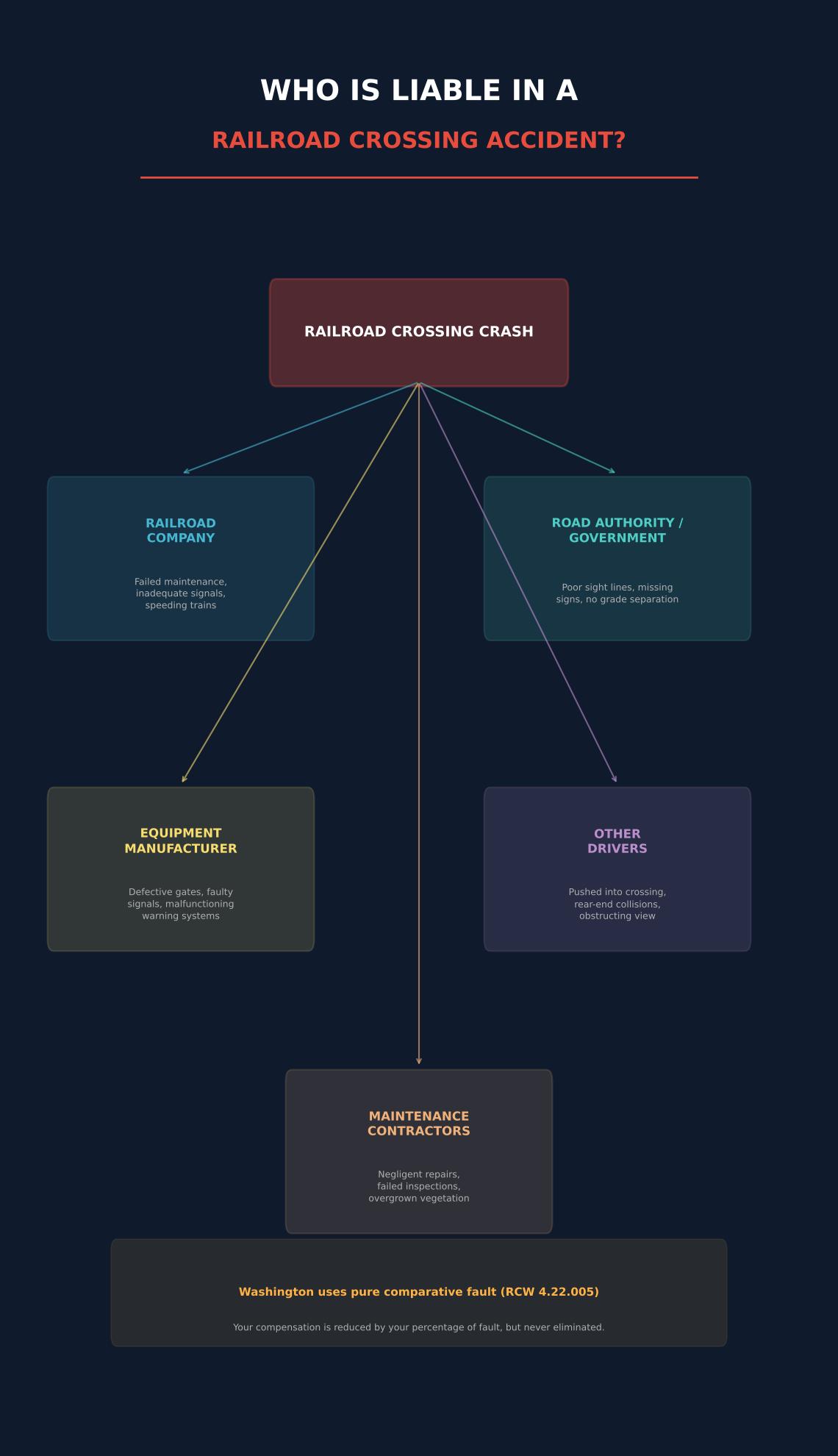
Yes. Washington law allows injured people to pursue claims against every party whose negligence contributed to the crash. Depending on the facts, responsible parties can include:
- The railroad company, for failing to maintain signals, gates, tracks, or sight lines, or for operating a train at unsafe speed through a crossing
- A signal or gate contractor, for installing or maintaining warning devices that malfunctioned
- A government road authority, such as a city, county, or WSDOT, for poor crossing design, missing signage, or failure to upgrade a dangerous crossing
- Another driver, whose actions forced a vehicle into the path of a train
- A vehicle or parts manufacturer, if a defect such as a stalling engine or failed brakes left a car stuck on the tracks
A common example: a driver approaches a crossing where the warning signals fail to activate. A train strikes the car. Investigation reveals the railroad deferred maintenance on the signal system, the contractor who last inspected it missed a fault, and the county ignored requests to improve sight lines. All three could share liability.
For a broader look at pedestrian accident claims, including those involving trains, see our pedestrian accident page. For an overview of crossing claim concepts, see this national resource.
Do Crossing Crash Numbers Show a Real Risk in Washington?
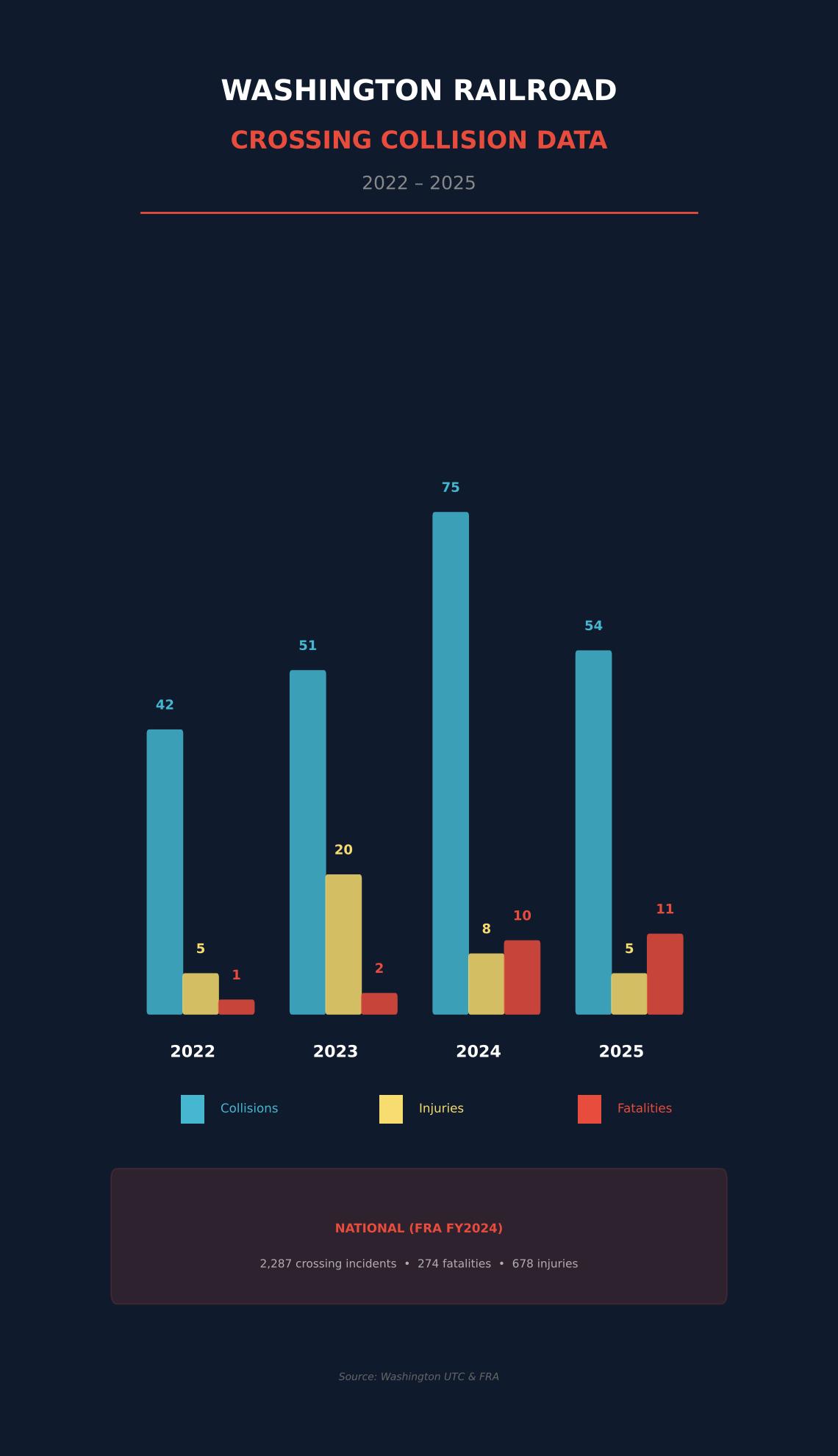
They do. The Washington Utilities and Transportation Commission tracks crossing collisions statewide. The UTC rail crash data page shows the following recent numbers:
| Year | Crossing Collisions | Injuries | Fatalities |
|---|---|---|---|
| 2022 | 42 | 5 | 1 |
| 2023 | 51 | 20 | 2 |
| 2024 | 75 | 8 | 10 |
| 2025 | 54 | 5 | 11 |
Fatalities jumped sharply in 2024 and stayed high in 2025. Nationally, the Federal Railroad Administration recorded 2,287 highway-rail crossing incidents in fiscal year 2024, resulting in 274 fatalities and 678 injuries across the country.
Do Washington Railroad Crossing Laws Set Rules for Railroads and Drivers?
Yes. Both state and federal law impose specific duties at railroad crossings.
State Crossing Law: Chapter 81.53 RCW
Washington’s chapter 81.53 gives the UTC authority over railroad crossings. The UTC can order safety improvements, require better signage, and set standards for how crossings are built and maintained. When a railroad or a road authority ignores a UTC order or fails to meet these standards, that failure can be evidence of negligence.
Federal Rules: Train Horn Rule and Part 234
The Train Horn Rule (49 CFR Part 222) requires locomotive engineers to sound the horn at least 15 seconds before reaching a public crossing, starting no more than one-quarter mile in advance. Municipalities can establish quiet zones, but only if they install alternative safety measures that the FRA approves.
49 CFR Part 234 requires railroads to report signal malfunctions to the FRA and to take immediate action when a warning system fails. A railroad that knows about a signal problem and does nothing has a hard time arguing it was not negligent.
Driver Stop Rules: RCW 46.61.350
Drivers have duties too. RCW 46.61.350 requires drivers to stop within 50 feet but not less than 15 feet from the nearest rail when a crossing signal is flashing, a gate is lowered, a flagman gives a signal, or a train is approaching closely enough to be an immediate hazard. Violating this statute can be used as evidence of fault, but under Washington’s comparative negligence rules it does not automatically bar recovery.
Can a Railroad Crossing Signal Malfunction Make the Railroad Liable?
A crossing signal that fails to activate, activates too late, or gives a confusing indication can be powerful evidence of negligence. Signal problems that have led to claims include:
- Gates that did not lower before the train arrived
- Flashing lights that were dark or stuck
- Signals that activated so frequently with false alarms that drivers learned to ignore them
- Inadequate warning time between signal activation and train arrival
In Seattle, a 2023 collision between a Link light rail train and a pedestrian at the South Orcas Street crossing led to a federal lawsuit. According to KOMO News, the plaintiff alleged that the crossing’s design and warning systems were inadequate, contributing to the collision. The case was filed in U.S. District Court for the Western District of Washington.
Washington courts have also recognized the concept of an extra hazardous crossing. When a crossing has characteristics that make it unusually dangerous, such as poor sight lines, heavy traffic, or a history of collisions, the railroad and the road authority may owe a higher duty of care. This can affect both liability and the damages available in a catastrophic injury case.
Can You Recover Compensation If You Were Partly at Fault?
Yes. Washington follows a pure comparative fault rule under RCW 4.22.005. Your damages are reduced by your percentage of fault, but you are not barred from recovery at any threshold. This matters in crossing cases, where the railroad will almost always argue the driver should have stopped.
Here is how comparative fault works in a $100,000 crossing crash claim:
| Your Fault | Defendant’s Fault | Your Recovery |
|---|---|---|
| 0% | 100% | $100,000 |
| 20% | 80% | $80,000 |
| 40% | 60% | $60,000 |
| 60% | 40% | $40,000 |
Even a driver who ran a signal may recover if the signal was malfunctioning or the crossing was poorly designed. The percentages are for the jury to decide based on all the evidence.
To see what railroad cases have actually settled for in Washington, see our train accident settlement page.
Does Federal Preemption Block Some Crossing Claims?
It can. The Supreme Court held in Norfolk Southern v. Shanklin, 529 U.S. 344 (2000), that when the federal government has funded the installation of specific warning devices at a crossing, state law claims that the warning devices were inadequate are preempted. In plain terms, if the federal government paid for the gates and lights, you generally cannot argue under state law that the crossing needed better gates and lights.
But preemption does not block every claim. Claims that typically survive federal preemption include:
- Negligent maintenance of federally funded devices (the devices were adequate but the railroad let them break down)
- Excessive train speed
- Failure to sound the horn
- Obstruction of sight lines by the railroad’s own equipment or vegetation
- Claims against parties other than the railroad, such as a road authority that failed to maintain the approach road
Whether preemption applies depends on the specific crossing, its funding history, and the theory of liability. This is one of the reasons railroad crossing cases need careful legal analysis early.
Is There a Deadline to File a Railroad Crossing Accident Lawsuit?
Yes, and missing it can end your case. In Washington, the general statute of limitations for personal injury is three years from the date of injury (RCW 4.16.080). But several factors can change the deadline:
- Government claims. If a city, county, or state agency is a defendant, you must first file a claim form and then wait 60 days before suing (RCW 4.96.020). These procedural steps must happen within the limitations period.
- Federal claims. Claims under the Federal Employers’ Liability Act, which covers railroad workers, have a three-year statute of limitations (45 U.S.C. § 56). Claims under 49 U.S.C. § 28103 for violations of federal rail safety laws also have their own requirements.
- Evidence preservation. Railroads routinely recycle event recorder data (the train’s “black box”), repair or replace damaged equipment, and reassign crew members. Sending a preservation letter immediately after the crash is critical.
If the crash caused a death, a wrongful death claim must be brought by the personal representative of the deceased under RCW 4.20.010, with its own procedural requirements.
Do You Need to Act Fast After a Railroad Crossing Accident?
Yes. Evidence at a railroad crossing disappears quickly. Event recorders are overwritten, signal maintenance logs are stored for limited periods, and witnesses scatter. Here is what to do:
- Get medical attention immediately. Some crossing injuries, especially head and spinal injuries, may not show symptoms right away.
- Report the crash. Call 911. A police report creates an official record of the scene, the parties, and the conditions.
- Document everything you can. Photograph the crossing, the signals, the vehicles, the tracks, sight lines, and your injuries. Note the time, weather, and lighting conditions.
- Collect names and contact information for any witnesses, including other drivers, passengers, and bystanders.
- Keep all medical records, bills, and documentation of lost wages and other expenses.
- Say as little as possible to railroad investigators and insurance adjusters. They may contact you quickly. What you say can be used against you.
- Contact a lawyer who can send a preservation letter to the railroad and any other potential defendants. This letter demands that they preserve the event recorder data, signal maintenance records, crew records, and any other evidence related to the crash.
For safety education and prevention resources, visit Operation Lifesaver’s Look. Listen. Live. campaign.
Can a Washington Railroad Crossing Accident Lawyer Improve Your Settlement?
Railroad crossing cases are more complex than typical car crashes. The railroad will have a team of investigators and lawyers at the scene quickly, sometimes within hours. Hiring a lawyer early can level the field.
A railroad crossing accident lawyer can help you recover damages including:
- Medical expenses, past and future
- Lost wages and diminished earning capacity
- Pain and suffering
- Permanent disability or disfigurement
- Loss of enjoyment of life
- Wrongful death damages, including loss of consortium for surviving family members
The value of a crossing claim depends on the severity of injuries, the strength of the liability evidence, and the insurance and assets available. As one example, The Columbian reported a $6.5 million settlement in a case involving rail deaths in the Seattle area.
When choosing a lawyer, look for experience with railroad cases, a track record of results, access to accident reconstruction and railroad safety experts, and a willingness to take the case to trial if necessary.
Why Elsner Law Firm Is the Right Choice for Railroad Crossing Accident Claims
Elsner Law Firm focuses on personal injury law in Washington State and has represented injury victims since 2007. Here is what that means for railroad crossing accident clients:
- Free consultations. Call or text (206) 447-1425, 24 hours a day, 7 days a week, including holidays, or book online. Virtual appointments, in-office meetings, and meetings at your home, hospital, or office are available.
- No upfront cost. The firm works on contingency, advances all case expenses, and collects a fee only if it wins your case through settlement or trial.
- A network of experts. Railroad safety engineers, accident reconstruction specialists, medical professionals, and economic experts help build your case.
- Trial-ready preparation. Every case is prepared as if it will go to trial, which gives the firm leverage in settlement negotiations with railroads and their insurers.
- Offices across the state. Seattle (by appointment), Brier, Ellensburg, and Pullman. The firm also supports Hispanic clients with services in Spanish.
- Personal attention. The firm says its clients are real people with a story, not case numbers.
Frequently Asked Questions
What if I was a pedestrian or cyclist hit at a railroad crossing?
You have the same right to pursue a claim as a driver. Pedestrians and cyclists injured at crossings can hold the railroad, the road authority, or other parties liable for negligent maintenance, inadequate warnings, or dangerous crossing design.
Are Link light rail crossings treated the same as freight railroad crossings?
Light rail crossings involve many of the same legal principles, but the responsible parties may differ. Sound Transit, the City of Seattle, or a contractor may be liable depending on who designed, built, and maintains the crossing. Government immunity defenses and claim filing requirements also apply.
Should I accept the railroad’s first settlement offer?
Be cautious. Railroads and their insurers often make early offers before the full extent of injuries is known. Once you accept a settlement and sign a release, you cannot go back for more. Have a lawyer review any offer before you respond.
Can I file a wrongful death claim if a family member was killed at a railroad crossing?
Yes. Under RCW 4.20.010, a wrongful death claim is brought by the personal representative of the deceased. Damages can include loss of financial support, loss of companionship, and funeral and burial expenses.
How much does a railroad crossing accident lawyer cost?
Elsner Law Firm takes railroad crossing cases on contingency. You pay nothing upfront, and the firm collects a fee only if it recovers money for you.
Talk to a Seattle Train Accident Attorney About Your Railroad Crossing Crash
A railroad crossing accident can leave you facing serious injuries, lost income, and an opponent with vast resources. Understanding your legal rights is important, but acting on them is what makes the difference.
If you or a family member was hurt or killed at a railroad crossing in Washington, Elsner Law Firm offers a free consultation. Call or text (206) 447-1425 any time, or book an online consultation. You can also email info@elsnerlawfirm.com. The Seattle office, at 2130 Westlake Ave N, #3, Seattle, WA 98109, is available by appointment. You pay nothing unless the firm wins your case.
This article is general information, not legal advice. Every case depends on its own facts, and deadlines can be shorter than they appear.