Call Today!

 CALL US NOW
 TEXT US NOW


A Seattle railroad accident settlement amount often falls between $10,000 and $1,000,000 or more. Your number depends on how badly you were hurt, who owns or runs the train, and which legal path your claim follows.
A train crash changes your life in seconds. Hospital bills arrive fast. Paychecks stop. Then a railroad claim agent calls, sounds kind, and offers a quick check. That offer is rarely built to cover your full future. One early choice can change how much your claim is worth, and most people make it before they talk to anyone on their side.
This guide gives you real numbers, not vague promises. It uses past Washington results, plain-English legal rules, and clear steps. It is written for riders, drivers, pedestrians, railroad workers, and families who lost someone. Elsner Law Firm, a Seattle personal injury firm, prepared it to help you judge any offer you receive.
Every case is different, so treat these figures as general ranges. Many come from national data, not Washington-only data. Past results do not predict your outcome. They do show what is possible when the facts, the injuries, and the proof line up.
Here is what this guide covers:
- Typical settlement ranges for minor, serious, and catastrophic train injuries
- Real Washington examples, from the Amtrak Cascades derailment to a light rail settlement
- How FELA claims differ from claims by passengers, drivers, and pedestrians
- Rules for suing Sound Transit and other government agencies
- Steps in the first days that protect your case value
Maybe you were hurt on the Sounder line, at a crossing in Kent, or on the job for BNSF. The same question comes first: what is my claim worth? The sections below answer it step by step.
Does the Seattle Railroad Accident Settlement Amount Have a Typical Range?
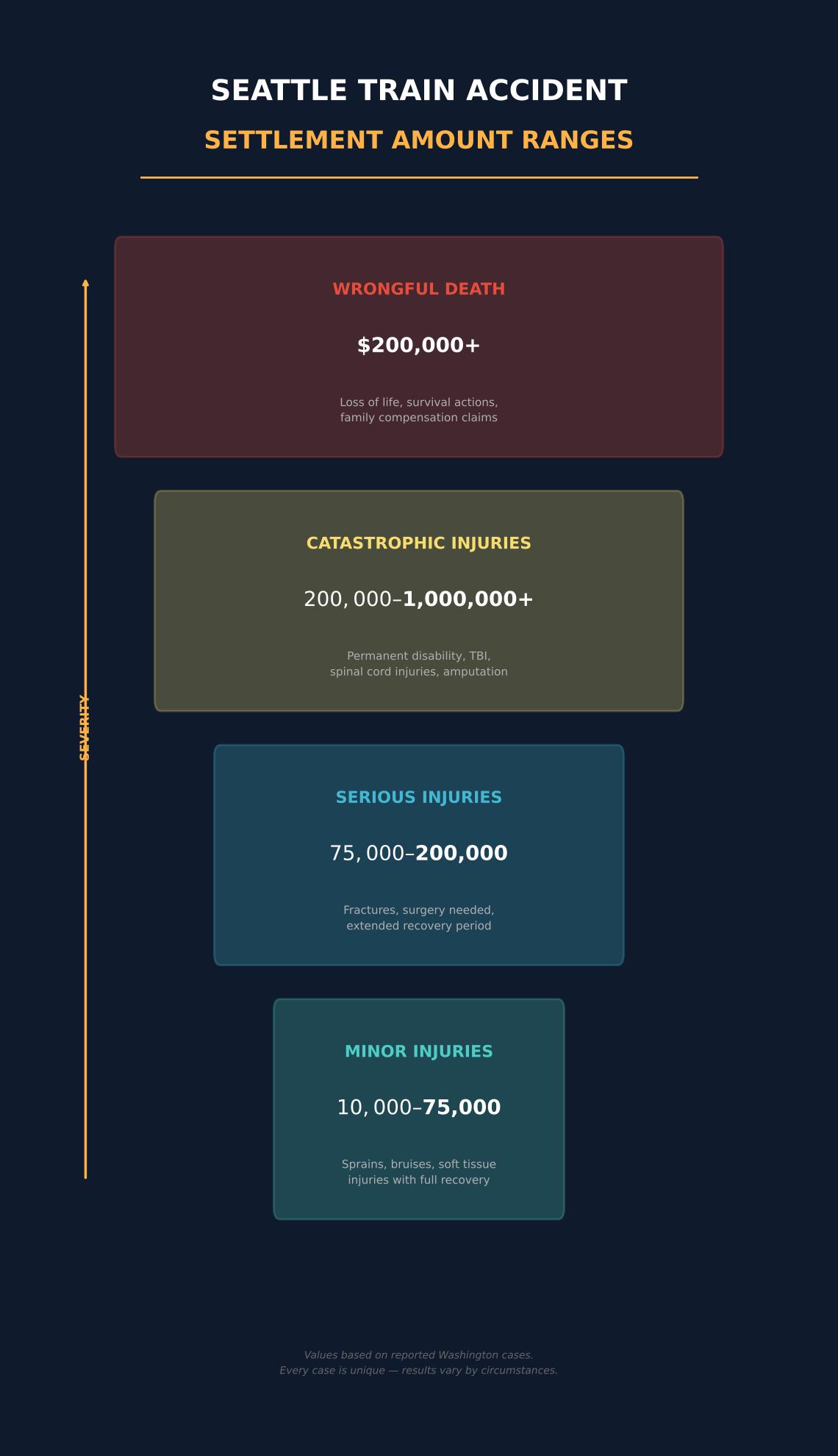
Yes. Most individual claims fall between about $10,000 and $1,000,000 or more. Derailments and catastrophic injuries have produced multi-million-dollar results. This answers the common search for the average settlement for a train accident, but one average hides big gaps between cases.
The table below shows general estimates for railroad accident settlement amounts. It is not Washington-only data, and it is not a quote.
| Injury level | Common examples | General range |
|---|---|---|
| Minor | Sprains, soft tissue injuries, short recovery | About $10,000 to $75,000 |
| Serious but recoverable | Fractures, surgery, months off work | About $75,000 to $200,000 |
| Permanent or catastrophic | Traumatic brain injury (TBI), spinal cord injury, amputation | About $200,000 to $1,000,000+ |
| Wrongful death | Loss of a family member | Usually $200,000+, higher when fault is clear |
So how much is a train accident worth in your case? Two kinds of damages build the answer.
- Economic damages: medical bills, future medical costs, lost income, and lost earning capacity
- Non-economic damages: pain and suffering, lost enjoyment of life, and psychological harm such as post-traumatic stress
In permanent injury cases, a life care plan prices lifetime medical needs. An economic loss expert prices lost earning power. Those two reports often move the number more than any other proof.
You may see a train accident settlement calculator online. Treat it with care. Some sites multiply medical bills by 1.3 to 5.5, but those tools miss facts that move value. They cannot see policy limits, shared fault, a railroad’s self-insured retention, or federal rules that limit a claim.
Example: A rider breaks a leg, has one surgery, and misses four months of work. That claim sits in the serious range. If a surgeon later says the knee will never fully heal, the claim can move up a tier, because future care and lost earning capacity now count.
Do Past Cases Show What a Seattle Train Accident Settlement Can Reach?
Yes. Past results show that serious rail cases can reach into the millions. These are past outcomes, not predictions, and each one reflects its own facts. They give useful context for a Seattle train accident settlement and for Washington train accident settlement amounts in general.
Amtrak Cascades derailment, DuPont (Dec. 18, 2017). This is the best-known train derailment settlement Washington has seen. The train left Interstate 5 near DuPont. A federal jury in Tacoma awarded nearly $17 million to three plaintiffs against Amtrak, in amounts of $7.75 million, $7 million, and $2 million. Separately, Clifford Law Offices reported $56.78 million in settlements for its derailment clients. The NTSB found the train entered a 30 mph curve at about 78 mph. Positive Train Control, which can slow an over-speed train, was installed but not yet in service.
Example: Any Amtrak accident settlement is shaped by the federal liability cap, covered in a later section. In DuPont, the NTSB findings gave victims strong proof of fault.
Link light rail crash, Rainier Valley (reported Jan. 2024). Seattle transportation agencies agreed to pay $6.5 million to settle claims over a couple killed on their way to a Mariners game. The families alleged a hazardous trackway with no crossing arms.
Railroad worker (FELA) results. One railroad injury firm reports results of about $400,000 to $4 million per case. It lists a below-knee amputation that settled for $4 million. The middle of its list is about $1.25 million.
Train and car collisions outside Washington. The same firm reports a $6.875 million verdict for a young woman with TBI and PTSD. It also reports a $12 million confidential settlement for a motorist with a severe brain injury.
The pattern is clear. Severe injuries, strong proof of fault, and a defendant with clear safety failures push results up. Weak proof or shared fault pulls them down.
Does Your Role Change the Legal Path After a Train Accident?
Yes. Your role decides which law applies. Railroad workers use a federal law called FELA. Passengers, drivers, and pedestrians use Washington negligence law. Public agencies add a claim-filing step.
| Who you are | Main law | Key points |
|---|---|---|
| Railroad worker | FELA, 45 U.S.C. §§ 51-60 | Replaces workers’ compensation; no damage cap; lenient causation standard |
| Passenger, driver, or pedestrian hurt by a private railroad | Washington negligence law | Three-year deadline; pure comparative fault; passengers get a higher duty of care |
| Amtrak passenger | Federal and state law | One shared cap of about $294 million per accident (2016 figure, adjusted for inflation every five years) |
| Rider or pedestrian hurt by Sound Transit, a city, or a county | Negligence plus a claim process | Claim form must be filed before suit |
Start with the worker’s side. A railroad worker injury settlement comes from FELA, not workers’ compensation. FELA has no damage cap. A worker can recover if the railroad’s negligence played even a small part in the injury. That is why FELA settlement amounts Washington workers receive can run high. No public Washington-only data exists, but the results above show a range from about $400,000 to $4 million for one firm.
Now the non-worker side. Passenger railroads are common carriers, so they owe riders a higher duty of care. Freight railroads such as BNSF and Union Pacific owe drivers and pedestrians a duty to operate and maintain crossings safely. Federal Railroad Administration (FRA) rules set track, equipment, and operating standards. A broken rule supports a negligence claim.
Example: A conductor hurt by defective equipment files under FELA and does not need to prove the railroad was the only cause. A driver hit at a crossing in Auburn files under Washington negligence law and must show the railroad or another party failed a duty of care. For how liability works at crossings, see our guide to railroad crossing accidents in Washington.
Can You Sue Sound Transit After a Light Rail or Sounder Accident?
Yes, but you must file a claim with the agency first. Sound Transit runs Link light rail and Sounder commuter trains. Under RCW 4.96.020, claims against local government entities start with a claim form filed with the agency. The law also sets a waiting period before a lawsuit can begin, generally 60 days after filing. Exact steps and timing can change, so confirm them before you file.
A Sound Transit accident lawsuit follows that path. If the claim is not resolved, the case can be filed in King County Superior Court or the Western District of Washington.
Missing the claim step can hurt your case. A weak or incomplete form can also limit what you can say later about how the crash happened. Agencies also have their own lawyers and risk managers, who review every claim.
Government cases can still pay well. The $6.5 million Link settlement shows that agencies will pay when claimants show a hazard that caused harm.
Example: A rider is hurt at a Link crossing. The rider files the claim form, waits the required period, and then sues if the agency does not offer fair payment. Skipping the form first can end the case before it starts.
Sounder trains share track with freight on the BNSF line through Everett, Edmonds, and Mukilteo. South of Seattle, they run through Kent, Auburn, and Puyallup. Crash claims there can involve both an agency and a private railroad, which is why early legal review matters.
If you were hurt in a rail crash, Elsner Law Firm offers a free case review any time, so you can learn your options before you speak with a claim agent.
Does Fault Reduce Your Washington Train Accident Settlement?
Yes, fault can reduce your settlement, but it does not erase it. Washington uses pure comparative fault under RCW 4.22.005. If you are 20% at fault on $100,000 in damages, you still recover $80,000.
This rule shapes train accident compensation Washington victims can receive. Railroads often argue that a driver ignored a signal or a pedestrian crossed in the wrong place. A good case answers that with proof, such as horn data, speed records, and crossing design.
Five rules change value more than most people expect:
- Deadlines: Most Washington injury suits must be filed within three years under RCW 4.16.080. FELA also gives three years under 45 U.S.C. § 56.
- Amtrak cap: Passenger claims share one federal limit of about $294 million per accident, set in 2016 and adjusted for inflation every five years, under 49 U.S.C. § 28103. In a big derailment, many victims compete for the same total.
- Federal preemption: Railroads sometimes argue that federal rail rules block state-law claims. A skilled lawyer plans for this defense early.
- Pain and suffering: Washington does not cap pain and suffering in ordinary injury cases.
- Punitive damages: Washington generally does not allow them unless a statute says so.
Most cases settle through a demand letter and negotiation. Some move to mediation or arbitration. If offers stay low, a trial-ready firm can file suit.
Example: A driver is 20% at fault for crossing after the gates went down, but the railroad skipped a required maintenance inspection. The jury cuts the award by 20%, yet the railroad still pays most of the damages.
Is a Train Accident Claim Worth More Than a Car Accident Claim?
Often, yes. A train collision usually causes more severe injuries, so the train vs car accident settlement gap can be large. A car weighs roughly two tons, while a locomotive weighs hundreds of tons. They are not equal forces. The injuries match that gap: brain injuries, crush injuries, amputations, and death.
Higher value does not mean an easier case. Railroads have large legal teams and often hold the key proof, such as the locomotive event recorder. This black box stores speed, braking, and horn data. Federal rules, preemption defenses, and multiple defendants add more work.
A car crash claim often turns on one driver and one insurer. A train claim may involve a railroad, a transit agency, a contractor that maintained the crossing, and a city that designed the road. Each party points at the others.
Example: A soft tissue injury from a rear-end car crash may settle in the lower range. A train and car collision that leaves a driver with a TBI can reach the top range. Read more about how settlement values are built for other crash types.
Is a Wrongful Death Train Accident Settlement Higher Than Other Claims?
Usually, yes. A wrongful death train accident settlement most often lands in the top tier, $200,000 and up, and goes higher when the railroad or agency is clearly at fault.
Under RCW 4.20.010, a personal representative can sue when a death was caused by another party’s wrongful act. The claim is brought for the family members who depended on the person who died. Washington also allows a survival action, which covers the person’s own losses before death, such as medical bills and pain.
Damages can include:
- Funeral and burial costs
- Lost income and financial support
- Loss of companionship and guidance
- The person’s own suffering before death
No money replaces a loved one. A fair settlement can still protect a family’s future, especially when children are involved. Large awards may be paid through a structured settlement for catastrophic injury or death. That plan spreads payments over time and can protect long-term needs.
Example: The $6.5 million Link light rail settlement followed the deaths of a couple on their way to a ball game. It shows how fatal crashes with clear hazards can resolve at high values. If your family needs to understand its options, a Seattle wrongful death lawyer can explain them.
Do You Need a Seattle Railroad Accident Lawyer in the First Days?
Nothing requires you to hire one. Still, early help protects evidence and case value. A Seattle railroad accident lawyer can act before records are lost and before a claim agent shapes your story.
Many people search for a Seattle train accident lawyer or a railroad accident attorney Seattle WA only after a low offer arrives. By then, evidence may be gone. Locomotive recorder data, video, and maintenance logs can be overwritten.
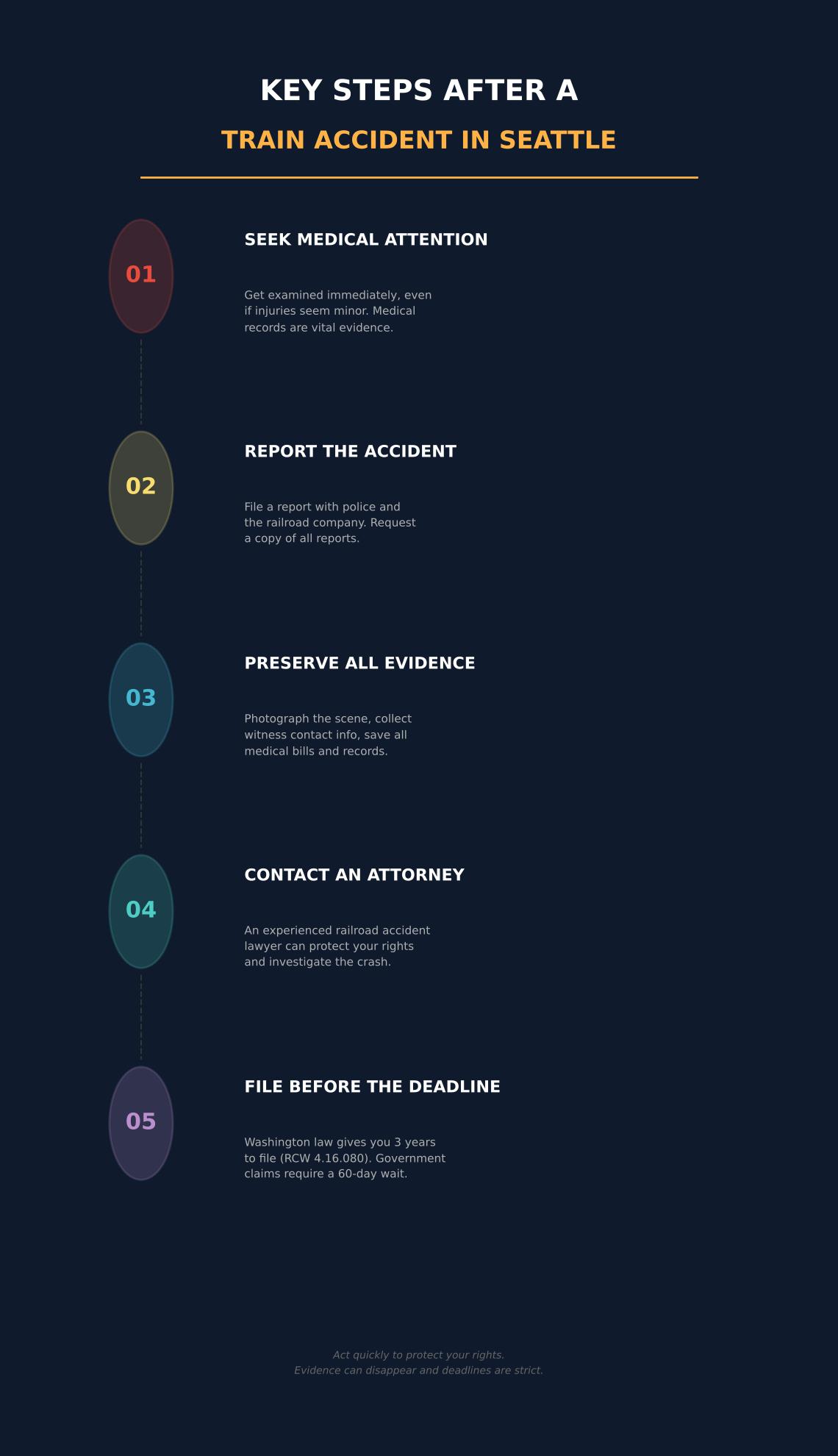
Take these steps in the first days:
- Get medical care and follow it. Gaps in treatment give the railroad a reason to cut your claim.
- Do not give a recorded statement. Railroad claim agents work for the railroad and its insurer.
- Do not sign a release. A signed release usually ends your claim for good.
- Save your own proof. Take photos, write down witness names, and keep every bill and pay stub.
- Send a preservation demand. A lawyer can send an evidence preservation letter to the railroad right away.
Example: A pedestrian is hurt near a crossing in Puyallup. Within days, a lawyer sends a preservation letter that covers the event recorder, crossing signal logs, and camera footage. Weeks later, that proof shows the horn sounded late.
Why Elsner Law Firm Is the Right Choice for Seattle Railroad Accident Settlement Claims
Rail cases need legal knowledge and the money to fight a large railroad. Elsner Law Firm builds each case with that in mind. The points below show how the firm supports train accident victims.
- Exclusive focus on Washington personal injury law- The firm has over 17 years of experience handling only injury cases. That means deep knowledge of pure comparative fault and state deadlines.
- Free consultations, any time- You can call, text, or book online, with in-person, virtual, or home visit options. Help is available right after a crash.
- No fee unless the case is won- The firm advances all costs. You do not pay upfront, and the firm’s goals match yours.
- Trial-ready preparation- Every case is built as if it is going to court. That pressure helps push back against lowball offers.
- A strong network of experts- Medical professionals, accident reconstruction specialists, therapists, and vocational experts help prove what your injuries will cost.
- Local roots and statewide reach- Offices in Seattle, Brier, Ellensburg, and Pullman serve clients across Washington. The firm also offers culturally sensitive support for the Hispanic community.
Clients are treated as people, not case numbers. That care matters most when a family is dealing with pain, debt, and fear at once.
Frequently Asked Questions
Can I settle a train accident claim without going to court?
Yes. Most train accident claims settle through negotiation, and some resolve in mediation or arbitration. Settlement leverage often comes from showing you are ready to file suit if the offer stays low.
Will a train accident settlement take months or years?
It depends on the injuries and the defendant. Simple claims can resolve in months. Catastrophic injury cases and claims against federal or government defendants often take longer, because your doctors need to know your long-term needs before you settle.
Are train accident settlements taxable?
Compensation for physical injuries is generally not taxed as federal income. Some parts of a settlement, such as interest, may be taxed. Ask a tax adviser about your case.
Should I accept the railroad’s first settlement offer?
Usually not before you know your full medical picture. First offers often leave out future care and lost earning capacity. Once you sign a release, you generally cannot reopen the claim.
Can I sue BNSF or Union Pacific in Washington?
Yes. Railroads that operate in Washington can be sued here. State claims can go to King County Superior Court or the Western District of Washington, depending on the case. FELA claims can be filed in either state or federal court.
Next Steps After a Train Accident
You now know how injury severity, legal path, and fault shape a Seattle railroad accident settlement amount. The rest comes down to three points.
First, injury level drives the range, and permanent harm and death sit in the top tiers. Second, your role decides your legal path: FELA for workers, Washington negligence law for most others, and a claim form for agencies like Sound Transit. Third, the first days matter, because evidence disappears and early statements can lower your claim.
A railroad claim is a fight between you and a well-funded defense team. You do not have to take it on alone. Know your range, protect your proof, and compare every offer to your real long-term costs.
Elsner Law Firm
2130 Westlake Ave N #3, Seattle, WA 98109
Phone: (206) 447-1425 | elsnerlawfirm.com
Call or text today for a free case evaluation, available 24/7. You pay nothing unless your case is won.
This article is general information, not legal advice. Every case depends on its own facts, and deadlines can be shorter than they appear.