CALL US NOW
 TEXT US NOW
Burn injury settlements in Seattle typically range from $75,000 to over $1,500,000 for moderate to severe cases, and reaching the higher end almost always depends on knowing exactly what your claim is worth before you ever speak to an insurance adjuster. If you suffered a serious burn injury in Seattle or anywhere in Washington State, that is exactly what this guide answers. Burn injury claims are among the most financially complex personal injury cases because the damages run deep. Emergency hospitalization, multiple skin grafts, reconstructive surgery, months of rehabilitation, permanent scarring, and psychological trauma all factor into the final number. Insurance companies know this. Their first offer almost never reflects the full value of your claim. At Elsner Law Firm, we have spent over 17 years representing burn injury victims across Seattle and Washington State.
Our experienced burn injury lawyer team knows that personal injury victims represented by an attorney recover an average of 3.5 times more than those who negotiate alone. According to the American Burn Association, approximately 486,000 burn injuries receive medical treatment in the United States each year, with a significant portion resulting in hospitalization and long-term care costs that can easily reach six or seven figures.
How Are Burn Injury Lawsuit Settlement Amounts Calculated in Seattle, Washington?
Burn injury lawsuit settlement amounts in Seattle, Washington are calculated by totaling all documented economic losses and adding a non-economic damages component that accounts for pain, suffering, and long-term life impact. Washington State follows a pure comparative negligence standard under RCW 4.22.005. Even if you were partially at fault, say 20% responsible, you can still recover 80% of your total damages. No other legal rule has a bigger practical impact on burn injury settlements in this state.
Economic Damages in a Burn Injury Claim
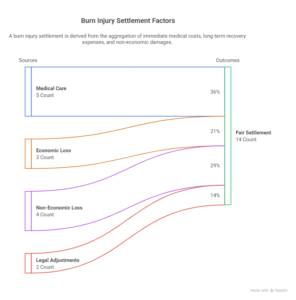
Economic damages are every financial loss with a paper trail. These are the concrete, documentable costs that form the foundation of your claim: Emergency room treatment and hospitalization Surgical procedures, including skin grafts and wound debridement Reconstructive surgery and plastic surgery consultations Infection treatment and wound care Prescription medications and pain management Physical therapy and rehabilitation Occupational therapy Lost wages during recovery Reduced earning capacity if you cannot return to the same work Future medical costs, including scar revision surgery
Non-Economic Damages in a Burn Injury Claim
Non-economic damages cover the human cost of the injury, the part insurance adjusters work hardest to minimize. Washington State does not cap non-economic damages in personal injury cases, which matters enormously for severe burn victims. Learn more about pain and suffering compensation and how it applies to burn claims: Physical pain and suffering Emotional trauma, anxiety, and depression Permanent scarring and disfigurement Loss of enjoyment of life Impact on personal relationships Sleep disruption and ongoing psychological distress A third-degree burn covering a significant portion of the body can justify non-economic damages exceeding $1 million on its own. Understanding how insurers calculate and challenge these numbers is one reason having an experienced Seattle burn injury attorney matters from the very start of your claim.
What Are Typical Burn Injury Settlement Amounts by Burn Degree?
The degree of the burn is the single most reliable predictor of settlement value. The deeper the tissue damage, the higher the medical costs, and the higher the compensation.
First-Degree Burns
First-degree burns affect only the outer layer of skin. Redness, mild swelling, and surface pain are typical. These injuries rarely require hospitalization and usually resolve without permanent scarring. Settlement range: $5,000 to $25,000. These amounts primarily cover medical treatment and any short-term lost income. First-degree burn cases rarely proceed to litigation.
Second-Degree Burns
Second-degree burns penetrate into the dermis, causing blistering, significant pain, and a real risk of infection. They may require hospitalization, extended wound care, and in more severe presentations, skin grafting. Settlement range: $25,000 to $200,000. The final amount depends on the size of the burn, whether surgery was required, the recovery timeline, and the extent of residual scarring.
Third-Degree Burns
Third-degree burns destroy all layers of skin, exposing underlying tissue, fat, and sometimes bone. They require surgical debridement, multiple skin grafts, and extended rehabilitation. Many victims experience permanent nerve damage, significant disfigurement, and lasting psychological trauma. The CDC reports that burn injuries are among the most costly acute injury categories in the United States due to the intensive, prolonged care they require. Settlement range: $200,000 to over $1,000,000. Complex cases involving severe disfigurement, large surface area burns, or permanent disability regularly push well above seven figures. Burns of this severity often qualify as catastrophic injuries under Washington law.
Fourth-Degree Burns
Fourth-degree burns penetrate completely through skin into muscle, bone, and connective tissue. They are life-threatening and often result in amputation injury. These are among the most catastrophic personal injury cases in Washington State, and fatal outcomes may give rise to a wrongful death claim on behalf of surviving family members. Settlement range: $500,000 to several million dollars. Cases involving permanent disability, amputation, or lifelong care needs typically result in the highest awards.
| Burn Degree | Typical Settlement Range | Key Damages Driving Value |
|---|---|---|
| First-degree | $5,000 to $25,000 | Medical costs, minor lost wages |
| Second-degree | $25,000 to $200,000 | Surgery, scarring, missed work |
| Third-degree | $200,000 to $1,000,000+ | Skin grafts, disfigurement, long-term care |
| Fourth-degree | $500,000 to several million | Amputation, disability, lifelong medical needs |

What Factors Raise or Lower Burn Injury Compensation in Washington State?
Settlement value is never determined by burn degree alone. Insurance adjusters and defense attorneys review the full picture, and so do experienced burn injury attorneys.
Factors That Increase Settlement Value
Permanent scarring or disfigurement significantly increases the non-economic component of a claim. Visible scars on the face, neck, or hands carry greater weight because of their psychological and professional impact on the victim’s daily life. Multiple surgeries create a larger documented economic record, which strengthens the factual basis for a higher settlement demand. Clear liability moves negotiations in your favor. When the at-fault party’s negligence is well-established, whether a landlord who ignored fire code violations, an employer who failed to provide protective equipment, or a manufacturer of a defective product, insurers face greater trial risk and negotiate more seriously. Punitive damages may be available when a defendant acted with gross negligence or intentional misconduct. A property owner who knowingly disabled smoke detectors, or a company that concealed known product safety failures, may face punitive damages on top of compensatory damages. Significant wage loss and reduced earning capacity are major factors, particularly for tradespeople, skilled workers, and professionals whose injuries prevent them from returning to their field. Understanding how to prove loss of wages in a personal injury case can strengthen this part of your claim.
Factors That Can Reduce Settlement Value
Shared fault under Washington’s comparative negligence system reduces your recovery proportionally. If an insurer argues you contributed 25% to the accident, your award is reduced by 25%. Pre-existing conditions affecting the burned area or respiratory health can be used by insurers to argue the injury was less severe than you claim. Delayed medical treatment creates gaps in your medical record that insurers will use to question the seriousness of your injuries. Early recorded statements to insurance adjusters without legal counsel often result in victims inadvertently minimizing their own damages. If your insurer has already denied or underpaid your claim, understanding your options after an insurance claim denial is an important next step before accepting any outcome.
What Types of Burn Injury Claims Exist in Seattle?
Vehicle Fire Burn Injuries
Car accidents, truck accident, and motorcycle crashes can cause severe burn injuries when fuel systems rupture or vehicles ignite. These cases typically involve a third-party personal injury claim against the at-fault driver alongside a potential product liability claim if a vehicle defect contributed to the fire. Car accident burn injury cases often include both liability and underinsured motorist coverage claims, and the interaction between those two coverage layers requires careful legal coordination. Motorcycle accident burns follow similar logic but tend to produce more severe injuries because riders have no protective vehicle body around them. Fuel contact burns and road rash in combination often result in higher total damages.
Workplace Burn Injuries
According to OSHA, tens of thousands of workers are injured by burns each year in the United States, with construction, manufacturing, and chemical industries carrying the highest risk. Washington’s workers’ compensation system through the Department of Labor and Industries provides baseline benefits, but a workplace burn injury victim may also have a separate third-party claim against a contractor, equipment manufacturer, or property owner. Third-party claims are not subject to the caps that limit workers’ compensation benefits, which means they often yield substantially higher total recovery. Construction workers, welders, electricians, and chemical handlers should ask their attorney specifically whether a third-party claim exists alongside any L&I claim. Construction injury cases in particular frequently involve multiple liable parties.
Chemical Burn Injuries
Chemical burn injury cases involve caustic substances such as industrial cleaners, pool chemicals, battery acid, or laboratory chemicals that cause severe tissue destruction without flame. These cases often involve product liability claims against manufacturers and distributors, premises liability claims against property owners, or employer negligence claims. Expert toxicological testimony is often necessary to establish the causal connection between the chemical exposure and the documented tissue damage.
Premises Liability Burn Injuries
Apartment fires, house fires, gas explosions, and electrical fires caused by a landlord’s negligence fall under premises liability law. If a property owner failed to maintain smoke detectors, repair faulty wiring, fix a known gas leak, or meet Washington State building code requirements, they can be held liable for the full extent of a tenant’s burn injuries.
Product Liability Burn Injuries
Defective lithium batteries, faulty appliances, dangerous consumer products, and improperly labeled chemical products give rise to product liability claims. These cases can name the manufacturer, distributor, and retailer as defendants, which often means access to larger insurance policies and significantly higher settlement potential.
Burn Injuries in Truck Accidents
Commercial truck collisions involving fuel tankers or vehicles carrying hazardous materials represent some of the most severe burn injury cases in Washington State. Truck accident burn injury cases may involve federal FMCSA transportation regulations, commercial insurance policies with substantially higher limits, and liability spread across the driver, the trucking company, and the cargo loader.
How Does Washington’s Comparative Negligence Law Affect Burn Injury Claims?
Washington’s pure comparative negligence standard, codified in RCW 4.22.005, allows burn victims to recover compensation even when they share partial fault for the accident. This is more favorable than most states, which cut off recovery entirely if the victim is more than 50% responsible.
How Partial Fault Affects Your Settlement
Insurers routinely argue that burn victims contributed to their own injuries, claiming the victim stood too close to a flame, ignored warning labels, or failed to use protective equipment. Under Washington law, this reduces your award proportionally but does not eliminate it. A victim found 30% at fault still recovers 70% of the total damages. Anticipating and countering these arguments before the insurer formalizes them is one of the most valuable things an attorney does early in a burn injury claim.
How Multiple Defendants Are Handled
In workplace fire cases involving a contractor, an equipment manufacturer, and a property owner, Washington’s comparative fault rules allow liability to be apportioned across all responsible parties. Your attorney can pursue each defendant’s proportional share, which preserves your ability to recover from whichever party carries the largest insurance coverage.
Underinsured Driver Situations
If your burn injuries resulted from a car accident and the at-fault driver’s policy is insufficient to cover your damages, Washington’s underinsured motorist coverage rules create additional recovery pathways. Understanding how uninsured and underinsured motorist coverage works in a burn injury context can mean the difference between partial recovery and full compensation.
What Is the Burn Injury Lawsuit Timeline in Seattle?
Most burn injury claims in Seattle and Washington State resolve without going to trial, but the timeline depends on injury complexity and the insurer’s conduct. Reviewing a general personal injury accident timeline can help you understand each stage before your attorney explains the specifics of your case.
Phase 1: Medical Treatment and Evidence Building (Months 0 to 6)
During active treatment, your attorney begins gathering evidence: medical records, accident reports, employer documentation, witness statements, and expert opinions. No demand is submitted until you reach maximum medical improvement, because submitting too early undervalues future care costs and locks in a number that cannot be revised upward later.
Phase 2: Demand and Negotiation (Months 6 to 18)
Once treatment stabilizes, your attorney submits a formal demand to the insurance company. Negotiation follows. Straightforward cases with clear liability often settle in this phase.
Phase 3: Litigation (18 Months to 3 or More Years)
If the insurer refuses a fair settlement, your attorney files a lawsuit. Discovery, depositions, and expert witness retention follow. The majority of cases settle before trial, often during or just before the trial period begins. Washington State’s statute of limitations for personal injury claims is three years under RCW 4.16.080. The clock runs from the date of injury. Missing this deadline permanently bars your claim regardless of how serious your injuries are.
Why Expert Support Determines Severe Burn Injury Settlement Value
Severe burn cases are medically complex. Insurance companies retain their own consultants specifically to minimize the long-term impact of your injuries. Countering that requires credible, independent expert analysis built around your specific medical history and prognosis. Elsner Law Firm works with a network of burn specialists, vocational experts, and life care planners who document the full financial picture of your injuries, including: Current and projected future medical costs Vocational impact assessments when returning to prior work is not possible Psychological evaluation for PTSD, depression, and anxiety related to disfigurement and trauma Life care planning covering decades of future treatment needs Expert-backed documentation is what separates a $150,000 settlement from a $750,000 settlement in a severe burn case. The goal is not to demand more. It is to prove more, with documentation that withstands scrutiny at every stage of negotiation and litigation. If you were hurt in a workplace burn and are unsure whether you have a third-party claim in addition to workers’ compensation, reviewing your full legal options with a Seattle workplace injury attorney before accepting any offer is the single most important step you can take.
Why Elsner Law Firm Is the Right Choice for Burn Injury Compensation in Seattle
With over 17 years of exclusive personal injury practice in Washington State, Elsner Law Firm has the specific knowledge and track record that burn injury cases demand. Washington-focused expertise. Our entire practice covers Washington State personal injury law, including pure comparative negligence, L&I rules, and Washington’s insurance regulations. No fees unless we win. We operate on a contingency fee basis and advance all case costs. You pay nothing unless we recover compensation for you. Trial-ready case preparation. Every case is built as if it is going to trial. This approach pressures insurers into fair offers rather than lowball responses. Proven settlement results. Our clients regularly recover six times initial insurance offers and, in many cases, full policy limits. Read what our past clients have to say on our client testimonials page. Statewide coverage with local knowledge. Offices in Seattle, Brier, Ellensburg, and Pullman give us deep familiarity with regional courts, local insurers, and Washington-specific legal dynamics. 24/7 availability. Free case evaluations are available by call, text, or online at any time, with home visits available when your injuries prevent travel.
Frequently Asked Questions
How much is a burn injury claim worth in Washington State?
It depends on burn severity, medical costs, lost income, and long-term impact. Minor burns may settle for $10,000 to $50,000. Severe third-degree or fourth-degree burns frequently settle for $300,000 to over $1 million, particularly when permanent scarring, disfigurement, or disability is involved. The catastrophic injury settlement amounts page covers how high-value cases are evaluated in Washington.
Can I file both a workers’ compensation claim and a personal injury lawsuit for a workplace burn in Seattle?
Yes. Washington’s workers’ compensation system through L&I and a third-party personal injury lawsuit are separate claims. If your burn was caused by a contractor, equipment manufacturer, or property owner rather than your direct employer, you can pursue a civil lawsuit for full damages in addition to L&I benefits. Both claims can be pursued at the same time.
Does Washington State cap pain and suffering damages for burn injuries?
No. Washington does not cap non-economic damages in personal injury cases. Visible scarring, permanent disfigurement, and long-term psychological trauma can be fully compensated without an arbitrary ceiling. This is one of the reasons severe burn cases in Washington regularly reach seven figures. To better understand what qualifies, read about emotional distress damages in personal injury cases.
What evidence do I need to support a burn injury settlement claim?
Strong claims are built on complete medical records, documented burn treatment history including skin grafts and surgeries, photographs of injuries taken over time, expert opinions on long-term prognosis, employment records showing income loss, and witness statements where available. Your attorney handles collecting and organizing this evidence. The American Burn Association provides additional resources on burn treatment standards that can support medical documentation.
How long does a burn injury lawsuit take to settle in Seattle?
Most cases resolve within 12 to 24 months when liability is clear and the insurer acts in good faith. Cases with disputed liability, multiple defendants, or bad-faith insurer conduct can take two to four years. Washington’s three-year statute of limitations under RCW 4.16.080 means you should speak with an attorney as soon as possible after your injury. For a deeper look at what each stage involves, the Washington State Courts website outlines the civil litigation process in detail.
Conclusion
Burn injury claims are high-stakes cases where the gap between a fair settlement and a lowball offer is often enormous. Washington State law gives burn victims strong rights to compensation, and Elsner Law Firm is here to make sure those rights are fully exercised. Elsner Law Firm serves burn injury victims across Seattle and Washington State, with offices in Seattle, Brier, Ellensburg, and Pullman. Free case evaluations are available 24/7 by call, text, or online, with home visits available. Call or text 206-447-1425. No fees unless we win your case.