CALL US NOW
 TEXT US NOW
How much can you realistically get from a car accident settlement in Washington? The answer depends on several factors: the severity of your injuries, who was at fault under Washington’s pure comparative negligence rule, available insurance coverage, and the evidence you can provide to support your claim. There isn’t a single “average” number of settlements that can range from a few thousand dollars for minor injuries to hundreds of thousands or even millions for catastrophic injuries.
In this guide, you’ll learn how injury severity impacts settlement value, what economic and non-economic damages you can recover, why Washington’s fault rules matter, and how insurance policy limits can affect your payout. We’ll also discuss why many online settlement calculators can be misleading and what evidence strengthens your claim. By the end, you’ll understand what realistic outcomes look like in Washington and how to protect your right to fair compensation.
Key Takeaways from This Blog:
- Washington car accident settlements vary widely depending on injury severity and fault allocation.
- Both economic and non-economic damages contribute to total compensation.
- Insurance policy limits can cap even strong claims; additional coverage may help.
- Proper documentation, like medical records and police reports, increases settlement amounts.
- Lawyer representation often leads to higher recovery compared to self-representation.
Is There Really an “Average” Car Accident Settlement in Washington
There isn’t one fixed “average” that applies to every case. The car accident rates and statistics reported by local data sources show broad variability:
- Minor injuries often settle in the low‑to‑mid five figures or less.
- Moderate injuries typically fall in the mid‑five figures to low six figures.
- Severe injuries can reach high six figures or more in serious cases.
For example, one analysis of Washington claims found average settlements of about $6,800 for minor injuries, $25,000 for moderate injuries, and almost $490,000 for severe injuries. These figures show typical patterns but every case differs based on medical evidence, fault allocation, policy limits, and future costs.
In Washington, minimum liability coverage is $25,000 per person and $50,000 per accident for bodily injuries, so settlements often align with or exceed these minimums only when higher coverage applies.
How Injury Severity Drives Your Settlement Value in Washington
Minor Injuries (Whiplash, Soft Tissue, Short Recovery)
If you have strains, sprains, or whiplash and recover quickly, settlements normally cover medical costs and a modest amount for pain and discomfort. Typical ranges can fall between about $1,000 and $15,000.
Example: A neck strain after a rear‑end collision that required physical therapy but no surgery might settle closer to the lower end of this range.
Moderate Injuries (Broken Bones, Herniated Discs, Surgery)
Moderate injuries that require hospitalization, surgery, or extended therapy usually settle higher, often between $15,000 and $100,000. This range depends on the total cost of care and how the injury affected your ability to work or perform daily activities.
Example: A herniated disc requiring surgery and months of physical therapy might settle around the mid‑five figure mark if evidence supports substantial recovery costs.
Severe & Catastrophic Injuries (TBI, Spinal Cord Injury, Permanent Disability)
If injuries involve significant disability or lifelong treatment, settlements commonly exceed $100,000 and can reach into the millions depending on future medical costs, lost earning capacity, and emotional impact.
Example: A severe traumatic brain injuries from accidents requiring ongoing medical care and loss of future wages might produce a settlement closer to six figures or above.
Range Table
| Injury Level | Common Range |
|---|---|
| Minor | ~$1,000 – $15,000 |
| Moderate | ~$15,000 – $100,000 |
| Severe / Catastrophic | ~$100,000 – $2,700,000+ |
These ranges reflect local Washington outcomes and variations based on how each case is documented and negotiated.
How Washington’s Pure Comparative Negligence Rule Affects Your Payout
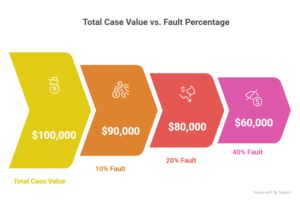
If you are partially responsible for an accident, your settlement amount will be reduced by your percentage of fault. This applies even if your share of fault is low or high.
Example: If a case has a calculated settlement value of $100,000 and you are found 20% responsible under Washington’s pure comparative negligence standards, your final recovery would be reduced to $80,000.
This rule means every detail that affects fault in a rear-end accident such as police reports, witness testimony, and accident reconstruction evidence matters. Strong documentation that shows the other driver’s responsibility can protect more of your settlement.
What Damages Can You Actually Recover in a Washington Car Accident Claim
Economic damages are the measurable costs you have already paid or will pay:
- Medical bills related to treatment and follow‑up care
- Lost wages from missed work
- Future medical treatment and rehabilitation
- Vehicle repair or replacement if a car is considered totaled here
- Rental car fees, towing, and storage
Non‑economic damages cover losses that don’t have bills attached:
- Physical pain and suffering
- Emotional distress
- Loss of enjoyment of life
- Change in daily routines
Washington does not cap non‑economic damage awards in car accident cases, meaning victims can seek full compensation for how the injury affected their life beyond medical bills.
Example: If you miss significant work due to surgery and also endure months of chronic pain, your claim should reflect both tangible losses and intangible impacts.
Why Most Online Car Accident Settlement Calculators Are Unreliable in Washington
Online calculators promise estimates, but they fail to include key Washington‑specific factors like comparative fault, policy limits, and how non‑economic damages are assessed. A national tool might use default multipliers for pain and suffering, but actual settlement value depends on your unique case details.
These tools may provide a rough starting point, but they can be misleading when used alone to set expectations for Washington claims.
How Insurance Policy Limits Can Cap Even Strong Washington Claims
Policies limit maximum payouts. If the at‑fault driver carries only minimum coverage ($25,000 per person/$50,000 per accident), that cap often defines your ceiling for recovery unless additional coverage applies.
Example: If your damages total $80,000 but the at‑fault driver’s policy limit is $25,000, you may only recover $25,000 unless you pursue additional claims (such as uninsured/underinsured coverage or a lawsuit).
Minimum liability coverage helps protect drivers, but it can also limit compensation for serious injuries.

What Evidence Actually Increases Your Car Accident Settlement Amount
Settlements increase when claims are backed by detailed evidence, including:
- Medical records and bills from seeking medical care immediately
- Police report and citations
- Photos of injuries and the accident scene
- Statements from witnesses
- Repair estimates and receipts
- A daily journal showing how injuries affect life
Strong evidence clarifies the extent of harm and avoids debates over fault or injury severity. This documentation can significantly improve negotiation outcomes.
Should You Accept the Insurance Company’s First (or Second) Offer
Insurance companies often start with low initial offers to resolve claims quickly. Before accepting any offer:
- Review medical bills and future costs
- Check if lost wages are fully included
- Look at how non‑economic damages are valued
- Compare the offer to documented evidence
A low offer does not mean the settlement value of your case is low; it often reflects an insurer’s desire to close the claim cheaply. Evaluate offers carefully before accepting.
If you’re unsure whether you should sue someone after car accident and whether the settlement offer reflects your damages, consider having a Washington personal injury expert review it and provide guidance.
How Much More Do People Recover With a Washington Car Accident Lawyer
Research and data show that claimants who choose the best accident attorney and have expert representation tend to achieve better outcomes compared to self‑represented claimants. While specific multipliers vary across cases, having professional negotiation and evidence presentation often increases total compensation.
Example: A moderate injury case that might otherwise settle for a standard insurer offer can increase significantly after a lawyer presents future medical needs and negotiates non‑economic damages.
Experienced advocates ensure economic and non‑economic losses, insurance limits, and fault issues are fully addressed before agreeing to a settlement.
Why Choose Elsner Law Firm
At Elsner Law Firm, we focus exclusively on helping car accident and personal injury victims in Washington State. With over 17 years of experience, our team combines legal expertise, personalized care, and strategic negotiation to maximize your settlement while guiding you through every step of the claims process.
Exclusive Focus on Washington Personal Injury Law
We specialize only in personal injury cases, ensuring deep knowledge of local laws, pure comparative negligence, and regional insurance practices.
24/7 Free Consultations
Clients can access free case evaluations anytime via call, text, or online scheduling, including in-person, virtual, or home visits.
Contingency Fee Structure
No upfront costs or fees unless we win your case, making legal support accessible without financial barriers.
Proven Track Record of Higher Settlements
Clients often recover significantly more than initial insurance offers, sometimes 3.5× higher, by leveraging evidence and negotiation expertise.
Extensive Network of Experts
We collaborate with medical professionals, accident reconstruction specialists, therapists, and vocational experts to strengthen your case and maximize compensation.
Frequently Asked Questions About Car Accident Settlements in Washington
What is the average car accident settlement in Washington State?
Settlements vary widely: minor injuries may settle for $3,000–$15,000, moderate injuries $15,000–$100,000, and severe injuries $100,000–$1,500,000+. There is no true average.
How is pain and suffering calculated in Washington?
Pain and suffering is determined using multipliers of economic damages, considering the injury’s severity, recovery time, and emotional impact.
Can I still get a settlement if I was partially at fault?
Yes. Washington uses pure comparative negligence, reducing your payout by your percentage of fault.
How long do I have to file a car accident claim in Washington?
You generally have three years from the accident date to file a personal injury claim.
Conclusion
Settlement amounts in Washington range widely based on the timeline after a car accident. Minor claims may be modest, moderate injuries often bring mid‑range settlements, and severe cases can reach high figures when properly documented. Key drivers include injury severity, fault allocation under pure comparative negligence, insurance policy limits, and strong evidence.
Understanding these factors helps set realistic expectations and protects your right to fair compensation. Don’t accept quick low offers without verifying that all your costs economic and non‑economic are included.
For detailed guidance tailored to your situation and help evaluating settlement offers, contact a Car Accident Lawyer Seattle for a free review of your case.