CALL US NOW
 TEXT US NOW
How to Maximize Compensation for a Spinal Fusion Claim
You didn’t ask for this. A car crash, a fall at work, a rear-end collision on the freeway. Now your doctor is telling you that you need spinal fusion surgery. That word alone can stop your heart for a second. Surgery. Screws. Rods. Months of recovery. And somewhere behind all of it is an insurance company that may already be looking for a reason to deny your claim.
The fear is real. So is the financial pressure. Medical bills stack up fast after spinal fusion surgery, and if you’re out of work during recovery, that pressure turns into panic. Most people in this situation have no idea what their case is actually worth or what it takes to prove it. A dedicated spinal cord injury lawyer can help you understand the full value of your claim and build a case that holds the responsible party accountable.
Here is what this guide covers:
- What spinal fusion surgery settlements actually look like in Washington State
- How to prove medical necessity when the insurance company pushes back
- What documentation builds the strongest personal injury or workers comp claim
- Common reasons insurers deny or undervalue these claims, and how to fight back
- How an experienced Washington personal injury attorney can change your outcome
What Is the Average Settlement for Spinal Fusion Surgery?
There is no single number. Average settlement for spinal fusion surgery cases in Washington State ranges widely, from $150,000 on the lower end to well over $1 million in serious cases involving permanent disability, nerve damage, or failed fusion requiring revision surgery.
Several factors determine where your case falls:
Injury severity: lumbar fusion, cervical fusion, or multi-level fusion each carry different value. Cervical fusions involving proximity to the spinal cord often command higher settlements due to the risk of paralysis and other catastrophic injury.
Liability: was the other party clearly at fault, or is there shared negligence? Washington’s pure comparative negligence system allows recovery even when fault is shared.
Lost wages and earning capacity: spinal fusion recovery can sideline workers for 6–12 months or longer. Documenting lost wages accurately from the start is critical to maximizing this component of your claim.
Future medical costs: adjacent segment disease, pseudarthrosis, or the need for a spinal cord stimulator adds significant projected expenses. A catastrophic life care plan developed by a qualified expert is the most effective way to document these long-term costs.
Pre-existing conditions: a prior degenerative disc disease diagnosis does not eliminate your claim, but it must be handled carefully.
Workers comp settlements for lumbar fusion in Washington tend to be structured differently from personal injury cases, with permanent partial disability ratings and vocational rehabilitation factoring heavily into final numbers.
How to Prove Medical Necessity for Spinal Fusion Surgery
This is where most claims live or die. Insurance companies, including workers comp carriers, routinely deny spinal fusion surgery claims by arguing the procedure was elective, premature, or not causally related to the accident.
To prove medical necessity, your claim needs to show:
Documented conservative treatment failure: physical therapy, steroid injections, and pain management must have been tried first, for a reasonable period, with recorded outcomes.
Imaging evidence: MRI and CT scans showing herniated disc, spinal stenosis, spondylolisthesis, or spinal fracture directly linked to the accident.
Neurosurgeon or orthopedic surgeon recommendation: the operative recommendation must be supported by clinical findings, not just patient-reported pain.
Causation link: the injury must be connected to the specific accident, not attributed solely to degenerative disc disease that predated the event.
Washington State insurers frequently request an independent medical examination (IME) to challenge necessity. IME doctors are often hired by the insurer and known for minimizing findings. Having your own treating physician’s records organized and detailed before that exam is critical. Your treating doctor’s documentation can make or break your case at this stage.
What Documentation Wins a Spinal Fusion Claim
Strong medical documentation is the backbone of a high-value spinal fusion surgery compensation claim. The moment after your accident, documentation starts mattering.
Key records to preserve and organize:
- Emergency room and urgent care notes from the day of the accident
- All diagnostic imaging with radiologist interpretation reports
- Treating physician notes showing ongoing symptoms and treatment progression
- Physical therapy records showing attempts at conservative treatment
- Operative reports and surgical notes
- Post-surgical recovery records and follow-up visits
- Pharmacy and medical billing records
- Employer records showing missed work and lost wages
- A vocational rehabilitation assessment if return to original work is uncertain
If your injury involves a failed spinal fusion, resulting in pseudarthrosis or the need for revision surgery, that documentation trail becomes even more important and the value of your claim increases substantially. Understanding the lifetime expenses associated with spinal cord injuries helps frame the true scope of what you are owed.
Spinal Fusion Workers Comp Settlement: What Washington Workers Should Know
Spinal fusion workers comp settlement cases in Washington are handled through the Department of Labor and Industries (L&I). These cases follow a different structure than personal injury claims but involve just as much documentation and just as many opportunities for insurers to undervalue what you are owed.
Key considerations for Washington workers:
Temporary total disability (TTD): payments cover lost wages during recovery, but they are capped and often disputed.
Permanent partial disability (PPD): ratings determine long-term settlement value an impairment rating from a qualified physician carries significant weight.
Maximum medical improvement (MMI): is the point at which L&I considers your condition stable. What happens at that evaluation shapes your settlement permanently.
Vocational rehabilitation: may be available if you cannot return to your prior job due to spinal instability or chronic back pain.
Cervical fusion workers comp settlement: cases often involve higher values than lumbar cases due to the proximity to the spinal cord and greater risk of nerve damage or paralysis.
Many injured workers accept the first offer from L&I without understanding what their permanent restrictions actually mean for their long-term earning capacity. That is one of the most common and most costly mistakes made in these cases. If your injury happened at a workplace or construction injury, understanding your full rights under Washington law is essential before accepting any settlement.
Spinal Fusion Car Accident Settlement: Personal Injury Claims in Washington
If your spinal fusion surgery resulted from a car accident, a rear-end collision guide, a T-bone crash, or any other collision. your claim falls under Washington’s personal injury framework, which follows a pure comparative negligence system.
That means even if you were partially at fault, you can still recover damages proportional to the other party’s responsibility. A skilled attorney builds the case to establish the maximum possible liability on the at-fault driver.
Pain and suffering settlement compensation is often the largest component of a spinal fusion car accident settlement. Washington law allows recovery for:
- Physical pain during recovery and beyond
- Emotional distress and reduced quality of life
- Loss of consortium (impact on family relationships)
- Long-term care costs if permanent disability results
In Washington, you generally pursue the at-fault driver directly, which opens the door to full damages recovery. If the at-fault driver was drunk driving or distracted driving, punitive arguments can strengthen your case further.

Why Insurance Companies Deny or Undervalue These Claims
Understanding insurer tactics helps you anticipate and counter them.
Common denial strategies include:
Pre-existing condition arguments: claiming your degenerative disc disease, not the accident, caused the need for surgery.
Causation disputes: arguing the accident was not severe enough to cause the documented spinal injury.
IME manipulation: using hired physicians to produce findings that contradict your treating surgeon’s records.
Delayed treatment gaps: pointing to time between the accident and your first medical visit as evidence the injury is unrelated. This is why seeking medical care immediately after an accident is so important.
Conservative treatment skipping: arguing surgery was not medically necessary because you did not exhaust non-surgical options first.
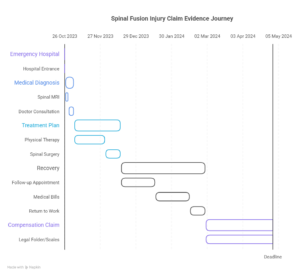
Each of these tactics has a counter. A documented, chronological medical record that shows the full treatment timeline, from the day of the accident through surgery and recovery, is the most effective defense against all of them.
If you are already facing one of these denials, the team at Elsner Law Firm can review your claim and help you understand your options. If the insurer is acting in bad faith, Washington’s Insurance Fair Conduct Act (IFCA) attorney may provide additional legal remedies. Call or text 206-447-1425 for a free case evaluation, available 24/7.
Why Elsner Law Firm Is the Right Choice for Spinal Fusion Claims in Washington
Exclusive Washington State focus- Over 17 years handling personal injury and workers comp cases under Washington law, including complex spinal surgery claims involving permanent disability and disputed medical necessity.
No upfront costs, ever- The firm works on contingency. You pay nothing unless they recover compensation for you. All case expenses are advanced by the firm.
24/7 access and real availability- You can call, text, or schedule online at any hour. Home visits and virtual consultations are available for clients who cannot travel during recovery.
Expert network ready to work on your case- Access to medical professionals, vocational rehabilitation experts, life care planners, and accident reconstruction specialists — the people who turn a medical record into a compelling legal claim.
Proven settlement results- Clients regularly receive multiples of initial insurance offers. Data shows injury victims with legal representation recover an average of 3.5 times more than those who negotiate alone.
Trial-ready preparation- Every case is built as if it will go before a judge and jury. That preparation pressures insurers toward fair settlements rather than lowball offers.
Frequently Asked Questions
How long does a spinal fusion settlement take in Washington?
Most cases resolve within 12 to 24 months. Cases involving disputed medical necessity, failed fusion, or litigation can take longer. Your attorney can give a more accurate timeline once your medical treatment is complete.
Can I still recover compensation if I had a pre-existing back condition?
Yes. Washington’s eggshell plaintiff doctrine holds that a negligent party takes the victim as they find them. A prior degenerative disc disease diagnosis does not eliminate your claim. It must be properly documented and argued. The Washington State Court Rules on independent medical examinations (CR 35) outline the procedures insurers must follow when requesting their own exam of your condition.
What if my workers comp claim was denied after spinal fusion surgery?
You have the right to appeal. An attorney can request an independent review, gather additional medical evidence, and challenge the denial through Washington’s L&I appeals process.
How is pain and suffering calculated in a spinal fusion case?
There is no fixed formula in Washington. Attorneys typically use a multiplier applied to your economic damages, based on injury severity, recovery duration, and long-term impact on your life. According to the American Association of Neurological Surgeons (AANS), spinal fusion recovery timelines vary significantly based on the number of vertebral levels fused, which directly affects the pain and suffering valuation in your case.
Do I need a lawyer for a spinal fusion claim?
You are not required to have one, but statistics consistently show that represented claimants recover significantly more. For a surgery of this magnitude, having legal representation is almost always worth it.
Conclusion
Spinal fusion surgery changes your life. The recovery is long, the costs are real, and the insurance company on the other side is not working in your interest.
What you do in the weeks and months after surgery directly shapes what your claim is worth. Organized documentation, a clear treatment record, and an attorney who knows how Washington’s system works, those are the three things that move the needle. Settling too early before understanding the full impact of your injury is one of the most costly mistakes you can make.
Elsner Law Firm has spent over 17 years fighting for Washington injury victims in exactly this situation. Serving Seattle and clients across the state, the team is available 24/7 with no fees unless they win your case. Call or text 206-447-1425 today for your free case review. You have nothing to lose and a fair settlement to gain. You can also explore the spinal cord injury practice area to learn more about how the firm handles these complex claims.